From Freight to Fun: The Canal’s Decline and Recreational Rebirth
The waterway that built America nearly died — killed off by railroads, the St. Lawrence Seaway, and the slow end of freight. Then it came back as something no one in 1825 could have imagined: a place to play.
For most of a century, the Erie Canal was the single most important artificial waterway in America — the ditch that moved a nation west, turned frontier villages into cities, and made New York the Empire State. Then, over the course of a few generations, the world stopped needing it. The story of how the canal nearly died, and how it came back as something entirely new, is the reason this guide exists.
The first rival ran on rails
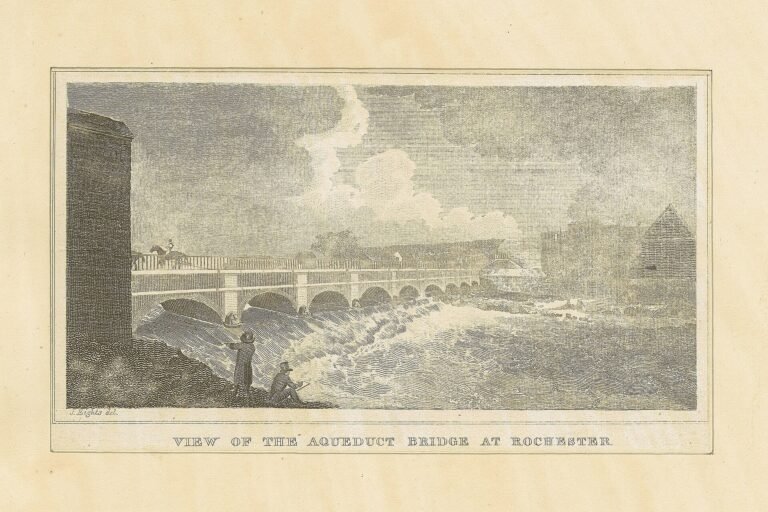
The canal’s troubles began, fittingly, at the height of its success. Traffic on the Erie peaked in the mid-nineteenth century — 1855 was the busiest year, with tens of thousands of commercial shipments moving through the system. But even as the canal ran at full tilt, its replacement was already being laid across the same valleys: the railroad.
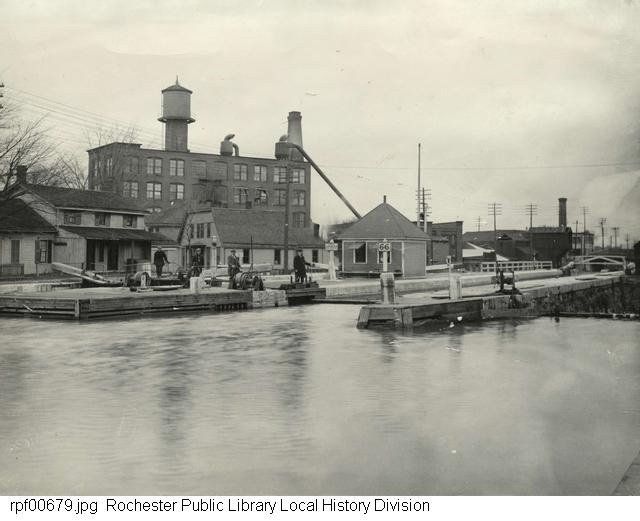
Trains were faster, ran year-round, and did not freeze solid every winter the way the canal did. New York answered the way it always had — by building bigger. The original 1825 canal was enlarged between 1836 and 1862 to carry heavier boats, and then rebuilt entirely: in 1905 the state began the New York State Barge Canal, a machine-age reconstruction that moved the waterway off the old hand-dug ditch and into the rivers and lakes themselves. Completed in 1918 at a cost of $96.7 million, the Barge Canal was engineered for 2,000-ton barges and steel-hulled tugs — a canal built for the twentieth century.
This is the single fact most visitors get wrong, so it is worth stating plainly: the canal you boat and bike today is not Clinton’s 1825 ditch. It is the 1918 Barge Canal, wider, deeper, and running for long stretches through the Mohawk River itself. If you want the full story of that rebuild — and why the difference matters — start with our companion piece on which canal you’re actually looking at.
A century of quiet decline
The irony is bitter. New York finished its grandest canal just as the technologies that would doom it were coming of age. The Barge Canal opened in 1918 into a world already tilting toward the truck and the train, and the tilt only steepened. Tolls, which had helped the original canal pay for itself many times over, were abolished decades earlier — a state constitutional amendment ended toll collection on the New York canals effective January 1, 1883 — so the waterway had long since stopped being a moneymaker for the state and had become, instead, a public work to be maintained.
Through the first half of the twentieth century the canal still carried real freight — grain, oil, steel — and as late as 1951 it still moved some 5.2 million short tons in a single year. Then came the blow it could not absorb. On June 26, 1959, the St. Lawrence Seaway opened, a deep-water channel along the U.S.–Canadian border that let ocean-going ships sail straight into the Great Lakes and bypass New York entirely. Combined with the new Interstate highways and the trucking that ran on them, the Seaway caused commercial traffic on the Erie to “decline dramatically,” in the National Park Service’s phrase, over the second half of the century.
The end came not with a bang but with a last barge. The canal’s final regularly scheduled commercial hauler, a motorship called the Day Peckinpaugh, ended service in 1994. After nearly 170 years, the waterway that had carried the freight of a continent was, for all practical purposes, no longer carrying freight at all.
The rebirth nobody planned
Here is where the story turns — and where a lesser waterway would simply have been abandoned, drained, or paved over. Instead, the Erie Canal did something rare among aging infrastructure: it found a second life.
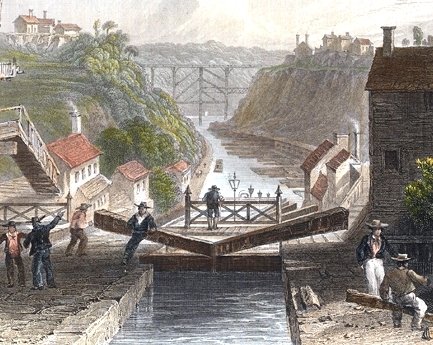
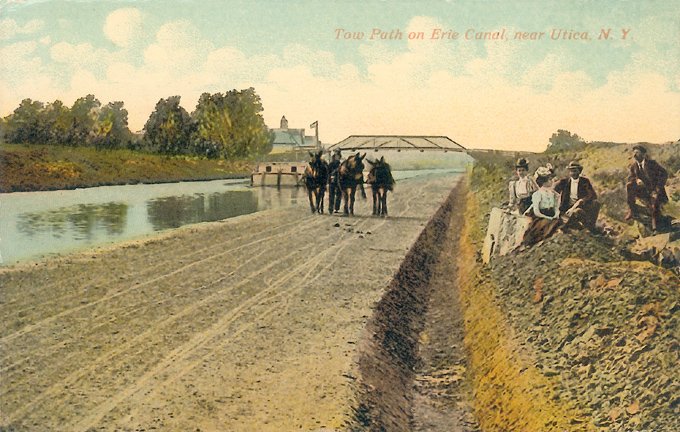
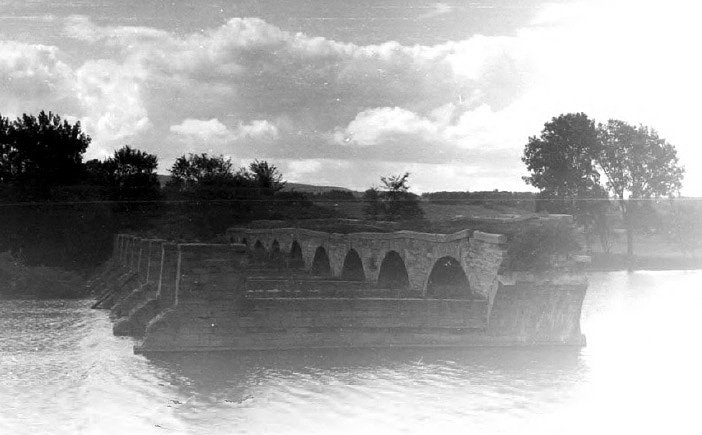
The reinvention was pragmatic before it was romantic. A canal that no longer paid its way in tonnage still had value — as a ribbon of water and green space threading through the heart of the state, past its oldest cities and quietest villages. The mules were gone, but the towpath they had walked for a century was still there. So were the locks, the lift bridges, the stone aqueducts, and the calm, current-free channel that had made the canal a highway in the first place. What had been built for commerce turned out to be nearly perfect for recreation.
By the turn of the twenty-first century, the transformation was formal. In 2000, the U.S. Congress established the Erie Canalway National Heritage Corridor, recognizing 524 miles of navigable waterway — from Buffalo east to Albany and north toward Whitehall — as a nationally significant landscape worth protecting and celebrating. The designation put the canal in the company of America’s treasured places and reframed it, officially, as heritage rather than industry.
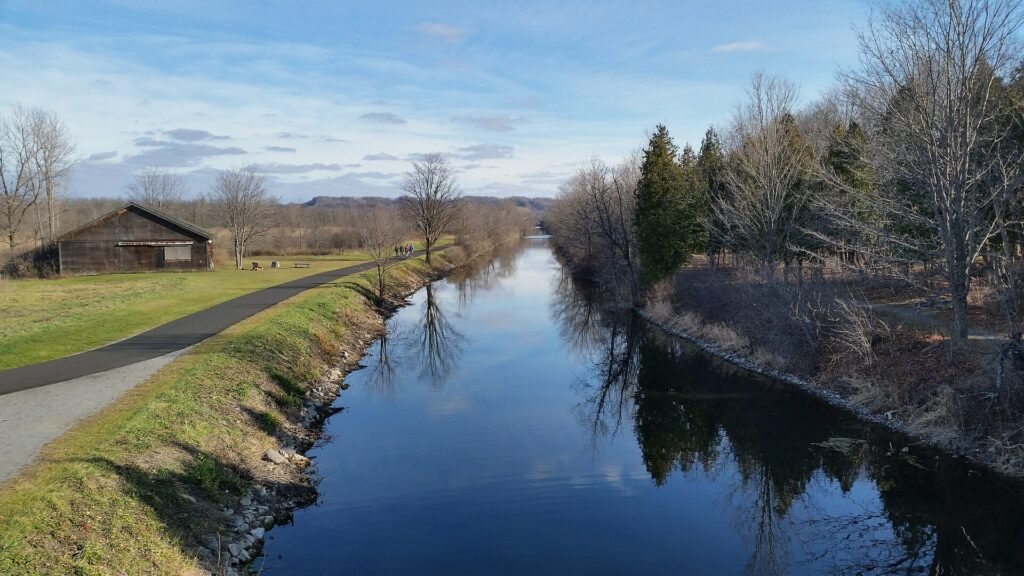
The land beside the water was reborn too. The towpath that mules once trudged is now, as the National Heritage Corridor puts it, a bike path — and over two decades New York knit its scattered trail segments into a single continuous route. The Erie Canalway Trail, roughly 360 miles from Buffalo to Albany, alternates between the modern Barge Canal along the Mohawk and the nearly 200-year-old original towpath. In December 2020 the state completed the larger Empire State Trail that absorbed it, and the Erie corridor became the spine of one of the longest multi-use trails in the country — walkable, bikeable, and, for its full length, free.
What the canal is now
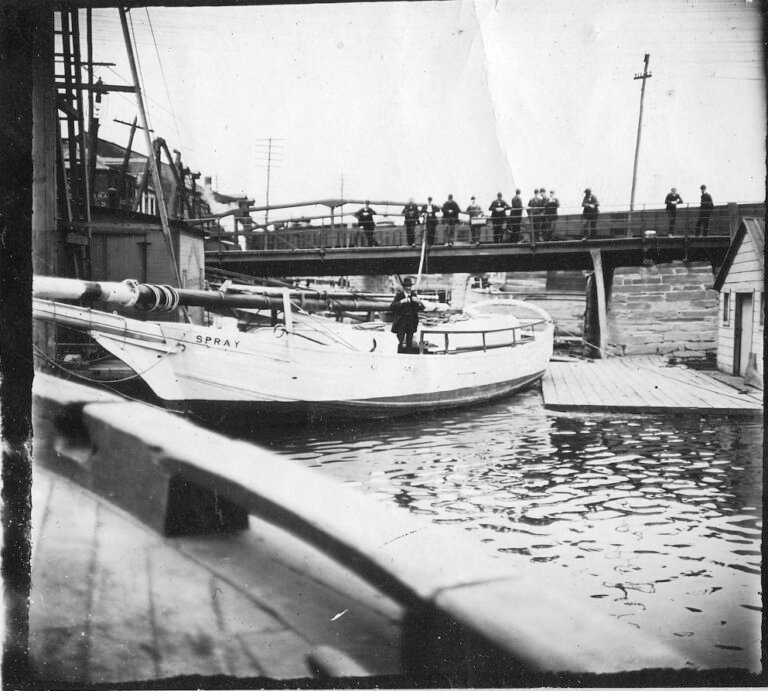
Today the Erie Canal is a working recreational corridor of roughly 35 locks, still tended by the state, still filled and drained every boating season — but the boats locking through are pleasure craft now: cruisers and kayaks, rental canal boats and the occasional tug, where grain barges used to be. In a single day on the water you can lock through a hundred-year-old chamber by the same hand-cranked physics DeWitt Clinton’s engineers would recognize, tie up in a canal-town harbor for lunch, and pedal a stretch of towpath older than photography.
That is the improbable arc of it. The canal that Thomas Jefferson dismissed as “little short of madness,” that built New York into the Empire State and then was rendered obsolete by the very progress it helped unleash, did not disappear. It slowed down, shed its cargo, and reopened as a place to spend a Saturday. The freight is gone. The fun is just getting started.
Go see it for yourself
The best way to understand the canal’s second life is to get out on it. Whether you want to boat the full length lock by lock, paddle a quiet section by kayak or canoe, or ride the towpath by bike, this guide is built to plan exactly that trip — lock by lock, town by town, harbor by harbor. Start at the Erie Canal Guide home page to map your route along the 360-mile corridor, then read the history of the very locks and canal towns you’ll pass through along the way. The ditch that built America is waiting — and this time, it was made for you.
Gallery
Sources
Erie Canalway National Heritage Corridor / National Park Service — History & Culture (eriecanalway.org/learn/history-culture): National Heritage Corridor established by Congress in 2000, 524 miles Buffalo–Albany–Whitehall; growth of railroads and highways and the 1959 St. Lawrence Seaway caused commercial traffic to “decline dramatically”; the mule towpath is now a bike path. Wikipedia — “Erie Canal” (corroboration; cross-checked): peak traffic 1855; tolls ended by state constitutional amendment effective January 1, 1883; New York State Barge Canal begun 1905, completed 1918 at $96.7 million; 1951 freight ~5.2 million short tons; St. Lawrence Seaway opened 1959; last regularly scheduled hauler Day Peckinpaugh ended service in 1994; modern canal ~35 locks. Wikipedia — “St. Lawrence Seaway”: formal opening June 26, 1959. Rails to Trails Conservancy & bikeeriecanal.com: Erie Canalway Trail ~360 miles Buffalo–Albany, alternating modern Barge Canal and original towpath; Empire State Trail completed December 2020. History.com — “Erie Canal”: enlargement of the original canal 1836–1862. Jefferson “little short of madness” quote per History.com (recorded 1809).