Rochester
Approx. Mile 256–265 along the Erie Canal
Barge Canal · 1918 — rerouted south of the city; the 1825 canal crossed the Genesee downtown. Which canal is this? →
Rochester is the anomaly of the modern canal. Where the original 1825 Erie ran straight through downtown and vaulted the Genesee River on a great stone aqueduct, the working Barge Canal bypasses the city to the south, arcing around the lower edge of town and crossing the Genesee at Genesee Valley Park — a genuine water crossroads where river meets canal. The result is a city with two canals: the through-channel out on its southern flank, and, hidden in plain sight downtown, the canal's most dramatic ruin.
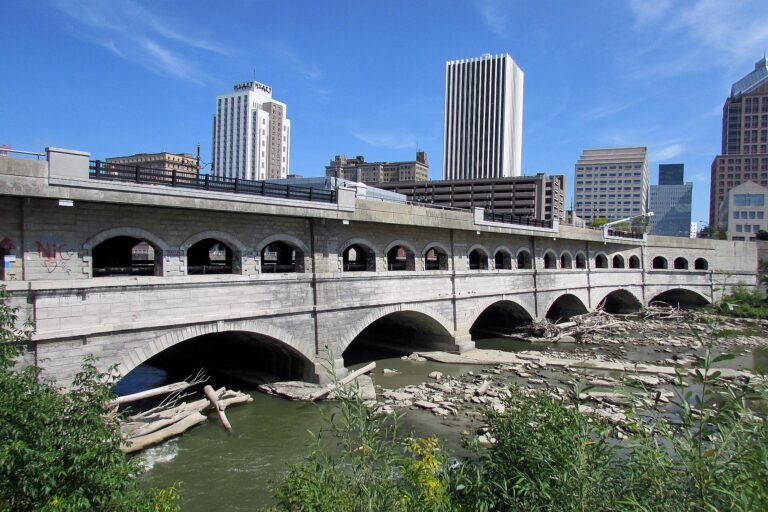
That ruin is the Second Genesee Aqueduct, completed in 1842 and now doing quiet duty as the Broad Street Bridge. It once carried the Erie over the Genesee; later its interior sheltered the abandoned Rochester Subway. For the traveler moving by boat, bike, or boot, Rochester's story is precisely this tension between original and current alignment — and the Genesee Riverway Trail is the thread that stitches the two together, linking the canal to Corn Hill, High Falls, and Lake Ontario.
Every canal has to cross the rivers it meets, and at Rochester the Erie met a serious one. The Genesee comes down out of the Pennsylvania hills, runs north through the middle of the city, and pours over a set of falls on its way to Lake Ontario — a working river, wide and quick, cutting straight across the canal’s path. There was no going around it. To reach Lake Erie, the Erie Canal had to be carried over the Genesee, boats and all, on a bridge built to hold a river of its own.
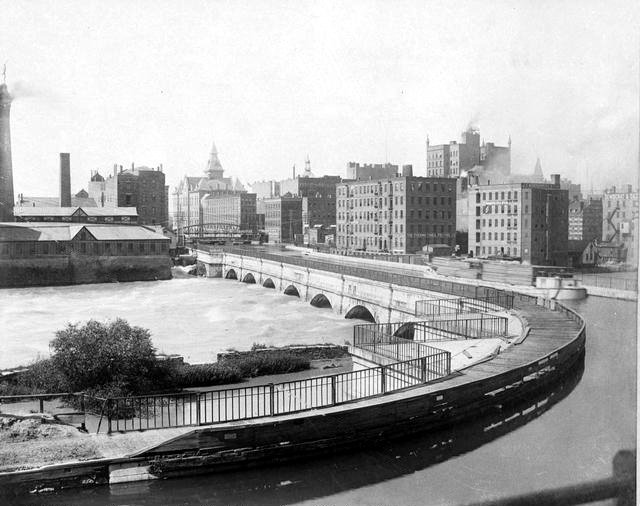
The first crossing went up fast and did not last. Between 1821 and 1823 the state raised a stone aqueduct across the Genesee — some 802 feet of red Medina sandstone on eleven arches, coped with Onondaga limestone — a genuine marvel for its moment, and one of the sights that made Rochester famous almost before it was a city. But it was built in a hurry, on soft rock, and it leaked. Within a decade it was plainly too small and too troubled for the traffic pounding through, and the state resolved to do the job over.
The replacement is the one that still stands. Begun in 1836 and placed in service in 1842, the second Genesee aqueduct spanned the river on seven cut-stone arches of fifty-two feet each — roughly 800 feet end to end, wing walls included — a heavier, sounder structure that carried Erie Canal boats over the Genesee for the rest of the canal’s working life downtown. It has outlived nearly everything around it. When the twentieth-century Barge Canal was rebuilt, engineers gave up on threading the enlarged waterway through the crowded city and rerouted the whole canal south of downtown, sending it across the Genesee at Olmsted-designed Genesee Valley Park instead. That left the 1842 aqueduct high, dry, and suddenly useless — a great stone trough with no water and no purpose.
What happened next is the strangest chapter in the whole story. Rather than tear the aqueduct down, the city repurposed it twice over. A road deck for Broad Street was laid atop the old span in 1922–1924, so that traffic now rolls across the bridge on the roof of a canal aqueduct. And inside — down in the drained trough where boats once floated — the city ran a subway. The Rochester Industrial & Rapid Transit Railway, built largely in the abandoned Erie Canal bed, carried passengers from December 1927 until 1956, crossing the Genesee through the belly of the very aqueduct the canal had left behind. Freight rattled through the tunnel for decades more. Cross the Broad Street Bridge today and you are standing on a stack of three transportation eras at once: a canal that became a road that hid a subway, all in one piece of 1840s masonry.
Just downstream, the Genesee produced a darker kind of fame. On November 13, 1829 — a Friday the thirteenth, as the story is fondly retold — the daredevil Sam Patch came to Rochester to leap the High Falls, a 94-foot drop in the heart of the city. Patch was the most celebrated jumper in America, a former mill hand who had made his name plunging into the gorge below Niagara and lived to bow for the crowds. At Rochester he built a platform to add another twenty-five feet to the fall and announced a second, grander jump. Thousands gathered on the banks. He stepped off, and something went wrong in the air; he struck the water badly and did not surface. His frozen body was found the next spring, downriver near the lake. The river the canal had worked so hard to cross had, in the end, the last word.
Stand at Broad Street and the layers are all there at once — the vanished ditch, the surviving aqueduct, the buried subway, and the falls just beyond where a showman made his last jump. Not sure which canal crossed here, and when? Start with our guide to the canal’s three lifetimes.
In this stretch
Places to Eat
Provisions & Shops
Things to see & do
Arriving by boat
Read the geography carefully before you plan an approach: the through-navigation channel runs south of downtown, not through it. To reach the city center you leave the canal and turn onto the Genesee River, which the canal crosses at Genesee Valley Park — the water crossroads of river and canal. From there the river carries you north toward Corn Hill and downtown.
Corn Hill Landing (250/280 Exchange Blvd) is the riverfront district most boaters aim for, home port of Corn Hill Navigation and its cruise boat Riverie (launched June 2023). Genesee Valley Park also offers a boat launch at the Genesee Rowing Club and a canoe launch at the Genesee Waterways Center.
The river-into-downtown run carries current and low-clearance considerations, and we have no verified last-mile data for transient dockage, fuel, pump-out, depth, or VHF here. Confirm dockage, clearances, and any amenities locally before you commit to the run.
By bike & foot
The Genesee Riverway Trail (GRT) is the spine of any land-based visit — roughly nine miles along both banks, running from the south city line to downtown near Court Street. It links the Erie Canalway Trail at Genesee Valley Park to High Falls and, eventually, Lake Ontario, passing the 1842 aqueduct, Corn Hill, and Olmsted's parks along the way.
For a longer expedition, the Genesee Valley Greenway State Park strikes 90 miles south from Genesee Valley Park along the former Genesee Valley Canal and railroad corridor. A designated National Recreational Trail, it ties directly into the Erie Canalway Trail. Access and parking are easiest at Genesee Valley Park (149 Elmwood Ave), Corn Hill Landing, and the downtown riverfront.
By paddle
The Genesee Waterways Center at Genesee Valley Park (149 Elmwood Ave) is the paddler's base — kayak and canoe rentals (seasonal, generally weekends noon–5) plus a free self-launch. Its sister site sits at Lock 32 in Pittsford, a short hop up the canal. Launch here and you drop in right at the river/canal junction: downstream toward downtown, upstream toward the canal.
One firm caution — this is not a continuous paddle through the city. The Genesee drops over High Falls downstream, so downtown is not a run-through. Portage points around the locks and falls aren't confirmed in our sources; scout your take-outs and portages locally before setting off.
By car
Drivers will find parking at Genesee Valley Park, Corn Hill Landing on Exchange Blvd, and downtown lots and garages. The headline stop is the Broad Street Bridge — the old aqueduct, best appreciated from street level; the subway ruins inside are not open to the general public. From there it's a short circuit to Corn Hill and the High Falls district, both of which reward an unhurried walk once you've parked.
Where to eat
Corn Hill Landing, on the west bank of the Genesee just south of the Frederick Douglass–Susan B. Anthony Memorial Bridge, is the natural place to eat. Rabbit Hole Tavern (284 Exchange Blvd) is the casual pick, trading on skyline and river views. Next door, Flight Wine Bar (262 Exchange Blvd) pours wine flights alongside small bites, while 809 Bar & Restaurant brings a Spanish-influenced menu to the Landing. For a lower-key morning, Neutral Ground Coffeehouse handles breakfast and lunch and welcomes dogs.
Where to sleep
The Hyatt Regency Rochester sits right on the Genesee River, connected to the Riverside Convention Center and standing as the tallest upscale hotel in the region. For something more boutique, The Strathallan Hotel & Spa, Tapestry by Hilton offers a downtown stay with a spa, and the Hilton Garden Inn Rochester Downtown occupies the former National Clothing Company building. (Corn Hill Landing itself is residential apartments, not lodging — plan to sleep elsewhere.)
What to see
The Second Genesee Aqueduct / Broad Street Bridge is the essential sight: the 1842 Erie Canal aqueduct that once carried the canal over the Genesee, with an interior that housed the Rochester Subway from 1927 to 1956. Nearby, the Corn Hill historic district hugs the riverfront and launches Corn Hill Navigation's Riverie cruises.
Downstream, the High Falls of the Genesee anchor a dramatic waterfall district reachable on the GRT, and back at the crossroads, Genesee Valley Park — Olmsted-designed — is where river and canal meet, and where most journeys through Rochester begin.
Local history
In pictures