Tonawanda & North Tonawanda
Approx. Mile 321–338 along the Erie Canal
Barge Canal — the Long Level’s end at the Niagara River; the practical modern head of navigation. Which canal is this? →
The twin cities of Tonawanda (Erie County, south bank) and North Tonawanda (Niagara County, north bank) mark the western navigable terminus of the Erie Canal, the point where the canal meets the Niagara River. The historic 1825 terminus lay farther south at Buffalo's Commercial Slip, but the miles between here and the city are no longer through-navigable, which makes the Tonawandas the practical western end of the line for most boaters today.
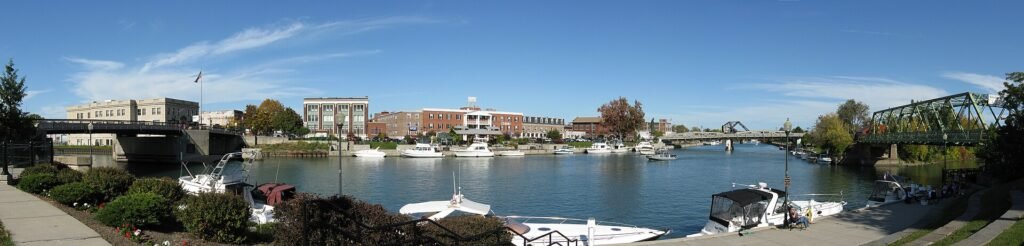
Life on both banks centers on Tonawandas Gateway Harbor Park, a free-docking waterfront destination known for the region's longest-running free summer concert series, held since 2002. Beyond the music, North Tonawanda carries a remarkable manufacturing heritage as a onetime carousel and band-organ capital, and the area preserves early-settlement history in the 1829 Benjamin Long Homestead.
The port that turned sawdust into carousel music
Count the annual rings on the Tonawandas and you find the whole nineteenth century pressed flat and stacked in board feet. For the last half of the 1800s, this was one of the great lumber ports of the continent — and by one widely repeated heritage claim, the “Lumber Capital of the World.” The geography made it inevitable. Great Lakes and Canadian forests — white pine, hemlock, oak — were felled far to the west, floated in enormous rafts down the lakes and the Niagara River, and delivered to the harbor where the Erie Canal met the river. Here the rafts were broken up, run through the mills, and re-shipped east on the canal toward Albany and New York City, or west by rail into the treeless Midwest. The trade did not trickle; it flooded.
The numbers still startle. Through the 1880s, lumber docks reportedly ran some six miles, from Two-Mile Creek in Tonawanda up to Gratwick in North Tonawanda, and the twin cities’ population swelled roughly fivefold in a single decade as immigrants poured in to work the yards. In 1890 the port is said to have received and forwarded 718,650,900 board feet of lumber — a figure that, boosters claimed, edged past Chicago to make the Tonawandas number one on earth. Treat the superlative the way the region’s own historians do: an honest measure of a genuine boom, and a title worn with pride rather than an unassailable world record.
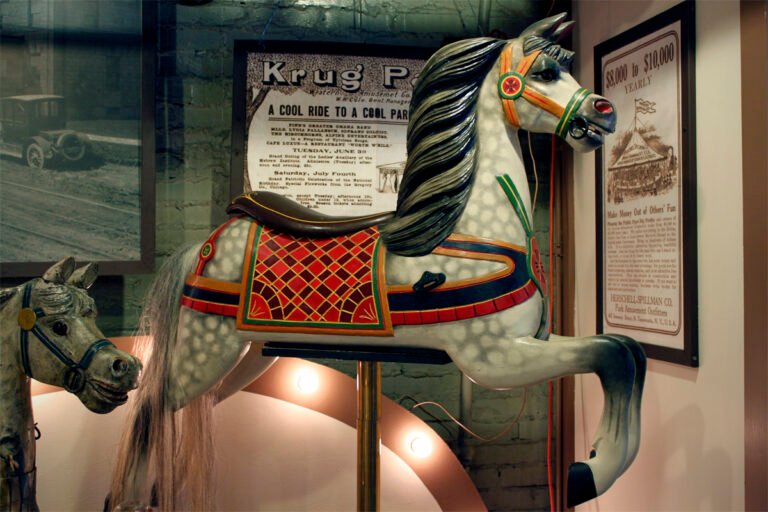
What makes the Tonawandas remarkable is not that the lumber ran out — every extraction economy eventually does — but what the town did with the skills the timber left behind. A community full of woodworkers, carvers, and machinists turned from milling planks to carving horses. North Tonawanda became a carousel capital. The Allan Herschell Company and its predecessors built merry-go-rounds that spun in fairgrounds around the world; at one point four carousel builders operated in the same small city. Their carved menageries needed music, and that industry grew up alongside them. In 1893 a barrel-organ factory opened to supply band organs for the carousels, led by a Prussian craftsman named Eugene de Kleist. In 1897 he struck a partnership with a Cincinnati music house called Rudolph Wurlitzer; by 1909 Wurlitzer had bought him out and taken over the North Tonawanda works, which grew into one of the largest musical-instrument plants in the world — calliope music, jukeboxes, and mighty theater organs, all born a few blocks from the sawmills.
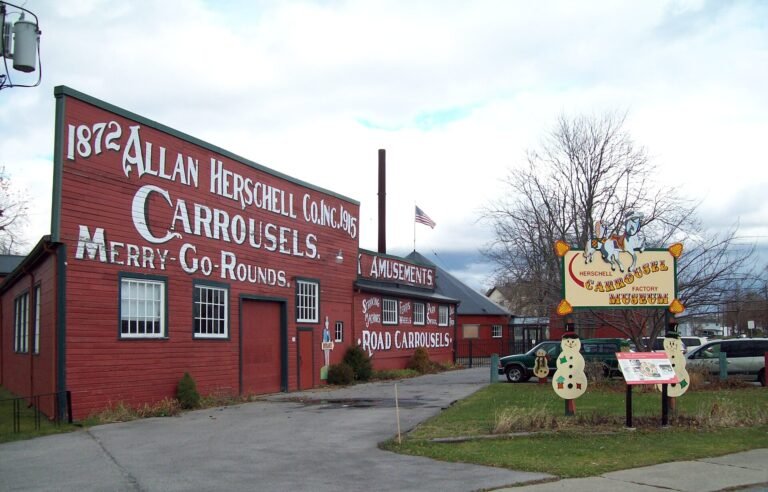
That double legacy is preserved, still turning, at the Herschell Carrousel Factory Museum on Thompson Street, housed in the original Allan Herschell factory buildings of about 1910–15. Visitors ride a restored 1916 Herschell carousel, watch carving demonstrations on the old factory floor, and stand in a Wurlitzer music room that keeps more than ten historic band organs and the only working Wurlitzer perforator known to survive — the machine that once punched the paper rolls that made the horses gallop in time.
The canal that built all this now defines the town’s quieter modern role. For most boaters today the through-navigable Erie ends here, at the Niagara River; the historic 1825 terminus lay a few miles south at Buffalo, but the water between is no longer continuously navigable. So the twin cities — Tonawanda on Erie County’s south bank, North Tonawanda on Niagara County’s north — hold the practical western end of the line: where a continent’s timber once came ashore, and where the canal now simply, gracefully, runs out.
In this stretch
Places to Eat
Provisions & Shops
Arriving by boat
Tonawandas Gateway Harbor Park sits at roughly Mile 338, the western end of the navigable canal where it opens to the Niagara River. It is best known for its free transient docking: crews get up to two hours free for dining and shopping downtown at the harbormaster's discretion, with a longer two-hour transient slip at $5 and daily and overnight rates scaling by length. Ashore, the Harbor House offers restrooms, showers, and laundry. Reach the harbormaster through City Hall at 716-695-1800.
Waterway Guide lists fixed docks with 30- and 50-amp electric, water, showers, and a ship store. Note the dockside depth of about 4 feet — shallow enough that deeper-draft boats should confirm space in season before committing to the approach. There is no fuel and no pump-out here, so plan to pump out earlier on your run west. This is the hand-off point to the Niagara River and the Black Rock Canal toward Buffalo; confirm current conditions and any navigation cautions near the river mouth in season.
By bike & foot
Tonawanda is a hub on the Erie Canalway Trail / Empire State Trail, with the Amherst-to-Lockport off-road segment passing through and the corridor continuing south toward Buffalo along the canal and Niagara River. Gateway Harbor Park sits directly on the waterfront trail, and downtown is highly walkable on both banks, linked by the canal bridges.
By paddle
This is a lockless stretch — the so-called Long Level — so there is no lock portage to work around. Paddlers should treat the western end with respect, however: the canal here opens directly to the Niagara River, and anyone continuing out into the river should account for current. Confirm launch sites in season.
By car
Everything worth seeing sits within a short drive of the waterfront: Gateway Harbor Park, the Herschell Carrousel Factory Museum (180 Thompson St, North Tonawanda), and the Benjamin Long Homestead are all close together across the twin cities.
Where to eat
Remington Tavern & Seafood Exchange is the standout — a full-service seafood house set in an 1895 brick 'Power House #4' directly on the canal, with a horseshoe bar, an oyster bar, and a canal-side patio (184 Sweeney St, North Tonawanda; 716-362-2802). Other canal-area options include Dockside Bar & Grill and The Hideaway Grille; confirm hours and canal-front seating in season.
What to see
Tonawandas Gateway Harbor Park anchors the waterfront at the canal's western navigable end. Its free summer concert series has run since 2002 — billed as the region's longest-running — alongside Food Truck Thursdays, Wednesday Concerts on the Canal on the North Tonawanda side, and the Spotlight Stage Series at the Canal Street Pavilion.
The Herschell Carrousel Factory Museum (180 Thompson St, North Tonawanda; 716-693-1885) fills the original Allan Herschell Company factory of about 1910–15, with two operating carousels — including a 1916 Herschell — plus the Carving Floor, Wurlitzer Music Department, Paint Shop, Roundhouse, and Kiddieland. It opened in 1983 and runs Wednesday through Saturday 10am–4pm and Sunday noon–4pm; confirm hours in season.
The Benjamin Long Homestead, an 1829 timber house hand-hewn from on-site black walnut and white oak, is among the area's oldest standing residences; the Erie Canal towpath once passed directly in front of it, and it is now a museum run by the Historical Society of the Tonawandas. That society also operates a local history museum in the twin cities. Together they tell the story of a great lumber port, where rafted logs were dismantled at the harbor, milled or re-rafted, and towed east on the canal — the trade that made the Tonawandas boom.
Local history
In pictures