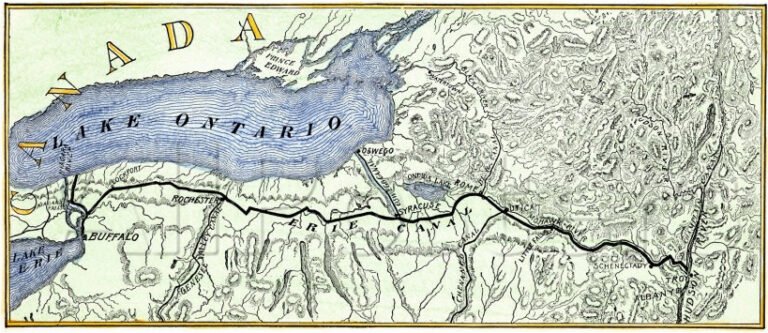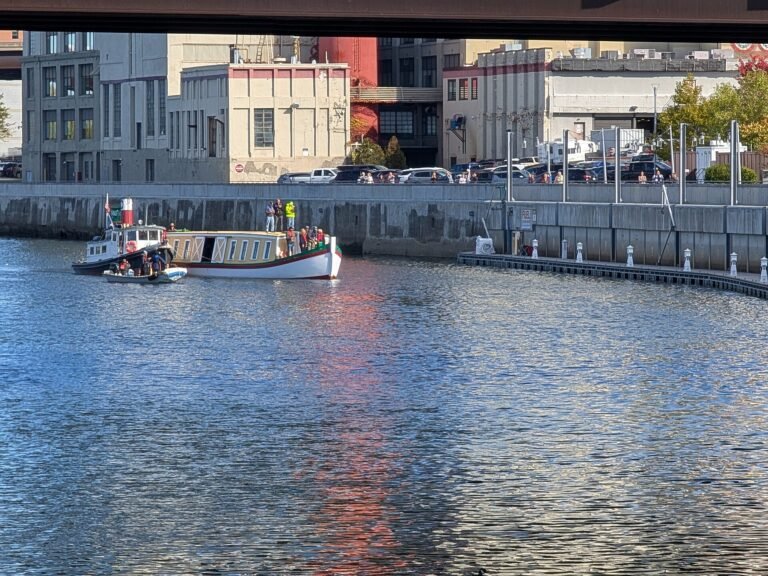
The Enlarged Erie: The Forgotten Canal in the Middle
Everyone remembers Clinton’s Ditch and the concrete Barge Canal — but between them ran a third Erie, the one that carried the canal’s greatest glory years and then all but disappeared.
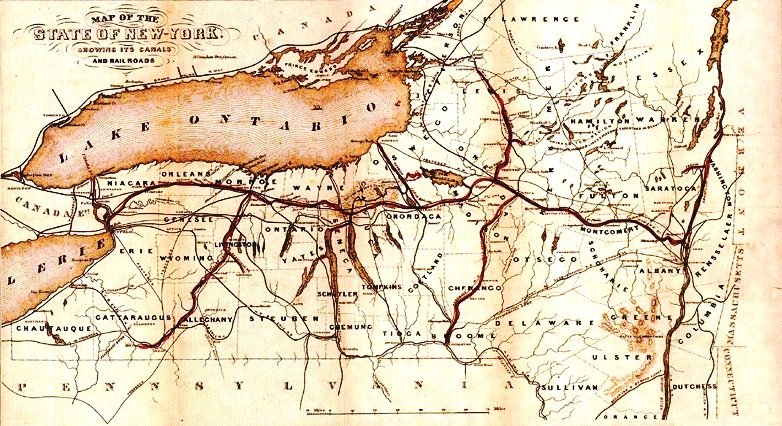
Ask anyone who knows a little canal history to name the Erie Canals, and you’ll usually get two answers. There is Clinton’s Ditch — the hand-dug wonder of 1825, four feet deep and forty wide, with eighty-three locks stepping across the state. And there is the New York State Barge Canal, the concrete-and-steel colossus of the early twentieth century that runs the rivers themselves and still carries pleasure boats today.
Between them stood a third canal. It carried more tonnage than either of the others ever would. It rebuilt the Erie in cut stone from Albany to Buffalo. And it has very nearly vanished from the story — the forgotten canal in the middle.
Obsolete almost the day it opened
The 1825 canal was a triumph and a bottleneck at the same time. Its dimensions — four feet of water, forty feet across the top, boats carrying roughly thirty tons — were a marvel of restraint when they were dug. They became a straitjacket almost immediately. Traffic overwhelmed the little ditch within a decade, and the crowding was worst on the busy eastern end, where boats stacked up waiting to lock through single chambers one at a time.
So New York decided to build the Erie again — bigger. The sources place the start of the improvement program slightly differently: Wikipedia dates “an ambitious program to improve the canal” to 1834, driven “mostly because of extreme crowding particularly on the eastern portion,” while other accounts point to the legislature’s 1835 agreement to enlarge the canal to seventy feet wide and seven feet deep. Either way, within ten years of the ribbon-cutting, the state had already resolved to tear up and outgrow its own masterpiece.
A quarter century of digging
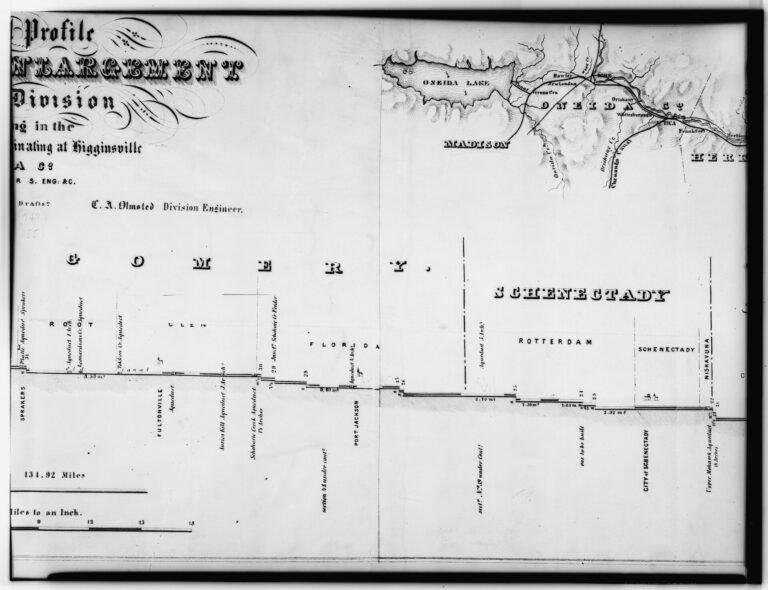
What followed is the least-remembered epic in the canal’s history: the First Enlargement, ground out over roughly a quarter century, from about 1836 to 1862. The plan was straightforward and enormous. Deepen the channel from four feet to seven. Widen it from forty feet to seventy. Rebuild the locks, the aqueducts, and the culverts at the new scale, much of it in cut stone to replace the original hasty stonework and timber.
The locks were the heart of it. The Enlargement cut their number from 83 down to 72 — and, crucially, it doubled them. “The enlargement included the doubling of the locks — two parallel chambers,” the specialist history at eriecanal.org records, “enabling traffic to proceed in both directions at the same time.” No more waiting your turn in a single chamber while a line of boats built behind you; eastbound and westbound traffic could now lock through side by side. It is the same two-lanes-of-water logic you can still read in the stone at Lockport.
It did not go smoothly. The Panic of 1837 gutted state finances just as the work got moving, and the money troubles never fully let go. Then politics stopped the canal outright. In 1842, the state passed the so-called “Stop and Tax” law — a debt-fearing measure that halted new canal construction cold until New York’s obligations were paid down. Work limped along on toll revenue and small appropriations for more than a decade. Only in 1854, when the Whigs regained control of the legislature, did full-blown construction resume. The Enlargement was finally declared complete in 1862 — and even then the job wasn’t truly finished. Fifteen locks, most of them west of Port Byron, still hadn’t been doubled; that work resumed in 1869 and wrapped in 1875, and the locks were being lengthened for “double-header” boats as late as the 1880s.
The glory years
Here is the part the forgotten canal earned and never got credit for: this was the Erie at its peak. Not Clinton’s Ditch, and not the Barge Canal — the Enlarged Erie carried the waterway’s greatest traffic of all time. The canal’s single biggest year by tonnage was 1880, when it moved 4,608,651 tons of freight. That is the enlarged, cut-stone, double-locked canal doing the work, nearly thirty years after the first railroad had reached across the same route to compete with it.
The glory didn’t last. The railroads kept getting faster and more flexible, and the freight the canal had been built to carry began slipping onto the rails. In 1882, New York voters approved a constitutional amendment abolishing canal tolls entirely, a last effort to keep boats on the water. Within a generation the state would commit to rebuilding the Erie yet again — this time as the concrete Barge Canal, opened in 1918, which abandoned much of the old towpath alignment and moved navigation into the rivers. The Enlarged Erie, having carried the canal’s best years, was simply left behind.
Where to find it today
That’s why it feels like a ghost. The Barge Canal didn’t always follow the enlarged channel — so in place after place, the nineteenth-century Erie was cut off, drained, and abandoned beside the modern waterway, rather than buried under it. Which means the forgotten canal is still out there in stone, if you know how to look.
- Lockport. The best-known relic of all. Beside the working modern locks at E34–35, five chambers of the Flight of Five survive — the cut stone you see is the 1836–47 Enlargement rebuild, standing on the line of the original 1825 flight and long since repurposed as a spillway. It’s commonly called the largest intact stretch of the old Erie left anywhere.
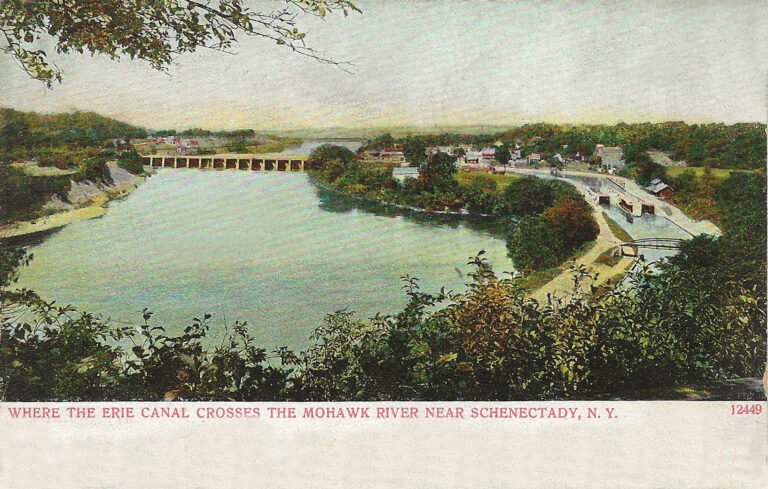
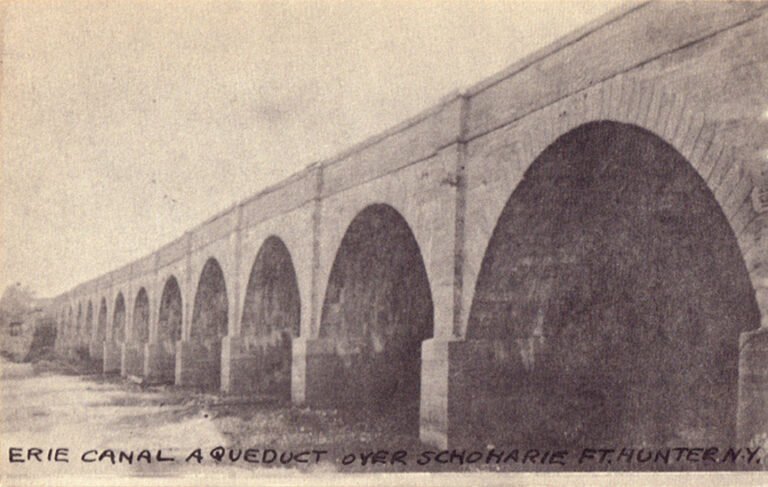
- Schoharie Crossing, Fort Hunter. The dramatic remnants of the Schoharie Aqueduct — the great stone arches that once carried the enlarged canal over Schoharie Creek — stand as ruins today, one of the most photographed pieces of vanished canal engineering in the state.
- The Newark and Palmyra–Pittsford corridor. Through the western “Long Level” country, abandoned enlarged-era stone locks and prism sit near the modern canal — including the widely visited remains of a nineteenth-century lock at Newark (locally known as Lock 59, a stop on the enlarged line before the Barge Canal renumbering) and the dry, cut-stone lock relics scattered around Pittsford and Palmyra.
Stand at any of them and the layering is the whole point. You are looking at the middle canal — the one obsolete-on-arrival Clinton’s Ditch forced into being, the one that dug through a panic and a political stalemate to reach seven feet of water and doubled locks, the one that carried the Erie’s all-time peak in 1880 before the railroads and then the Barge Canal passed it by. Three canals occupy this ground, and the forgotten one in the middle did more traffic than either of the neighbors people actually remember.
New to sorting out which canal is which? Start with our explainer, “Which Canal Am I Looking At?” — the field guide to the four Eries stacked across New York.
Gallery
Sources
Original 1825 dimensions (4 ft deep, 40 ft wide, 83 locks, ~30-ton boats): eriecanal.org — canal specifications, https://www.eriecanal.org/ ; corroborated by Wikipedia — “Erie Canal,” https://en.wikipedia.org/wiki/Erie_Canal . Enlargement program began 1834 “mostly because of extreme crowding particularly on the eastern portion” and widened 40→70 ft / deepened 4→7 ft, First Enlargement declared complete 1862: Wikipedia — “Erie Canal,” https://en.wikipedia.org/wiki/Erie_Canal . Legislature agreed in 1835 to enlarge to 70 ft wide / 7 ft deep; enlarged canal 350.5 mi, boats to ~240 tons: eriecanal.org, https://www.eriecanal.org/ . Locks reduced 83→72 and “the doubling of the locks — two parallel chambers — enabling traffic to proceed in both directions at the same time”; 15 locks (most west of Port Byron) not doubled by 1862, doubling resumed 1869 and completed 1875; lock lengthening for double-header boats began 1884: eriecanal.org — Locks, https://www.eriecanal.org/locks.html . “Stop and Tax” bill of 1842 halted new construction until the debt was paid; work continued only on toll revenue and small appropriations until 1854 when the Whigs regained the Legislature and resumed full construction, completed 1862: Consider The Source Online (NY State Archives Partnership Trust), “Enlarging and Improving the Canal,” https://considerthesourceny.org/using-primary-sources/erie-canal-new-yorks-gift-nation/chapter-6-enlarging-and-maintaining-erie-canal/historical-context-enlarging-and-improving-canal ; “Stop and Tax” and Panic-of-1837 context corroborated by Wikipedia — “Erie Canal.” Peak tonnage year 1880 = 4,608,651 tons; 1882 constitutional amendment abolishing tolls; railroad competition: Consider The Source Online — “Erie Canal Freight” and “The Railroads and New York’s Canals,” https://considerthesourceny.org/using-primary-sources/erie-canal-new-yorks-gift-nation/ ; corroborated by Wikipedia — “Erie Canal.” Lockport Flight of Five survival (rebuilt/widened during the mid-1800s enlargement, largest intact stretch of the old Erie): Erie Canalway National Heritage Corridor / NPS, https://eriecanalway.org/learn/history-culture ; Niagara Falls National Heritage Area, https://discoverniagara.org . Underlying primary history for the enlargement, lock counts, and doubling: Noble E. Whitford, “History of the Canal System of the State of New York” (Albany: Brandow Printing Co., 1906), https://www.eriecanal.org/texts/Whitford/1906/ . NOTE: sources vary on the enlargement’s authorization date (1834 program start per Wikipedia vs. 1835 legislative agreement per eriecanal.org) — both are surfaced in the text, not resolved.