Utica & Whitesboro
Approx. Mile 95–110 along the Erie Canal
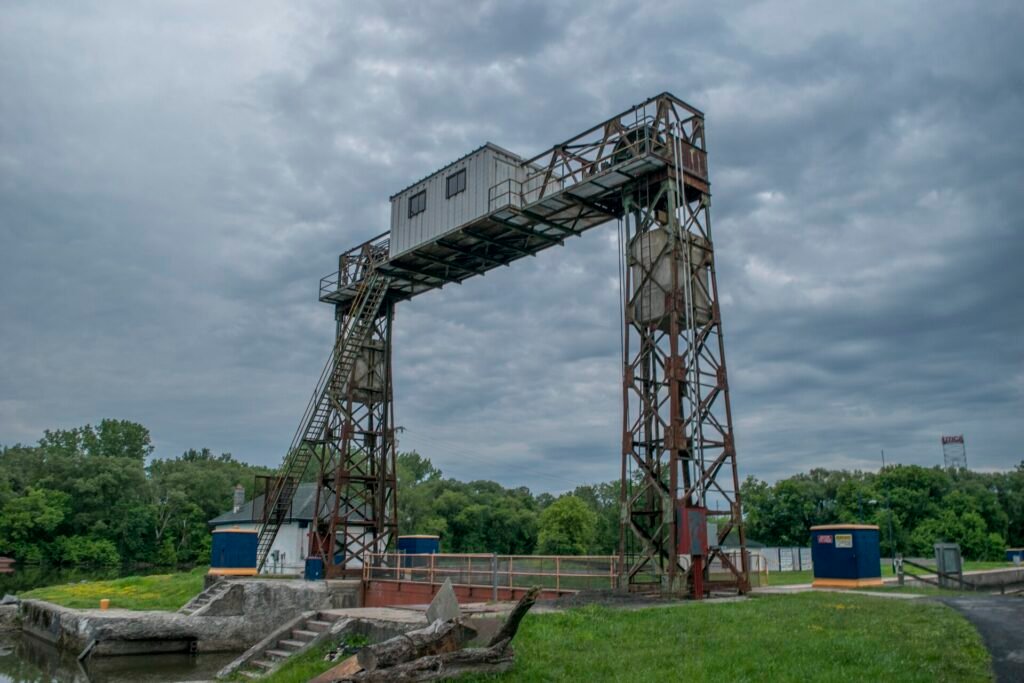
Barge Canal · 1918 — the canalized Mohawk near Utica, where the canal starts onto the land-cut summit level. Which canal is this? →
Utica meets the Erie Canal in the heart of the Mohawk Valley, and it does so in an unusual way. The main canal channel doesn't run through downtown — instead, the Utica Harbor Lock (Lock E20), built in 1917 as part of the New York State Barge Canal, swings open to admit boats into the Inner Utica Harbor, a sheltered basin now at the center of the Utica Harbor Point waterfront redevelopment. It is a spur off the main line, not a stop along it, and that detail shapes everything about how a boater arrives here.
The canal's fingerprints are all over the local map. Neighboring Whitesboro was founded in 1784 by Hugh White, and it was his grandson, Canvas White, who patented the hydraulic cement that made building the Erie Canal possible in the first place. Ashore, downtown Utica delivers the payoff: the F.X. Matt (Saranac) brewery, the Adirondack Bank Center at the Utica Memorial Auditorium — "the Aud" — and the walkable Bagg's Square district.
The cement that would not dissolve
The Erie Canal was very nearly beaten by chemistry. Its builders could dig a ditch across a state, but the locks and aqueducts that held the water in had to be laid in mortar, and ordinary lime mortar has a fatal flaw for a canal: submerged in water, it softens and washes away. Every masonry joint the canal depended on sat permanently underwater. Without a cement that could set and stay hard in water — a hydraulic cement — the whole enterprise risked slowly dissolving into the very channel it was meant to carry.
The man who solved it came from Whitesboro. Hugh White, a farmer from Middletown, Connecticut, had founded the village in 1784 on land in the Sadaquada Patent, planting one of the first white settlements west of German Flatts. His grandson, Canvass White, grew up in that frontier country and went to work as an engineer on the canal in its earliest years. Sent to England to study its canals, he came home convinced the answer to the mortar problem lay underfoot. Testing local limestone, he found a variety near the canal line that, burned and ground, produced a cement which hardened underwater. He patented it in 1820, and the canal was built on it — lock chambers, culverts, and the great stone aqueducts all cured with a material a Whitesboro grandson had wrung out of New York bedrock. It is not too much to say the canal stood because his cement did.
A harbor reached by its own strange lock
Utica, a few miles east, became the section’s anchor. This is the country where the waterway changes character: below here the modern canal runs as the canalized Mohawk River, but at Utica it climbs off the river and starts west across the dug land cut toward Rome and the canal’s summit — the long, level top of the whole system. Utica sits at that hinge, and it is joined to the main channel by one of the canal’s genuine oddities. The Utica Harbor Lock is the only harbor lock on the entire Erie — a short spur lock, built around 1917, that drops boats down into the Inner Utica Harbor rather than carrying them along the main line. Stranger still is how it seals: instead of the swinging miter gates used at every numbered lock, it closes with a rare vertical drop gate, a slab that lowers straight down into the channel. It carries no lock number of its own. The section’s mainline lock, E20, sits apart, a few miles west at Marcy — a distinction worth keeping straight, because the two are often confused.
The mill city that drank its own water
What the harbor served was a working city. Nineteenth-century Utica grew rich on knitting mills and textiles, its downtown packed with the machinery of a river-and-canal town. One appetite outlasted the looms. In 1888 Francis Xavier Matt reorganized a failing local brewery as the West End Brewing Company, and the F.X. Matt operation has made beer in Utica ever since — through Prohibition, when it survived by bottling soft drinks and near-beer under the Utica Club name, and out the far side as one of the oldest continuously family-owned breweries in the United States. More than a century on, the brewery still runs on the same West Utica ground, a living thread back to the mill city the canal built. Stand at the harbor today and the layers stack up at once: a village that gave the canal its cement, a lock unlike any other on the system, and a city that never quite stopped brewing.
In this stretch
Places to Eat
Provisions & Shops
Things to see & do
Arriving by boat
Getting to Utica by water means a deliberate detour. The Utica Harbor Lock (Lock E20) is the gateway — it connects the canal channel to the Inner Utica Harbor and is not on the main line, so plan the diversion rather than expecting to pass it underway. It's also a curiosity worth knowing before you arrive: instead of a standard miter gate, its upper gate is an unusual drop / vertical-lift guard gate. Don't confuse this harbor lock with a routine numbered stop on the main channel — the two are distinct, and the harbor is a destination you enter, not a passage you transit.
Inside, the primary boater stop is the publicly owned Utica Historical Marina, co-located with the Aqua Vino restaurant (formerly Kitty's on the Canal). Cited amenities include water, power, and restrooms; Aqua Vino also offers boat docking directly on the canal downtown. East of where I-90 crosses the canal, Marcy Marina adds ramp access and beach-launch options with limited services. Fuel, pump-out, controlling depth, VHF working channels, and any designated anchorages were not confirmed in our sources — confirm in season against NYS Canals Navigation Information and Waterway Guide before you rely on them.
By bike & foot
The Erie Canalway / Empire State Trail runs straight through Utica, and the city makes a natural jumping-off point in either direction. Heading east, the Utica-to-Frankfort segment covers 11 miles, beginning at a trailhead parking area off North Genesee Street on the north side of the city; the first roughly 3.5 miles are new paved off-road trail suited to walkers and cyclists of all abilities, after which the route shifts to on-road riding along the shoulders of Southside Road — better left to experienced riders. Westward, the Rome-to-Utica segment carries the trail on toward Rome.
By car, the trailhead is reachable from I-90 Exit 31: after the toll booth, stay straight/left onto N. Genesee Street, turn right and cross the canal (not the river), then turn left onto Harbor Lock Road to reach the lot. Bike shop recommendations weren't confirmed in our sources.
By paddle
Paddlers have a workable put-in at Marcy Marina, east of the I-90 crossing, where beach-launch options make for an easy entry. Portage specifics around the Utica Harbor Lock (Lock E20) weren't confirmed in our sources — check with NYS Canals for current guidance before planning a route that depends on carrying around the lock.
By car
Drivers headed for the waterfront should aim for the Harbor Lock Road lot, reached from I-90 Exit 31, which serves both the harbor and the Canalway trailhead. Downtown, the marquee drive-in attractions cluster within easy reach: the F.X. Matt / Saranac Brewery at 811 Edward Street, the Adirondack Bank Center at the Utica Memorial Auditorium, the Stanley Theatre, and the Munson-Williams-Proctor Arts Institute. Confirm parking specifics for each in season.
Where to eat
Aqua Vino (Esche's Aqua Vino) is the obvious boater's choice — a seafood, steak, and American-Italian kitchen set right on the Erie Canal downtown, with an outdoor canal-side deck and its own boat docking. It has been serving since September 2007. For something more industrial-scale, the F.X. Matt / Saranac brewery runs tours on Friday and Saturday at $5 per person, with kids 12 and under free; confirm current hours in season. Additional Utica dining picks weren't confirmed in our sources.
Where to sleep
The standout downtown stay is the DoubleTree by Hilton Hotel Utica at 102 Lafayette Street — a historic property built in 1912, roughly 1.6 miles from the Canalway Trail, and bookable through the Hilton network. The historic Hotel Utica also anchors downtown; confirm its current operating status before you count on it.
What to see
The F.X. Matt / Saranac Brewery tops most itineraries — brewing since 1888 and billed as the fourth-oldest family-owned brewery in the United States, with tours available. A block into the entertainment district, the Adirondack Bank Center at the Utica Memorial Auditorium — "the Aud" — hosts the Utica Comets. Down at the water, the Utica Harbor Point redevelopment is remaking the basin the harbor lock opens into. Round out the day with the Munson-Williams-Proctor Arts Institute, the Stanley Theatre, and the Utica Children's Museum.