Palmyra & Macedon
Approx. Mile 230–245 along the Erie Canal
Barge Canal · 1918 — a dug land cut; Enlarged-Erie stone relics survive nearby. Which canal is this? →
Palmyra and Macedon are two adjoining Wayne County canal towns strung along the Erie between Fairport and Newark, each anchored by a modern lock roughly three miles apart: Lock E29 at Palmyra and Lock E30 at Macedon. Palmyra earned the nickname "Queen of the Erie Canal towns" as a booming 19th-century port, and it holds a second, national kind of fame as the place where the Book of Mormon was first printed, at the E.B. Grandin shop in the village. Both towns guard rare relics of the old Enlarged Erie: the Mud Creek aqueduct remains and the Aldrich Change Bridge in Palmyra's Aqueduct Park, and the restored double Enlarged Lock 60 near Macedon.
One quirk to file away before you count locks: there is no Lock E31 on the Erie Canal. The number was never assigned, so the sequence simply skips from E30 to E32.
The canal town that printed a religion
Most Erie Canal towns shipped wheat, lumber, or barreled goods east on the water that made them. Palmyra shipped something stranger: a scripture. In a second-floor printshop on the village’s Main Street, a book rolled off a hand-press in the winter of 1830 that would seed a faith now counted in the millions — and it happened here, in a Wayne County boomtown, precisely because the canal had made this a place where money, people, and restless ideas all passed through at once.
The ideas came first, and they came in a fever. Western New York in the 1820s and ’30s was revival country — so thick with camp meetings, itinerant preachers, and new sects that the evangelist Charles Grandison Finney would later call it the Burned-Over District, a stretch so thoroughly evangelized there was no spiritual fuel left to burn. The canal was the accelerant. Preachers and pamphlets rode the same packet boats as the freight, hopping village to village down the corridor, and Palmyra sat squarely in the blaze — Presbyterians, Baptists, Methodists, and Quakers all competing for souls within a few miles of the towpath. Out of that competition, a young man named Joseph Smith described what he called an unusual excitement on the subject of religion. What he did next needed a printer.
He found one in Egbert B. Grandin, who ran a book-and-job shop in Palmyra village and printed the local Wayne Sentinel. The job was audacious: a first run of 5,000 copies — more than twice the size of an ordinary book of the day — for the sum of three thousand dollars. Grandin balked. By the accounts the Church itself preserves, he was reluctant enough that he tried to talk Smith’s backer, the farmer Martin Harris, out of financing it at all. Harris answered by mortgaging his farm as security, signing the deed over to Grandin in August 1829, and production began. Grandin’s compositor, John H. Gilbert, set the type from a manuscript he remembered as legible but carrying not a punctuation mark from beginning to end — every comma and period in the first Book of Mormon was Gilbert’s own. On March 26, 1830, the Wayne Sentinel announced the finished book was on sale at Grandin’s store.
Mind the map, because the geography gets muddled in the retelling. The Grandin shop stands in Palmyra village, Wayne County — that is where the printing happened. The other founding sites of the movement lie just to the south across the county line, in the Town of Manchester, Ontario County: the wooded Sacred Grove, the Joseph Smith family farm, and the drumlin called Hill Cumorah. The book was Palmyra’s; the visions were Manchester’s. And the same canal that printed the one carried the other outward — early missionaries fanned west along the waterway, so the corridor that built the town also distributed its most improbable export.
The canal made Palmyra rich enough to be called the Queen of the Erie Canal towns, and prosperity leaves relics. West of the village in Aqueduct Park, two survive from the vanished Enlarged Erie — the wider, deeper canal that succeeded the original ditch before the twentieth-century Barge Canal cut its own dug channel through here. One is the stone remnant of the old aqueduct that once carried canal boats over Ganargua Creek. The other is the Aldrich Change Bridge, an iron towpath span built in 1858 and reckoned among the oldest dated iron bridges in New York State — a rare cast-and-wrought survivor of the age when the whole valley ran on water. Stand beside it and the layers align: a revival, a printing, and a canal, all crossing at the same small town.
In this stretch
Places to Eat
Provisions & Shops
Things to see & do
Arriving by boat
The friendliest tie-up here is the Port of Palmyra Marina, a small man-made basin on the south side of the canal immediately east of Bridge E-117. Approach and dockside depths run about 6 to 7 feet, and the wall holds several boats with pump-out, water, and electric on hand. A comfort station with restrooms and showers stays open during canal operating hours, and downtown Palmyra, its museums, restaurants, laundromat, and shops, sits about two blocks away. Note that there is no fuel dock here, so top off elsewhere before you arrive.
Lock E29 at Palmyra and Lock E30 at Macedon each lift boats roughly 16 feet. Hail the lock operators on VHF Channel 13 as you approach, or signal with three horn blasts. Controlling depths and designated anchorages for this reach are worth a check against the current Notices to Mariners; confirm the details in season before you transit.
By bike & foot
The Erie Canalway Trail, carrying the Empire State Trail, runs straight through both villages, and the Palmyra harbor park sits right on it, a short walk from Main Street. In Macedon the trail crosses from the north bank to the south side of the canal on a restored bridge. Food, water, and restrooms are available in both village cores, and it's worth knowing there are no other services along the stretch between Fairport, Macedon, and Palmyra, so stock up in town.
For drivers meeting the trail, Aqueduct Park in Palmyra (off NY-31) and Lock 30 Canal Park in Macedon both offer parking and trail access.
By paddle
Palmyra offers a canoe and kayak launch at the Port of Palmyra Marina's harbor park. In Macedon, look for launch access at Lock 30 Canal Park, and note that the restored Enlarged Lock 60 can be reached from the water, watch for a floating dock and signs marking the site.
Both Locks E29 and E30 are working locks with roughly 16-foot lifts, so paddlers will need to portage around them; consult the NYS Canalway Water Trail Guidebook for carry paths before you set out.
By car
Aqueduct Park in Palmyra, off NY-31 just west of the village, gives drive-in access to the Mud Creek aqueduct remains, the Aldrich Change Bridge, and adjacent Lock 29. In Macedon, Lock 30 Canal Park has picnic areas, hiking trails, an observation deck, and the short Butterfly Trail lookout, while Enlarged Lock 60 is reached by land off Quaker Road. Palmyra's downtown historic district, including its four corner churches, is an easy stroll once you park.
Where to eat
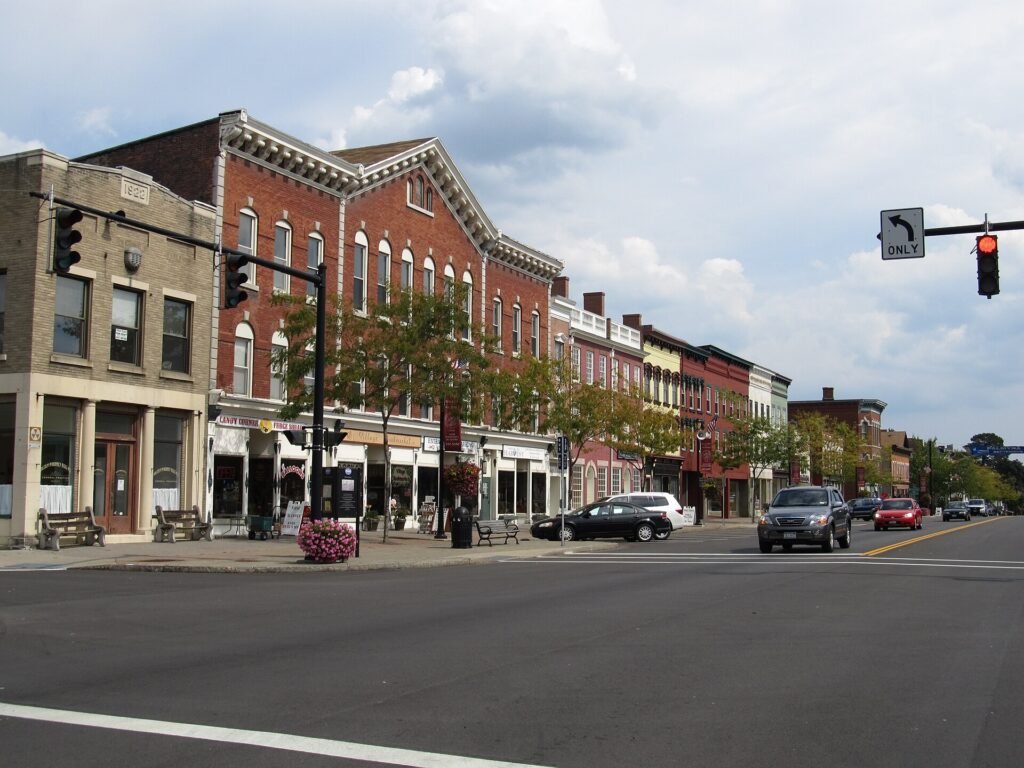
Palmyra keeps its dining close to Main Street and the canal. Black Hart BBQ (623 East Main Street) and Chill & Grill (616 East Main Street) sit along the main drag, while Akropolis Family Restaurant (513 Canal Street) and the Greek-American Athenia Restaurant round out the options a short walk from the water. Hours shift with the season, so confirm before you plan a meal around one.
Where to sleep
For a full-service stay, the Best Western Palmyra Inn & Suites offers around 60 rooms with hot breakfast, an indoor jacuzzi, a fitness center, and free WiFi, convenient to the LDS historic sites just south of town. For something more historic, the Canaltown Bed & Breakfast occupies an 1855 Greek Revival on Main Street near the four-corner churches, a short walk from the canal.
What to see
Palmyra's Aqueduct Park preserves the 1857 stone abutments of the Mud Creek aqueduct alongside a spillway "waterfall" on three-plus acres. Its centerpiece is the Aldrich Change Bridge, a Squire Whipple design built in 1858 and reconstructed here in 1997, the oldest dated iron bridge in New York State and one of only two surviving from the first enlargement of the Erie Canal.
Near Macedon, the restored Enlarged Erie Canal Lock 60 is a double lock dating to 1841, its twin chambers each 18 by 110 feet, with tow-rope grooves still visible worn into the limestone after a 25-year volunteer restoration. In the village, the Four Churches on Four Corners stand at the intersection of Routes 21 and 31, and the Alling Coverlet Museum (122 William Street) anchors Palmyra's cluster of local museums. Just south of town lie the founding sites of the Latter-day Saint movement, including the Grandin Building in the village where the Book of Mormon was first printed.