Clinton’s Ditch: How the Erie Canal Was Built
They called it a ditch, a folly, and “little short of madness.” Then it made New York the Empire State.
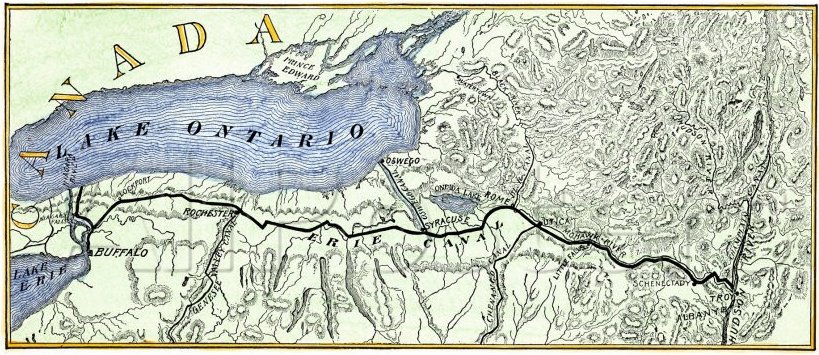
In 1809, a delegation pitched Thomas Jefferson on an audacious idea: dig a canal clear across New York State, more than 350 miles through unbroken wilderness, to link the Hudson River with the Great Lakes. Jefferson — no enemy of grand projects — reportedly dismissed it out of hand. “You talk of making a canal of 350 miles through the wilderness,” he is recorded as saying, “it is little short of madness to think of it at this day.”
Sixteen years later, that “madness” opened for business. The Erie Canal became the most consequential public work in early American history — and the standing rebuke to everyone who had called it impossible.
The idea nobody wanted to pay for
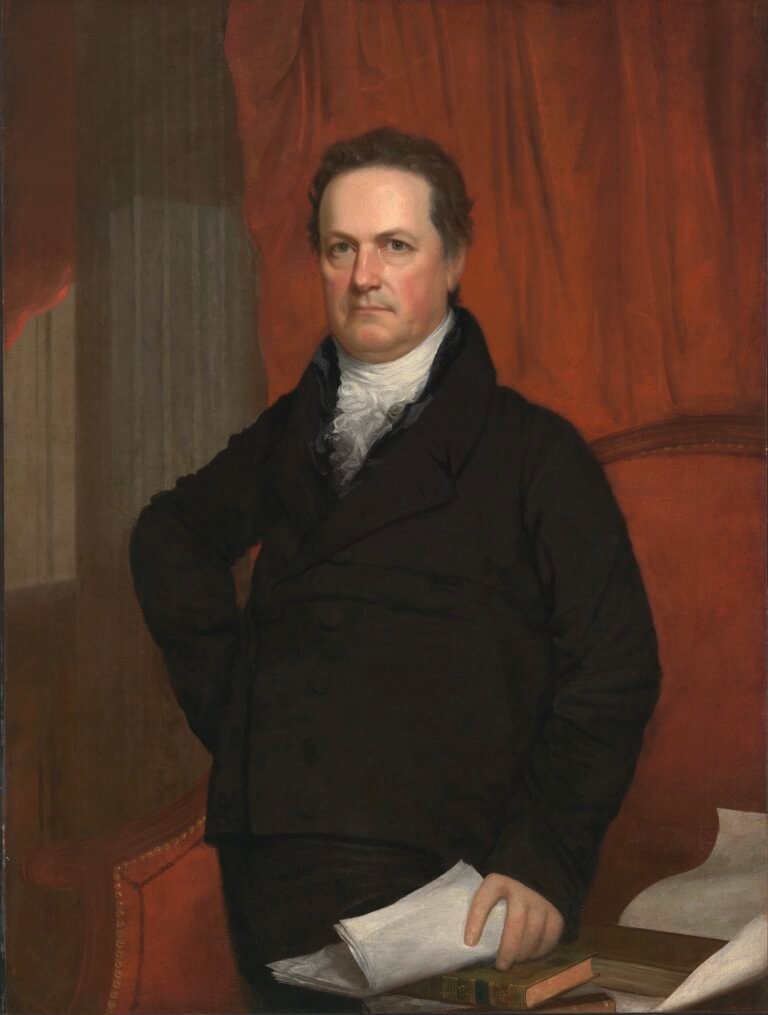
The notion of a water route to the west was old, but it took a politician with nerve to force it into being: DeWitt Clinton, the most powerful figure in New York politics for a generation. Clinton joined the state’s canal commission in 1810 and championed the project with a persistence the National Park Service credits as decisive — he was the canal’s “most persistent and effective champion.”
The first plan was to make it a national project. In 1817, a federal internal-improvements measure known as the Bonus Bill would have channeled money toward roads and canals — the Erie among them. But on March 3, 1817, his last full day in office, President James Madison vetoed it, arguing that the Constitution’s enumerated powers didn’t authorize Congress to fund such works. Federal money was off the table.
So New York decided to build it alone. In April 1817, the state legislature authorized the canal and pledged state funds to pay for it. Skeptics were merciless. The project was branded “Clinton’s Ditch” — and, when they wanted to twist the knife, “Clinton’s Folly” and “Clinton’s Big Ditch.” A governor was staking a state’s treasury, and his own career, on a trench across the frontier.
Breaking ground at Rome
Construction began on July 4, 1817, just outside Rome, New York. The Independence Day timing was no accident, and neither was the location. The builders started in the middle — the roughly ninety-mile stretch across the flat interior of the state, where, as historians put it, there were “the fewest natural impediments.” It was the section most likely to succeed, and success was what the project needed to silence its critics and keep the money flowing. Commercial traffic actually opened on the first completed segment years before the whole line was done.
The finished canal, completed in 1825 after about eight years of work, was a marvel of restraint and ambition at once:
- 363 miles long, running from Albany on the Hudson to Buffalo on Lake Erie
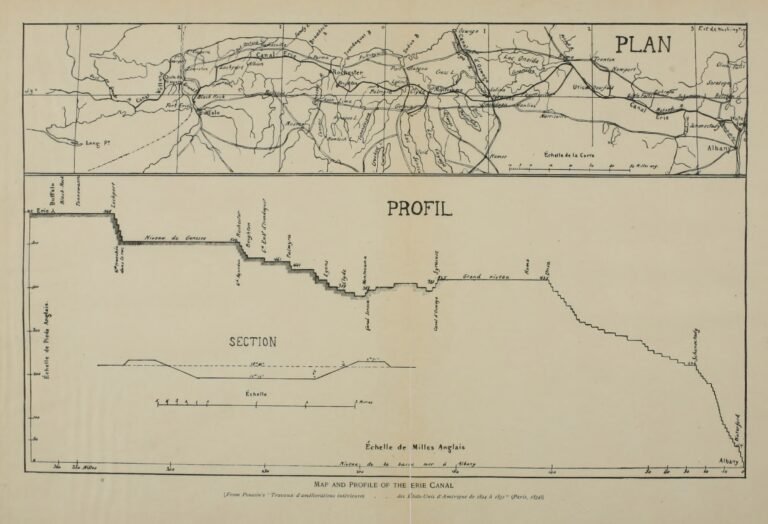
- 83 lift locks to manage the changes in elevation
- 18 aqueducts carrying the canal over rivers and ravines
- A rise of 568 feet from the Hudson to Lake Erie (one popular source cites ~600 feet — see the note below)
- Just 4 feet deep and 40 feet wide — narrow enough to seem almost modest
- Boats that could carry about 30 tons of freight
A note on the numbers. Figures vary by source and by which canal you mean. The 568-foot elevation rise comes from the specialist site eriecanal.org; History.com gives ~600 feet. We cite the more specialized figure and flag the discrepancy rather than paper over it. Also note that these are the dimensions of the original 1825 canal — later rebuilds made it far larger.
The self-taught engineers
Here is the part that still astonishes: America in 1817 had no civil engineers to speak of. There was no engineering school to hire from. The men who built the Erie Canal largely taught themselves as they went.
The chief engineers, Benjamin Wright and James Geddes, were lawyers who had “learned how to survey by prosecuting land disputes.” Their crews improvised as fast as the terrain demanded. When endless tree stumps blocked the route, Nathan Roberts designed a giant stump-puller with sixteen-foot wheels that could yank forty stumps a day, against about four by conventional means. When they needed mortar that would set underwater, they sent Canvass White to study English canals; he came home, found local limestone that produced a cheap hydraulic cement that hardened underwater, and solved one of the project’s deepest problems.
The canal became, in effect, the country’s first engineering school. The men who “began the project with an axe in their hands clearing trees” graduated from what came to be called the “Erie School of Engineering,” and went on to shape American public works for decades.
The labor was brutal and, in places, deadly. Crews cut through the malarial Montezuma marshes — where many sickened and died of what was then called “Genesee fever” — and blasted through solid rock at the Niagara Escarpment near Lockport. On the makeup of that workforce, the record is worth stating carefully: the popular image is of an all-Irish army of diggers, but the National Park Service notes that while some laborers were Irish immigrants, most were U.S.-born, with the immigrant share growing over the course of the build. History.com estimates peak labor of roughly 3,000 men a day on one section in 1818–19, with tens of thousands employed over the full construction.
A widely repeated claim that the canal was dug by “9,000 laborers, one-quarter of them Irish” could not be verified against authoritative sources and is contradicted by the figures above. We omit it rather than repeat it.
The Wedding of the Waters
When the canal was finished, New York threw one of the great celebrations of the nineteenth century.
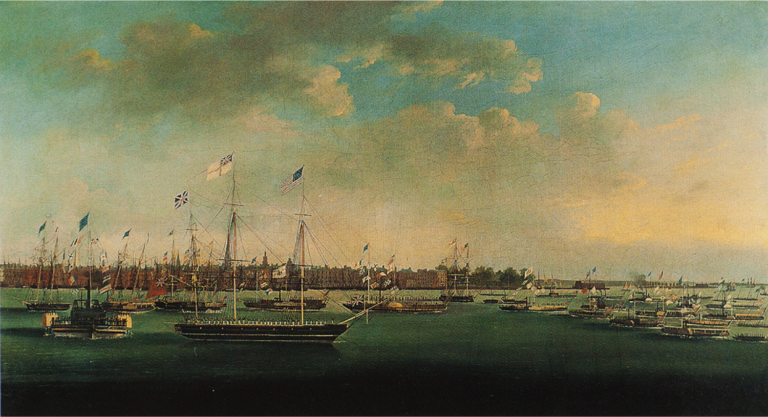
On October 26, 1825, Governor Clinton boarded a flotilla at Buffalo — led by the boat Seneca Chief — to travel the length of the canal to New York City. To announce the departure, gunners fired a relay of cannon stationed at intervals all the way down the canal and the Hudson. The signal traveled from Buffalo to New York City in about an hour and twenty-five minutes, and a return salute took roughly as long back. (Wikipedia describes it as a “90-minute cannonade”; the two figures are close, and we cite the range of ~85–90 minutes.)
The flotilla reached New York City on November 4, 1825. There, in the ceremony that gave the event its name — the “Wedding of the Waters” — Clinton poured a keg of Lake Erie water into the salt of the Atlantic, symbolically marrying the Great Lakes to the ocean.
What a ditch did
The economic effect was immediate and staggering. Before the canal, moving goods overland was so expensive that trade with the interior barely happened; the Park Service estimates the canal cut shipping costs by about 90 percent compared with hauling by wagon. The price of moving a barrel of flour, by one figure, fell from around $3 to about 75 cents. A trip from Albany to Buffalo that took a stagecoach many days could be done by packet boat in about five days.
The canal cost roughly $7 million to build (Wikipedia puts the precise figure at $7.143 million). How fast it paid for itself is one of the era’s great talking points — and the sources genuinely disagree. History.com says tolls covered construction costs within nine years; Wikipedia states that toll revenue exceeded the state’s construction debt in the very first year of operation. These claims measure different things (annual debt versus total cost), and we present both rather than force a single answer.
However you count it, the payoff was historic. New York City, with the only navigable water gateway to the American interior, rose to become the nation’s most populous city and busiest port, surpassing New Orleans, Philadelphia, and Baltimore. The canal poured settlers westward, turned frontier villages like Rochester, Syracuse, and Buffalo into cities, and earned New York its enduring nickname: the Empire State.
Not bad for a ditch.
Gallery
Sources
History.com — “Construction begins on the Erie Canal” (July 4, 1817): https://www.history.com/this-day-in-history/July-4/construction-begins-erie-canal; Erie Canal Museum, Reflections on Erie’s Waters — “DeWitt Clinton and the Erie Canal”: https://reflections.eriecanalmuseum.org/laborers-nys-employees/dewitt-clinton-and-the-erie-canal/; Erie Canalway National Heritage Corridor (NPS) — “History & Culture”: https://eriecanalway.org/learn/history-culture; Miller Center, University of Virginia — James Madison veto message on the Internal Improvements (Bonus) Bill, March 3, 1817: https://millercenter.org/the-presidency/presidential-speeches/march-3-1817-veto-message-internal-improvements-bill; History.com — “Erie Canal Construction, Engineering & Labor”: https://www.history.com/articles/erie-canal-construction-engineering-labor; eriecanal.org — canal specifications and 1825 opening: https://www.eriecanal.org/ and https://www.eriecanal.org/general-1.html; Wikipedia — “Erie Canal” (corroboration only): https://en.wikipedia.org/wiki/Erie_Canal