The Lockport Flight of Five: The Erie Canal’s Western Engineering Climax
Everything else on the Erie Canal was a matter of digging — at Lockport, they had to climb a mountain of solid rock with black powder, muscle, and a staircase made of water.
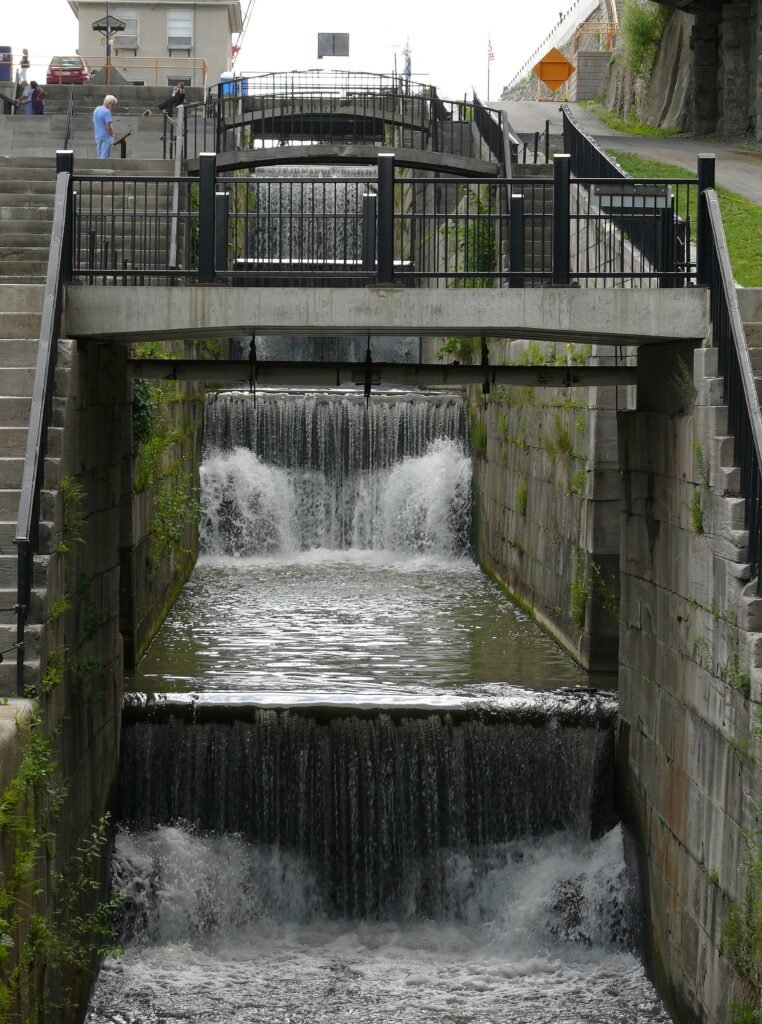
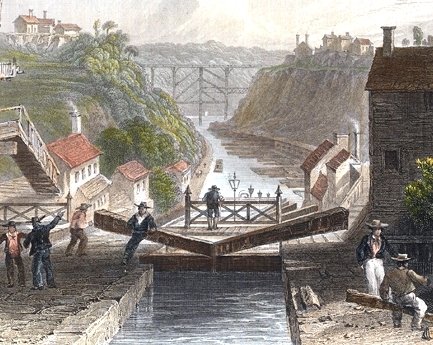
By the time the Erie Canal’s builders reached the far western end of their route in the early 1820s, they had crossed most of New York State. Then they hit the wall — literally. Between them and Lake Erie stood the Niagara Escarpment, the same rock ridge over which the Niagara River tumbles at the Falls, a natural barrier the canal had to somehow surmount. This was the single hardest problem on the entire canal, and the way they solved it became the project’s crowning engineering achievement: the Lockport Flight of Five.
A wall of rock
The escarpment presented two brutal challenges at once. First, the canal had to climb it. Sources put the rise the canal needed to overcome here at roughly 60 to 70 feet — a figure that varies because different accounts measure different things (the usable lift the locks provide versus the full height of the rock face, which some put at 75 feet or more of hard dolomitic limestone). Whatever the exact number, it dwarfed the canal’s ordinary locks, which could each raise or lower a boat only about 10 to 15 feet.
Second, west of the climb, the canal had to be carved through the escarpment to bring Lake Erie’s water eastward. This was the infamous Deep Cut — a channel gouged through solid rock toward Pendleton. Accounts of its length differ depending on what’s being counted: sources describe roughly three miles cut through solid rock, within an excavated stretch of about seven miles from Lockport to Pendleton. Its depth ran anywhere from about 12 to 30 feet, with one 1833 eyewitness diary putting the deepest sections higher still.
There was no dynamite in the 1820s. Crews blasted the rock with black powder and cracked it with fire and cold water, hauling out the debris by hand and, later, with a horse-drawn crane engineered on site to lift stone buckets sixty feet out of the cut. The work was lethal. According to History.com, dozens of workers were killed or maimed by exploding rock and falling debris, and the labor fell heavily on Irish immigrants — one account cites roughly 1,200 mostly-Irish workers, paid about $12 a month, sometimes partly in whiskey, amid tensions that erupted into a riot in 1822. (Those specific figures rest on a single source and should be treated as documented-by-one, not settled.)
The staircase made of water
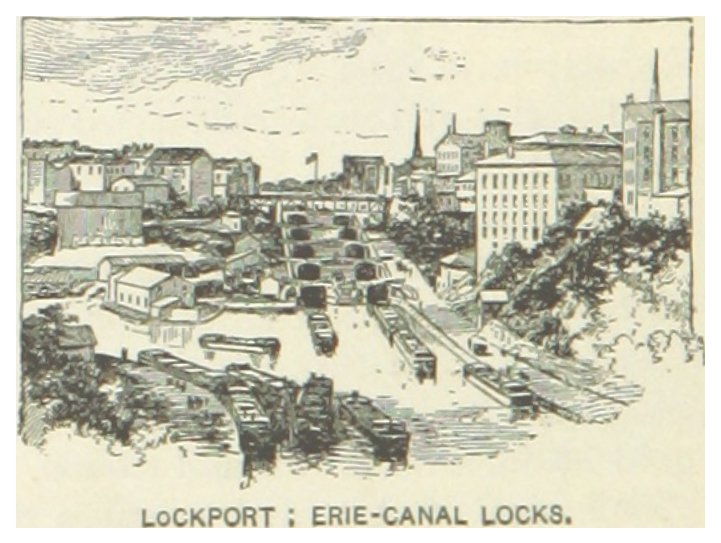
The genius of Lockport wasn’t the digging — it was the design that got boats up the cliff. New York held a competition for the solution, and it was won by Nathan S. Roberts, a former schoolteacher turned self-taught engineer. His answer: instead of one impossible lock, build a “staircase” of five locks in a row, each lifting a boat part of the way up the escarpment until, five chambers later, it emerged at the top. This is the Flight of Five.
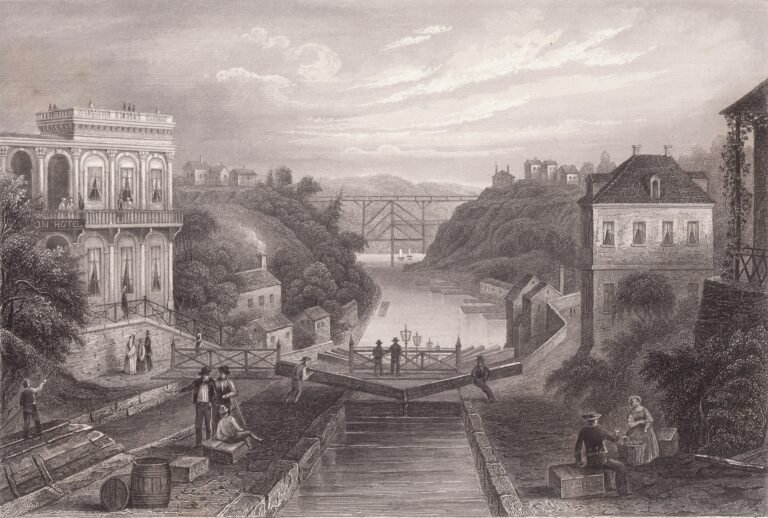
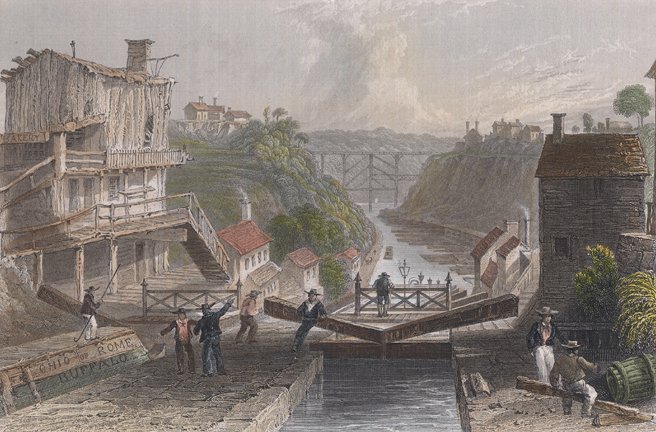
Roberts’s design had one more stroke of brilliance. He built the flight as a double set — five locks for boats heading up (west), and a parallel five for boats heading down (east) — so traffic could move both directions at once instead of waiting for a single channel to reverse. Until 1910, Lockport had two Flights of Five running side by side.
The particulars, per the specialist source eriecanal.org:
- Five combined locks in a staircase, completed in 1825 along with the rest of the original canal
- Each lock about 90 feet long by 15 feet wide, with a lift of roughly 12 feet
- A total rise of about 60 feet up the escarpment
- Historically numbered Locks 67–71 (under the enlarged-canal numbering scheme)
A note on the lift figure. You’ll see the Flight of Five’s total rise given as about 60 feet on most sources describing the original locks. But the modern replacement locks at Lockport are frequently cited at 49 feet. The gap almost certainly reflects the difference between the original five-lock flight and the two big modern locks that replaced part of it — possibly measured from different reference points. We flag it rather than silently pick one.
A settlement grew up around the great works almost overnight, and it took its name directly from them: Lockport. Contemporaries were awed — one period account called the flight “the most perfect specimen of architecture of the kind on the whole Canal.” (Whether Lockport was the single most-celebrated stretch at the grand 1825 opening is a claim we could not verify and don’t assert.)
What replaced the flight
The Erie Canal was rebuilt twice, and each rebuild reshaped Lockport. The original canal (1817–1825) gave way to the Enlarged Erie Canal (roughly 1835–1862), and then to the modern New York State Barge Canal (about 1905–1918).
During the Barge Canal reconstruction, the state removed the eastbound set of the double flight — the five locks on the southern side — and reused that space to build two huge steel locks, the modern Locks 34 and 35, completed around 1918. These two locks still do the work today, operating as a linked pair (locals describe them as working like a teeter-totter) and passing thousands of boats a season.
That left the northern set of the historic Flight of Five standing but disused — a stone relic beside a working canal. In the twenty-first century, the city undertook a partial restoration of that surviving flight. The record here needs care:
- Locks 69 and 70 were rehabilitated and reopened around 2014.
- Lock 68 was completed in 2019.
That’s three of the five historic locks restored to operating condition. Some sources compress this to “the restored locks reopened in 2014,” which understates the multi-phase reality. (A few accounts reference 2013 or 2015 milestones; those specific years appear tied to project announcements and a 2015 heritage award rather than restoration completions, so we treat them as unverified.)
Lockport today
The Flight of Five has become the anchor of Lockport’s identity as a heritage destination — described by the city as the largest intact section of the historic Erie Canal still remaining, and, per local tourism, “the only place in the country” where you can see original 19th-century locks beside a still-operating canal. Visitors can ride two-hour Lockport Locks & Erie Canal Cruises aboard double-deck paddlewheel boats and lock through the modern chambers, or descend into the Lockport Cave — a man-made hydraulic tunnel begun in 1858, now billed as “America’s longest underground boat ride,” first opened to tours in 1976.
Two pieces of local trivia are worth getting straight, because they’re easy to confuse:
- The “Upside-Down Railroad Bridge,” built in 1902, is a deck-truss span that looks like an ordinary bridge flipped over. A local legend holds it was deliberately built low to choke off canal-boat traffic and hurt the canal — but that story’s validity is explicitly uncertain, and we label it folklore, not history.
- The “Big Bridge,” built in 1914, is a different structure — one of the widest bridges in the world at roughly 399 feet wide, with a parking lot sitting on its deck.
Two centuries after Nathan Roberts sketched a staircase of water up a cliff, boats still climb the Niagara Escarpment at Lockport every summer day. The engines and the locks have changed. The wall of rock — and the audacity it took to beat it — have not.
Gallery
Sources
Discover Niagara / eriecanalway.org (NPS) — the Niagara Escarpment as the barrier the canal had to climb: https://www.discoverniagara.org/newpage62a1e013 and https://eriecanalway.org/learn/history-culture; History.com — “Erie Canal Construction, Engineering & Labor”: https://www.history.com/articles/erie-canal-construction-engineering-labor; eriecanal.org / Union College — “Making It Work”: https://www.eriecanal.org/UnionCollege/Making_It_Work-add.html; eriecanal.org — “Lockport” page: https://www.eriecanal.org/Lockport-1.html; Discover Lockport — the locks today: https://www.discoverlockport.com/thelocks; Wikipedia — “Flight of Five Locks” (corroboration only): https://en.wikipedia.org/wiki/Flight_of_Five_Locks; nyfalls.com — Lockport canal locks: https://nyfalls.com/waterfalls/lockport-canal-locks/; eriecanalway.org (NPS) — Lockport Locks reference: https://eriecanalway.org/learn/history-culture; HistoricBridges.org — Lockport “Upside-Down” railroad bridge: https://historicbridges.org/bridges/browser/?bridgebrowser=truss%2Flockportrr%2F; DCMNY / HistoricBridges.org — Lockport “Big Bridge”: https://dcmny.org/do/35f5c840-81e6-42aa-95dd-2ec805a945fc