Sylvan Beach & Oneida Lake (East)
Approx. Mile 123–140 along the Erie Canal
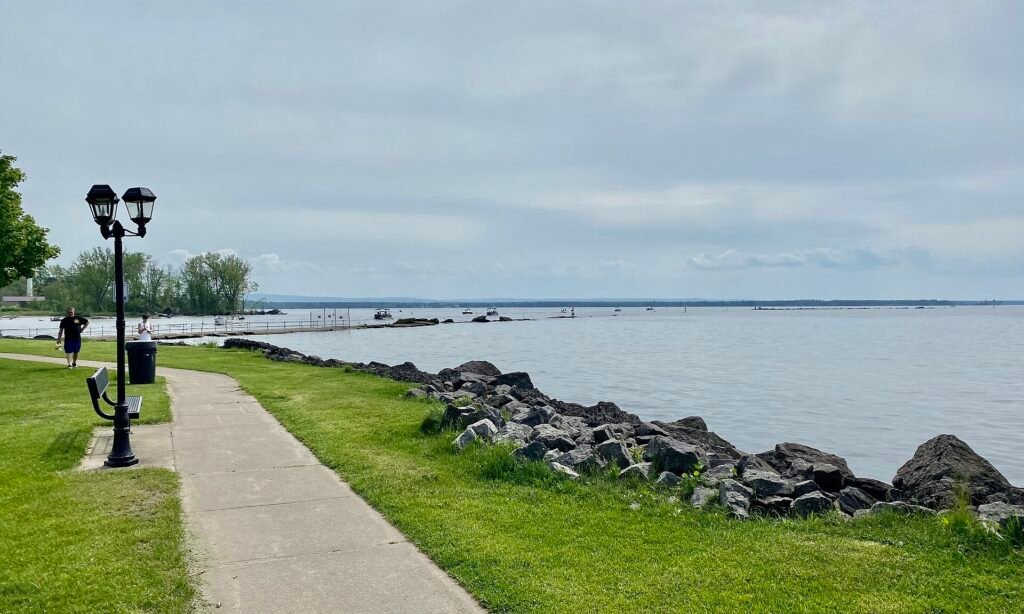
Barge Canal · 1918 — the east shore of Oneida Lake, the canal’s longest open-water reach. Which canal is this? →
Sylvan Beach sits on the eastern shore of Oneida Lake, at the mouth where the Erie Canal channel opens into big water. This is the eastern gateway to the Oneida Lake crossing — the canal's longest open-water reach — and the village wears its canal-town history on its sleeve, anchored by the historic Sylvan Beach Amusement Park, said to be among the oldest amusement parks in the country and the only one on the Erie Canal.
Coming from the east, boaters step down out of the Rome summit through two locks — Lock E21 (New London), with a lift of about 25 feet, and Lock E22 (Sylvan Beach) roughly a mile beyond it — then run past the Sylvan Beach breakwater before the lake spreads out ahead. Compact and walkable, the village clusters right at the corner of Beach and Canal, with the beach, the amusement park, and the water all a few steps apart.
Where the canal becomes a sea
Follow the Erie Canal west from Rome and something strange happens near Sylvan Beach: the channel runs out of banks. The dug ditch, the canalized river, the neat corridor of lock walls — all of it simply opens, and a boat that has spent a hundred miles between shorelines finds itself pushed out onto open water with a horizon of its own. This is Oneida Lake, and for the length of the crossing the “canal” is not a canal at all. It is the largest lake lying entirely within New York State — roughly 21 miles long and as much as 5 miles wide — and the Barge Canal, rebuilt in the early twentieth century, chose simply to use it. Rather than dig a parallel channel across the whole basin, the engineers routed the waterway in at Sylvan Beach and back out at Brewerton, letting the lake itself serve as the route.
That decision turned a beach town into a seaport in miniature. In the Barge Canal era, tugs and their strings of barges crossed Oneida Lake as an open-water leg of the trip inland, and pleasure boaters do the same today — locking down toward the lake, clearing the Sylvan Beach breakwater, and then running for the far shore across genuinely open water. It is one of the few places on the entire 360-mile system where a captain trades the certainty of canal walls for the judgment of a lake.
And Oneida Lake demands that judgment. It is big, but more to the point it is shallow — averaging only about 22 feet deep, and no more than roughly 55 at its deepest. Shallow water is nervous water: with little depth to absorb the energy, a rising wind stacks up steep, short, close-spaced waves in a hurry, and a lake that looked like glass at breakfast can be a punishing chop by afternoon. The Oneida people, by the commonly cited translation, called it something like Tsioqui — “White Water” — a name that reads today like a standing weather advisory. The practical rule for small craft has never changed: check the wind, cross early while it is calm, wear the life jacket, and be willing to sit at Sylvan Beach and wait the weather out. The lake is not the enemy. Underestimating it is.
The resort the canal built for fun
Most canal towns exist to move cargo. Sylvan Beach exists to spend a Saturday. The sandy strip on the lake’s eastern shore began drawing crowds in the 1870s, and through the 1880s and 1890s it bloomed into a full-blown resort — hotels, a bathing beach, excursion boats, and enough gaudy pleasure that boosters took to calling it “the Coney Island of Central New York.” The first amusement park here opened in 1886, and toward the end of the century a lakefront midway took shape near the water. That midway is the ancestor of today’s Sylvan Beach Amusement Park, a lakeside collection of rides and games that has been separating summer visitors from their pocket change for well over a century.
What made all of it possible was the water out front. The canal and the railroads delivered day-trippers by the thousand to a spot that, without them, was just a remote sandbar at the end of a lake. The park bills itself as the only amusement park on the Erie Canal — a nice line, and plausible, though it is the park’s own claim rather than an independently settled fact, so take the superlative in that spirit. What is not in doubt is the shape of the story: a working waterway, dug and rebuilt to haul freight over the spine of a continent, paused here long enough to build a place whose only cargo was a good time. Stand on the breakwater at dusk with the Ferris wheel lit behind you and the open lake going dark ahead, and you can see both halves of Sylvan Beach at once — the midway the canal brought to life, and the inland sea the canal had to cross to get here.
In this stretch
Places to Eat
Provisions & Shops
Things to see & do
Arriving by boat
Before anything else, check the forecast. Oneida Lake is the largest lake entirely within New York State — roughly 22 miles long, 1 to 5 miles wide, and shallow, averaging about 22 feet deep. Shallow water builds a steep, short-period chop fast when the wind comes up; the Oneida name for the lake even refers to its "white water." Local sheriff advisories have flagged hidden hazards such as submerged walls and rocks at high water. Cross early when the wind is calm, keep everyone in PFDs, and be ready to wait the weather out at Sylvan Beach rather than push into a building sea. This is open water, and it deserves to be treated that way.
Getting there, the run from Lock E21 down to the Sylvan Beach breakwater is a no-wake stretch — 4.3 knots (5 mph) — though there's no speed restriction on the lake itself. Marinas at Sylvan Beach offer docking, servicing, and fuel, and public launches ring the lake at Sylvan Beach, Godfrey Point, and Verona Beach State Park. The Cove, on the point where the canal meets the lake, adds boat rentals to the mix.
For fuel and services, a useful stop is Snug Harbour Marina at Verona Beach, near the east end of the lake — a good place to top off or pump out before or after the crossing. It offers water, a pump-out, restrooms, showers, laundry, ice, and a fuel dock with non-ethanol gas. Confirm hours, depths, and slip availability in season.
By paddle
Paddlers have easy access at the east end, with public launches at Sylvan Beach, Godfrey Point (a hard-surface ramp), and Verona Beach State Park. What paddlers should not do is treat an open Oneida Lake crossing casually — the same big-water advisory that governs powerboats applies double to a kayak or canoe. The lake builds a steep chop quickly, and the smart play is to hug the shoreline or shuttle around rather than strike out across the middle.
By car
By car, Sylvan Beach is an easy arrival: the village sits on Route 13 at the mouth of the canal, and the Sylvan Beach Amusement Park is a seasonal, drive-in landmark with lakefront parking. Nearby on the east shore, Verona Beach State Park offers a beach and camping. Launch lots serve trailer boaters too, including Godfrey Point (56 vehicles) and Oneida Shores (100 vehicles, fee).
Where to sleep
On the point where the canal meets the lake, The Cove offers 70 fully outfitted cottages — a natural base for a Sylvan Beach stay. For campers, Verona Beach State Park on the east shore has camping within easy reach of the beach and the water.
What to see
The landmark is the Sylvan Beach Amusement Park — historic, still seasonal, and billed by local tourism as the only amusement park on the Erie Canal and among the oldest in the country. Beyond the midway, the east shore stretches into more than four miles of sand beach along Oneida Lake, the largest lake lying entirely within New York State. It's the rare canal stop where an amusement park, a wide beach, and a genuine inland sea all share the same shoreline.