Lyons & Newark
Approx. Mile 220–226 along the Erie Canal
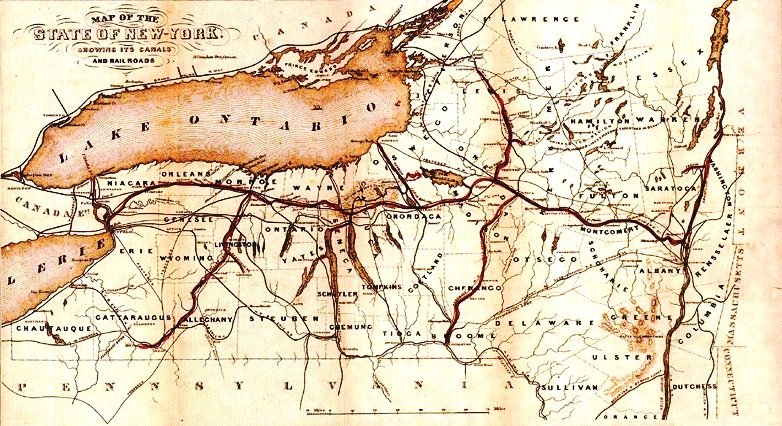
Barge Canal · 1918 — a dug land cut through Wayne County. Which canal is this? →
Lyons and Newark are twin canal villages in eastern Wayne County, both sitting directly on today's Erie Canal channel and both inside the Erie Canalway National Heritage Corridor. Lyons is the county seat, and it wears a distinctive legacy on its sleeve: this was the self-styled "Peppermint Capital," where the H.G. Hotchkiss Essential Oil Company distilled a fortune from mint after 1841. Newark, the county's most populous village, incorporated on July 21, 1853, and grew into a rose town — home to the Hoffman Clock Museum and the historic Jackson & Perkins nursery.
Three locks fall in this reach — E27 and E28A near Lyons, E28B at Newark — dropping boats through the heart of a working, lived-in stretch of canal where the towns still turn toward the water.
The story of Lyons & Newark: two fragrant empires on one water
Some towns are built on iron or grain or glass. Two villages in eastern Wayne County were built on scent — and both floated their fortunes east on the same ribbon of dug water. Here the Erie is not a canalized river but a true land cut, a channel carved through the drumlin country between the Finger Lakes and Lake Ontario, and along its banks Lyons and Newark grew into rival capitals of things that smelled wonderful.
Lyons went first, and it went to peppermint. In 1841 — the very years the state was widening Clinton’s original ditch into the Enlarged Erie — a merchant named Hiram G. Hotchkiss founded the H.G. Hotchkiss Essential Oil Company on the waterway and began buying peppermint from Wayne County farmers to distill into oil. The canal was the whole business model: a boat could carry fragile, valuable bottles of oil to New York and, from there, to the world, while a wagon could not. It worked spectacularly. By 1860 the Hotchkiss distillery reportedly produced roughly a third of all the peppermint oil made in the United States, its amber bottles wrapped in a medal-winning label that Hotchkiss displayed like a coat of arms. The trade made him rich enough, and famous enough, to be crowned “the Peppermint King,” and it gave Lyons a title the village still wears in its murals: the self-styled “Peppermint Capital.”
A few miles west, Newark answered with roses. In 1872 Albert E. Jackson and his son-in-law Charles H. Perkins founded a nursery on the canal that would become one of the most famous names in American horticulture: Jackson & Perkins. Their breeders bred a climbing rose called “Dorothy Perkins” — named for the founder’s granddaughter — and by the early twentieth century it had climbed trellises and cottage walls around the globe, a small-pink-flowered rambler that made a Wayne County village a household word among gardeners. Jackson & Perkins styled Newark the “Rose Capital of America,” and for decades its test-and-display gardens drew visitors by the thousands from June into September. The firm carried its roses onto the national stage at the 1939 New York World’s Fair, where its “Parade of Modern Roses” helped launch the mail-order rose business that put a catalog of named varieties into ordinary mailboxes.
Two towns, two empires, one water — peppermint and roses moving east on the same barges, past each other, toward the same markets. It is the kind of coincidence the canal specialized in: a dug channel through farm country that turned local specialties into national brands simply by giving them a way out.
The reach still shows the bones of the canal that made all this possible. Beside the modern chamber of Lock E28B in Newark, on North Clinton Street, stand the stranded stone walls of Enlarged Erie Lock 59 — “Upper Lockville,” a double-chambered lock of the 1840s canal, the very generation of waterway Hotchkiss shipped his first oil upon. It sits high and dry now, a masonry ghost a stone’s throw from the working canal that replaced it: the land cut you float on today is not the ditch these villages grew up beside, but a later, wider machine-age line. If the layering here confuses you, you’re in good company — which canal is this? is the right question to ask at almost every stop. At Lyons and Newark, the answer is written in stone on one bank and in peppermint and roses on the other.
In this stretch
Places to Eat
Provisions & Shops
Things to see & do
Arriving by boat
Newark hands transient boaters one of the best free walls on the whole canal. The Port of Newark / T. Spencer Knight Park (Mile ~227) is a free municipal wall with a 600-foot north wall plus a 100-foot floating dock in roughly 8 feet of water, and a 600-foot south wall in about 4 feet. The north wall has electric, and the shore side is genuinely generous: a free pump-out, free WiFi, and showers and laundry in the dockmaster's building — check in at the Chamber office upstairs. Grocery, pharmacy, and restaurants are a short walk across the bridge. There is no fuel dock here.
Upstream, the free Lyons Dock (Mile Post 220) ties boats along both the north and south sides of the canal, with 30 & 50 amp electric on both walls, water, WiFi, showers, and 24-hour video surveillance; restrooms are up the stairs at the firehouse on the north wall. Boats lie against a high concrete wall near the fire-station stairs — reviewers note the height makes stepping off awkward, so use the wall ladder. In summer the Lyons Canal Greeters welcome crews in. Nearby Miller's Marina is also in Lyons.
The three locks in the reach — E27 (~12.5 ft lift, ~MP 221), E28A (~19.5 ft lift, ~MP 222), and E28B (~12 ft lift, ~MP 226) — are free to transit with no permit. The canal runs daily from mid-May to mid-October, and each lock takes roughly 15–20 minutes. Fuel, VHF working channels, and water depths beyond the Port of Newark walls are worth a call to confirm in season.
By bike & foot
The Erie Canalway Trail / Empire State Trail runs straight through both villages. The Newark-area segment mixes off-road stonedust with on-road connections, including the shoulder of Route 31 — roughly half of the ~20-mile Newark-to-Savannah route is off-road, and the on-road stretches are best left to experienced long-distance riders. A 1.5-mile canal trail segment runs west from T. Spencer Knight Park to Stebbins Road, and trailside parking sits at the Canal Port lot.
Lyons adds its own canalway walking trail, a downtown mural tour, and a bike route that stitches the canal to the area's cobblestone heritage sites. Food and restrooms are available in each village, but not on the stretch between them, so top off before you roll.
By paddle
This reach falls within the NYS Canalway Water Trail (the Erie Rochester-to-Syracuse guidebook). Paddlers may lock through E27, E28A, and E28B, though many prefer to portage around them — confirm the launch points and each lock's portage path against the Canalway Water Trail Guidebook and NYS Canals before setting out.
By car
In Newark, park at T. Spencer Knight Park / Canal Port, or downtown near 121 High St for the library and Hoffman Clock Museum. Lock 28B sits off NY Route 31 on N. Clinton St and is drive-up viewable. In Lyons, look for canal-side parking near the Lyons Dock (MP 220) and along downtown Canal Street.
Where to eat
Lyons keeps its dining close to the water on Canal Street. Mac's Philly Steaks Diner (88 Canal St, formerly Burnham's Canalside) serves classic diner fare; Gabriel's Italian Comfort (1 Canal Street) leans Italian; and Villain Grill (20 Canal St) turns out pizza. Newark has its own downtown options — worth confirming current operators and hours in season before you count on a table.
Where to sleep
Newark carries the lodging for this reach. The Newark Garden Hotel sits on the banks of the Erie Canal with complimentary breakfast, an indoor pool, WiFi, Jacuzzi suites, and a gym. The Microtel Inn & Suites by Wyndham Newark (434 East Union St) is about a mile from Lock 28B, with free breakfast, WiFi, and a gym, and Vintage Gardens Bed & Breakfast (310 High St) offers a quieter option downtown. Cyclists and campers can point toward Whispering Winds, an 80-acre campground with 130-plus sites. Confirm rates and availability before you commit.
What to see
Newark's showpiece is the Hoffman Clock Museum, tucked inside the Newark Public Library at 121 High St — more than 500 clocks and watches, the largest collection of New York State clocks in the country, open since December 1954. It grew from the personal collection of Augustus L. Hoffman (1856–1945), a Newark jeweler and watchmaker of thirty years. Nearby, the town's rose legacy lives on through the Jackson & Perkins heritage and Perkins Park, whose test-and-display gardens once drew thousands from June through September.
The canal's own history stands exposed just off NY 31 on N. Clinton St, where Lock 28B and its 1916 powerhouse — one of the few to retain its original equipment — sit across from the remnants of the 1841 double-chamber Enlarged Erie Lock 59 ("Upper Lockville"). In Lyons, the H.G. Hotchkiss Essential Oil Company building on Water Street, now cared for by the Lyons Heritage Society, remains the enduring symbol of the peppermint era, echoed in the downtown murals — including a Hotchkiss peppermint mural — along the mural tour.