Lockport
Approx. Mile 315–321 along the Erie Canal
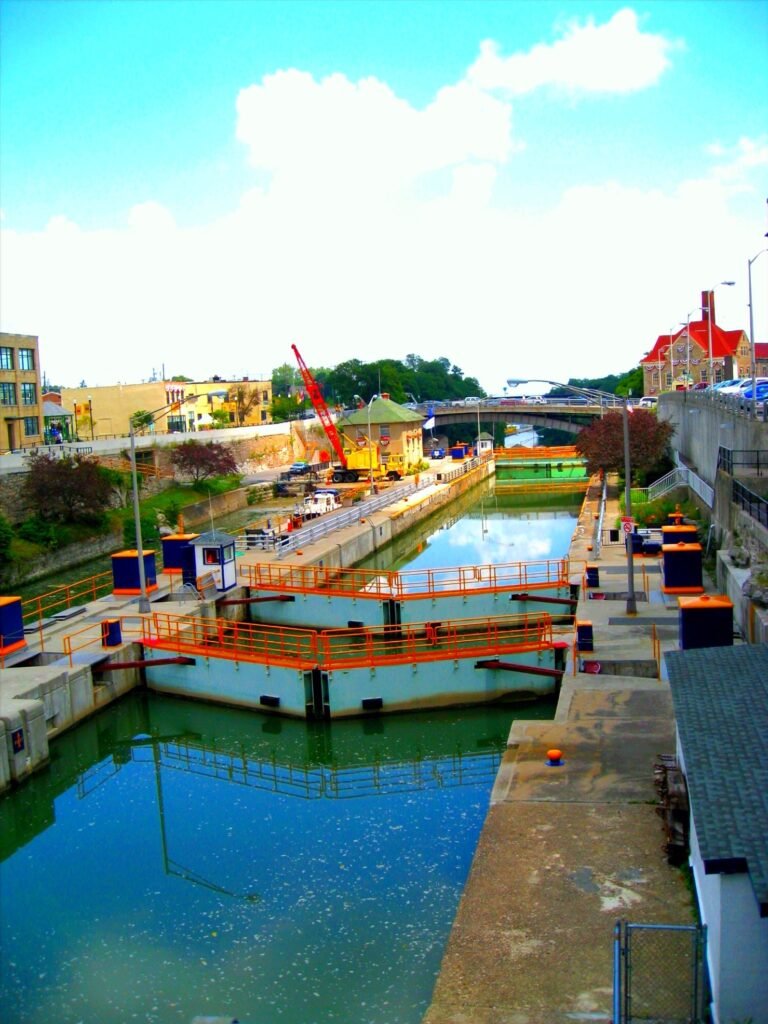
Barge Canal · 1918 — the climb over the Niagara Escarpment; the 1825 Flight of Five survives alongside. Which canal is this? →
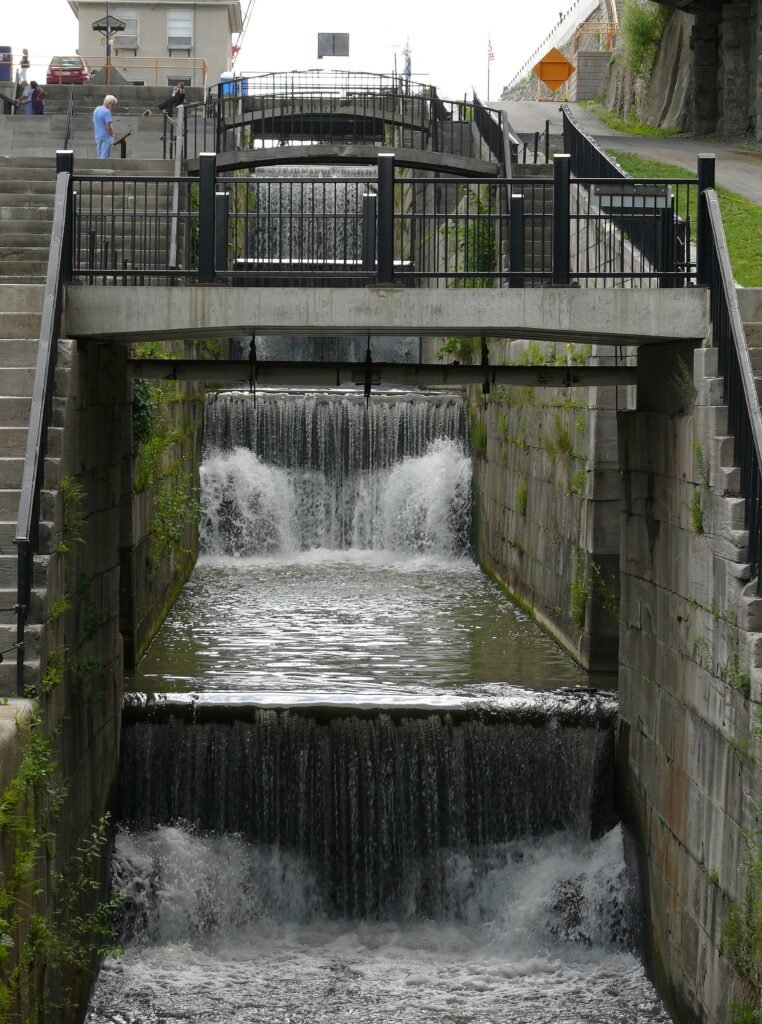
Lockport is the engineering climax of the Erie Canal. Here the 1820s builders faced their hardest problem on the entire waterway: lifting boats over the Niagara Escarpment, a hard ledge of solid rock that drops the country to the east some seventy feet. Their answer, completed in 1825, was Nathan S. Roberts' celebrated Flight of Five — a double staircase of five stepped locks, one flight for boats climbing and one for boats descending.
Today the modern double lock E34/E35 does the lifting, raising vessels the full height of the escarpment in the only double set of locks on the Erie Canal, while the restored northern chambers of the historic Flight of Five survive alongside as a spillway and living-history artifact. The result is a compact, walkable destination that packs the locks, an underground boat ride, an upside-down railroad bridge, and a canyon of blasted rock into a few downtown blocks.
Most canal towns grew up beside the water. Lockport grew up underneath it — a city that learned to steal power from a canal on its way downhill and turn borrowed water into an industrial engine. The locks that gave the place its name are only half the story. (For the great double staircase that climbs the Niagara Escarpment here, see the deep-dive on Locks E34–35 and the Flight of Five.) The other half is what happened to all that water once it had done its work of lifting boats.
Here is the physics that built the city. Water arriving at the top of the locks sits some sixty feet above the country below, and when a boat locks down, that water has to go somewhere. Rather than waste the drop, nineteenth-century Lockport captured it. Beginning in 1858, crews blasted a hydraulic raceway — a tunnel driven straight through the hard Lockport dolomite on the north side of the canal — to draw water from above the locks and send it plunging downhill through the rock. At the bottom, that falling water spun wheels and turbines. A whole row of mills and factories lined up along the escarpment to tap the “hydraulic race,” running on power that was, quite literally, the canal’s surplus. Control gates set at the tunnel’s mouth in 1858 metered the flow to the manufacturers below. Lockport had found a way to make the same water pay twice.
The man who blasted the first of those tunnels also happened to reinvent how American cities protect and heat themselves. Birdsill Holly Jr. — spelled with an i, though you will see “Birdsall” in careless print — founded the Holly Manufacturing Company in Lockport in 1859 and used the city as his proving ground. Around 1863 he built the Holly Fire Protection and Water System here: pumps, driven by water turbine or steam, that pushed water directly into a town’s mains and hydrants, doing away with the reservoirs and standpipes other cities relied on. In 1869 he patented the frost-proof fire hydrant — U.S. Patent No. 94,749 — the ancestor of nearly every hydrant standing on an American curb today. Then, in 1877, Holly did it again, patenting a district steam-heating system that replaced a neighborhood’s individual boilers with steam piped from one central plant. Modern urban firefighting and central heating were, in a real sense, both field-tested on the streets of Lockport.
You can still ride through Holly’s century. The Lockport Cave and Underground Boat Ride is not a natural cavern at all but a stretch of that man-made hydraulic raceway — a water-power tunnel blasted out of solid rock and expanded between 1858 and 1900, once used to drive local industry and now partly flooded, so that visitors glide by boat through the passage the mills once ran on. It is a rare thing: a working piece of industrial plumbing turned into an attraction, the borrowed-water economy made visitable.
Downtown, one more Lockport superlative spans the canal. The Big Bridge, built in 1914 where Main Street crosses the waterway, is broad enough that most people cross it without realizing it is a bridge at all. Historical markers here bill it as “one of the widest bridges in the world” — 399 feet wide against just 129 feet long — and when it was built it was reported to be the widest anywhere. Treat the world title as the proud local claim it is; the dimensions, at least, are on the marker. Wide, low, and easy to miss, the Big Bridge is a fitting monument to a city that made its fortune sideways — on the water it never quite let go of, dropping through the rock beneath the boats.
In this stretch
Places to Eat
Provisions & Shops
Things to see & do
Arriving by boat
Locking through Lockport is the marquee experience on the western canal. Boaters transit the modern double lock E34/E35 — a paired chamber with a combined lift of roughly 49 feet, the biggest single climb anywhere on the Erie Canal. The two chambers work as a staircase and allow two-way traffic; transiting New York's canal locks is free, with no permit required. Restored historic Flight of Five chambers stand immediately alongside as a spillway, so you climb the escarpment beside the very locks the 1825 builders cut into the rock.
For tie-ups and fuel, Wide Waters Marina — the Nelson C. Goehle Public Marina, near Mile 319 — has about 42 floating-dock slips, roughly ten of them transient, at $2.00 per foot daily. It is a genuine fuel stop: 87-octane non-ethanol gasoline is available on-site (call ahead for the current price). Shore power runs around 15 amps and up; reconfirm amperage in season. Pumpout availability, channel depth, and a monitored VHF working channel for Lockport were not confirmed for this guide — confirm in season with the NYS Canal Corporation or Waterway Guide before you rely on them.
By bike & foot
The Erie Canalway Trail, carried here by the Empire State Trail, runs directly through Lockport. From the Five Locks park in the city, a roughly 12-mile stonedust segment heads east along the north side of the canal through farmland to Middleport; a separate segment approaches from the southwest by way of Amherst. The surface is off-road stonedust, comfortable for cyclists and walkers of all abilities.
The Locks District itself is compact and highly walkable. Riley's Way is a 16-stop self-guided walking tour, and 45-minute Lock Tender walking tours run June through September for $15 per adult.
By paddle
Lockport sits on the NYS Canalway Water Trail, the 450-mile paddling route with more than 140 access sites. Wide Waters Marina offers a boat launch with no charge for canoes or kayaks, plus kayak rentals on-site.
One caution for paddlers: the canal through Lockport is a deep, narrow rock cut, and the E34/E35 lock structures make self-portaging non-trivial. Confirm the marked portage route in the Canalway Water Trail Guidebook before you commit to paddling through.
By car
Lockport rewards drivers, because everything clusters within a few walkable downtown blocks. The locks, the cruise dock at 210 Market Street, Lockport Cave at 5 Gooding Street, and the Erie Canal Discovery Center all sit within easy reach of one another. From the same compact core you can take in drive-up views of the locks, the blasted-rock Deep Cut, and the distinctive Upside-Down railroad bridge.
Where to eat
Lockport's dining leans casual and canal-adjacent. Lock 34 Bar & Grill sits right by the water, and the New York Beer Project is a large gastropub with craft beer, multiple bars, fire pits, and outdoor seating. Shamus Restaurant and One-Eyed Jack's round out the list of frequently cited local favorites. Confirm hours and addresses before you plan around them.
Where to sleep
The Lockport Hotel is a downtown boutique property with 95 individually furnished rooms and free WiFi. Best Western Plus Lockport sits minutes from Locks 34/35 and adds an indoor pool, breakfast, and a fitness center, while the Lockport Inn and Suites is a classic roadside value option near the locks. All three are bookable through the major online travel agencies.
What to see
The Flight of Five is the headliner: restored 1825-era stepped locks, the northern flight preserved as a working spillway beside the modern E34/E35. To see them in motion, book Lockport Locks & Erie Canal Cruises — a two-hour narrated trip that locks through the double chamber, passing beneath lift bridges and alongside the Flight of Five spillway (210 Market Street; $21.50 adults, $11 children; seasonal, roughly May–October).
Underground, the Lockport Cave & Underground Boat Ride travels a roughly 1,600-foot man-made hydraulic tunnel dating to the 1800s, billed as America's longest underground boat ride (5 Gooding Street; $27.55 adults, $18.42 youth 6–14, $7.35 age 5 and under; open roughly May–October, 10am–4pm). Ashore, the Erie Canal Discovery Center anchors the story with a large mural and a simulated lock experience, and the free Locks District Museum is open daily in season.
Don't miss the Upside-Down railroad bridge, a 1902 King Bridge Company deck-truss span that reads like an inverted through-truss, or the Deep Cut — the canyon of rock blasted through the escarpment to carry the canal west.
Local history
In pictures