The Erie Canal at 200: What the 2025 Bicentennial Celebrated
In 2025, New York spent the better part of a year marking two centuries since a hand-dug ditch remade the nation — capped by a global canal summit in Buffalo and a full-size replica boat that retraced DeWitt Clinton's 1825 voyage from Lake Erie to the Atlantic.
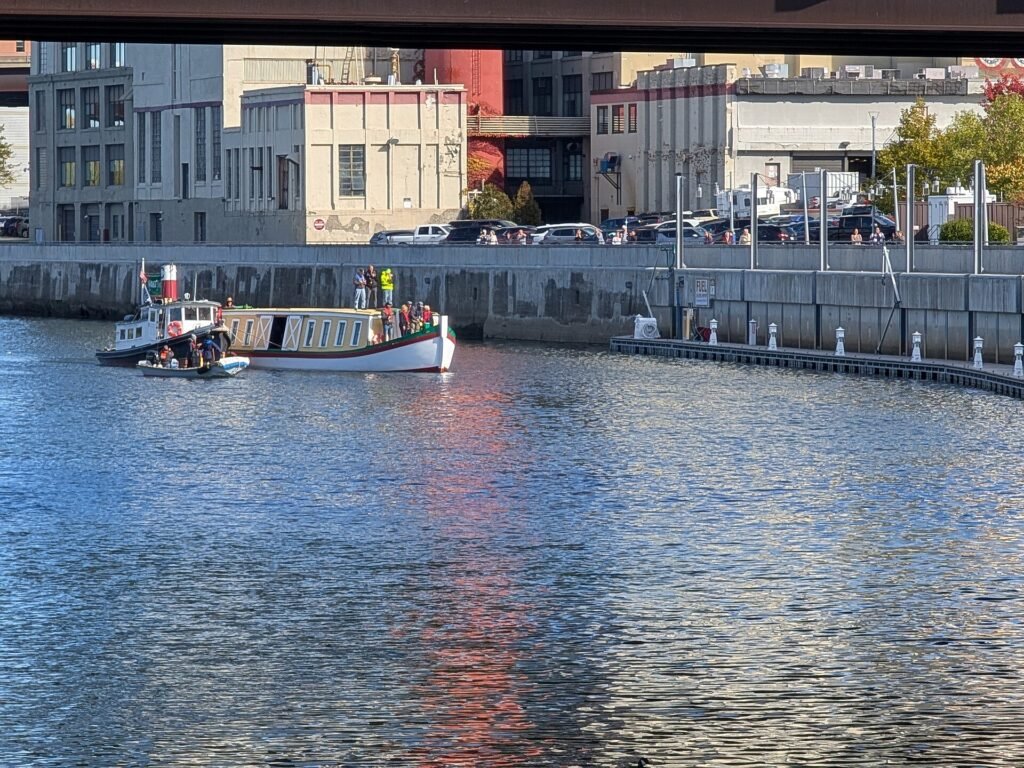
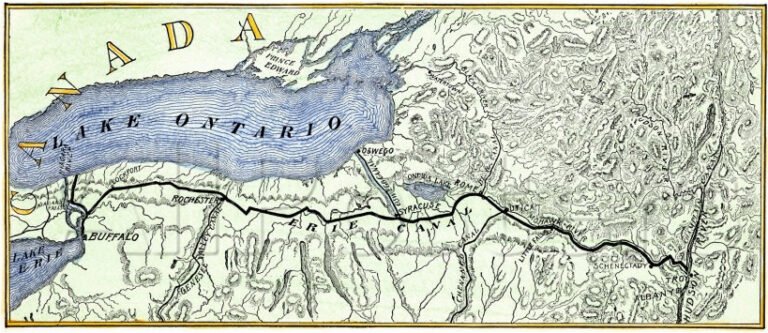
On the morning of October 26, 1825, Governor DeWitt Clinton climbed aboard a packet boat at Buffalo and pointed it east. Ahead lay 363 miles of freshly dug canal — the original Erie Canal, four feet deep and derided for years as “Clinton’s Ditch” — and beyond it the Hudson and the sea. The boat was named Seneca Chief. To announce its departure, gunners fired a relay of cannon stationed all the way down the line, carrying the news from Lake Erie to New York City in roughly an hour and a half. When Clinton finally reached the harbor days later, he poured a keg of Lake Erie water into the Atlantic and called it the “Wedding of the Waters.”
Two hundred years later, almost to the day, another boat named Seneca Chief made the same trip.
A bicentennial, not a birthday party
The number itself is worth pausing on. The Erie Canal opened in 1825, which made 2025 its bicentennial — and, as the state was quick to point out, the canal is no museum piece. New York counted 2025 as the 201st consecutive season of navigation on the canal system: the waterway a boater locks through today has been carrying traffic every year for two centuries, even if it is no longer the shallow ditch of Clinton’s era. (The canal you cruise now is largely the machine-age New York State Barge Canal, rebuilt into the rivers themselves in the early 1900s — a common and forgivable confusion the bicentennial gave New York a chance to untangle.)
Rather than stage a single ceremony, the state spread the commemoration across the whole 200-year arc. Governor Kathy Hochul had announced an Erie Canal Bicentennial Commission to lead the effort, co-chaired by Canal Corporation Director Brian U. Stratton and First Gentleman Bill Hochul. Its charge was broad: community events, capital investment in the aging canal infrastructure, and — notably — a mandate to tell “the diverse stories” of the waterway, including the ones earlier generations had skipped. At Buffalo’s historic waterfront, a four-month run of programming stretched across the summer of 2025, and the corridor from Albany to Buffalo filled with concerts, festivals, and theater through the season. Two events, though, became the year’s anchors.
The world came to Buffalo
The first was the 2025 World Canals Conference, held in Buffalo from September 21 to 25, 2025. The gathering is the marquee event of the global inland-waterways community, and its arrival in Buffalo — the canal’s western terminus, the city the canal arguably invented — was a deliberate piece of symbolism. Delegates and speakers came from eight countries: Canada, China, England, France, Germany, India, Scotland, and the United States, trading ideas about what canals built for nineteenth-century freight should become in the twenty-first century.
That question hangs over every working canal on earth, and the Erie is an unusually instructive case. It was rendered commercially obsolete by railroads and trucks, nearly abandoned, and then reborn as a recreational corridor — a 360-mile ribbon for boaters, cyclists, and paddlers. For a conference wrestling with the future of waterways, the host had already lived the whole cautionary-and-hopeful cycle. Buffalo, once the boomtown where lake grain met canal boats, opened the conference with free family programming at Canalside, the reclaimed harbor district built on the very slip where the canal used to end. (You can trace that whole arc through our Buffalo section.)
The boat that took five years to build and 33 days to sail
The second anchor floated. Inside a purpose-built shed called the Longshed at Canalside, roughly 200 volunteers and students spent nearly four years — from October 2020 through June 2024 — building a full-scale wooden replica of the Seneca Chief, the boat that had carried Clinton in 1825. They built it in full public view, the largest project of its kind, a piece of nineteenth-century boatbuilding reconstructed in plain sight of anyone who wandered down to the water.
On Wednesday, September 24, 2025 — during the World Canals Conference, so the assembled delegates could watch it go — the replica pushed off from Buffalo’s Commercial Slip and began retracing Clinton’s route. The 33-day voyage ran about 500 miles down the canal and the Hudson, with the crew of Buffalo Maritime Center staff and volunteers docking at 28 communities along the way. On October 26, 2025 — two centuries to the day after the original Seneca Chief set out from Buffalo — the replica pulled into Pier 26 at Hudson River Park in Manhattan. By the state’s count, some 20,000 people turned out to see the boat across its journey.
A wedding, reconsidered
The ending is where the bicentennial showed what two hundred years of hindsight can do to a founding story.
In 1825, the ceremony was a marriage: Clinton poured Lake Erie into the Atlantic, wedding the Great Lakes to the ocean and, by extension, the frontier to the world. In 2025, the organizers reached for a gentler and more inclusive image. At each of the 28 stops, the community added water from its own stretch of the canal or the Hudson to a traveling cask aboard the boat — a “Gathering of the Waters” rather than a wedding of them. When the Seneca Chief reached New York City, that commingled water was used not to be poured into the sea but to nourish a newly planted tree.
The trees mattered. Along the route, organizers planted Eastern White Pines — the Great Tree of Peace in Haudenosaunee tradition — in a gesture that openly acknowledged what the original celebration had erased: that the canal was dug across Haudenosaunee homelands, and that the waterway which enriched New York also displaced the people who had lived along its path. At the final planting, the children of Indigenous scholar Melissa Parker Leonard watered the tree with water gathered from across the state. It was the same symbolic act as 1825 — uniting the waters of New York — rebuilt to hold a fuller version of the truth.
Why 200 years still matters
It would be easy to file the bicentennial under nostalgia — a state throwing itself a party for a ditch. But the celebration kept circling back to a genuinely live argument: what is a two-hundred-year-old canal for?
The 1825 canal answered a question about commerce. It cut the cost of moving goods from the interior by roughly ninety percent, turned New York City into the nation’s premier port, and pulled Rochester, Syracuse, and Buffalo up out of the frontier. That work is done; freight moved to rails and interstates generations ago. The 2025 canal answers a different question — about recreation, heritage, and the economies of the towns still strung along the towpath — and the bicentennial was, in part, an argument that this second life is worth investing in. The World Canals Conference framed it as strategy; the Seneca Chief framed it as story. Both were making the same case: that a waterway can outlive its original purpose and still be worth keeping.
Not bad, two hundred years on, for a ditch.
Want the founding story the bicentennial commemorated? Start with how the Erie Canal was built — and the difference between the 1825 ditch and the canal you can boat today.
Sources
NYS Canals — “Bicentennial” (canals.ny.gov/Bicentennial): 2025 bicentennial, celebration “throughout 2025,” World Canals Conference Sept 21–25 Buffalo, Seneca Chief retracing the 1825 route with 28 community stops. • Governor Kathy Hochul press office (governor.ny.gov): Erie Canal Bicentennial Commission (co-chairs Canal Corp. Director Brian U. Stratton and First Gentleman Bill Hochul); 2025 as the 201st consecutive navigation season; bicentennial of the Oct 26, 1825 opening; corridor-wide events; commencement of the 2025 World Canals Conference. • ECHDC / Empire State Development (esd.ny.gov): four-month Buffalo-waterfront calendar of events (summer 2025). • New York Almanack — “2025 World Canals Conference in Buffalo September 21–25” (Sept 2025) and “Replica Erie Canal Boat ‘Seneca Chief’ Completes Bicentennial Journey” (Oct 2025): eight participating countries; 33-day voyage; 28 stops; ~20,000 attendees; built by 200+ volunteers over five years; departure Buffalo Commercial Slip Sept 24, 2025; arrival Pier 26, Hudson River Park, Oct 26, 2025; “Gathering of the Waters” barrel; Eastern White Pine (Great Tree of Peace) plantings; Melissa Parker Leonard’s children watering the final tree. • Buffalo Maritime Center — “2025 Bicentennial Voyage” (buffalomaritimecenter.org): departure Sept 24, 2025 from Commercial Slip; 33-day voyage; 28 ports; arrival Pier 26; gathered water used to nourish the final tree. • I LOVE NY — “Statewide Itinerary & Programming for Erie Canal Bicentennial Voyage Announced” (iloveny.com): full-scale replica built by ~200 volunteers/students Oct 2020–June 2024 in the Longshed at Canalside; ~500 miles; departure Sept 24, 2025; NYC arrival Oct 25–26, 2025 marking 200 years since the 1825 opening voyage. • 1825 baseline facts (Oct 26, 1825 Buffalo departure, cannon relay, “Wedding of the Waters,” 363-mi/4-ft original canal, ~90% freight-cost drop) cross-referenced to the site’s own “Clinton’s Ditch” feature and its cited sources (eriecanal.org; eriecanalway.org/learn/history-culture; history.com).