The Barge Canal: The Machine-Age Erie You Actually Boat On
The canal you cruise today isn’t Clinton’s Ditch — it’s a third, twentieth-century Erie that stopped digging around the rivers and simply swallowed them whole.
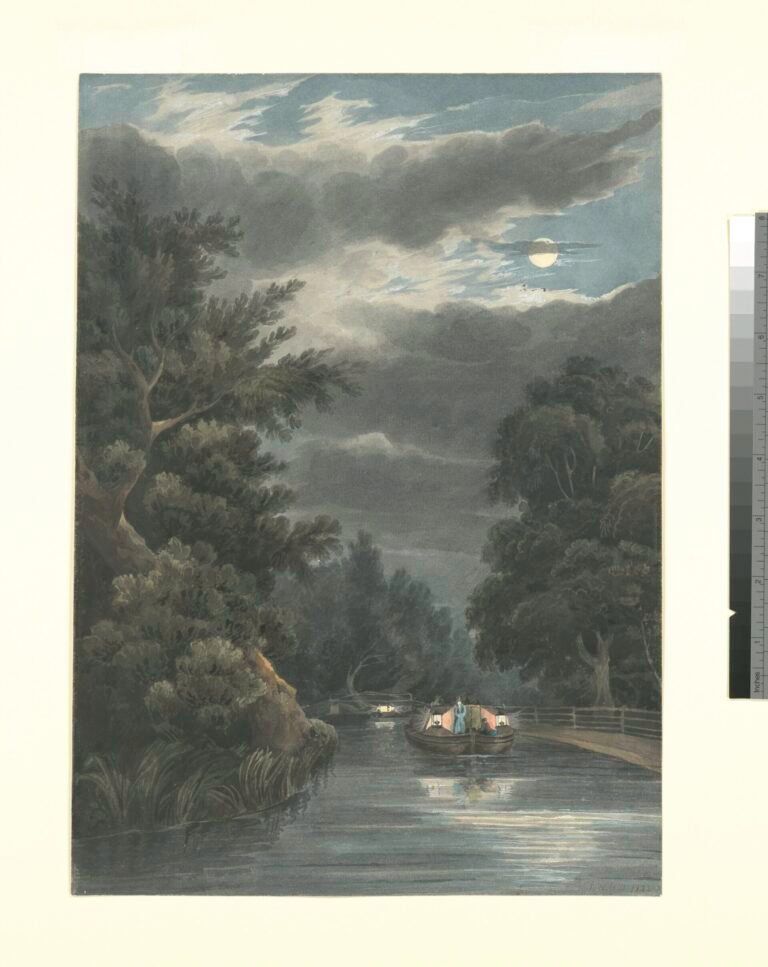
Here is the fact that undoes most people’s picture of the Erie Canal: the waterway you glide along today is not the one DeWitt Clinton opened in 1825. It is not even the enlarged version that followed. The canal you actually boat on is a third Erie — a machine-age rebuild finished in 1918 — and its engineers did something the first builders would have found almost unthinkable. Instead of digging a separate ditch to keep boats safely away from the wild rivers of upstate New York, they turned around and put the boats into the rivers.
The vote that rebuilt a canal
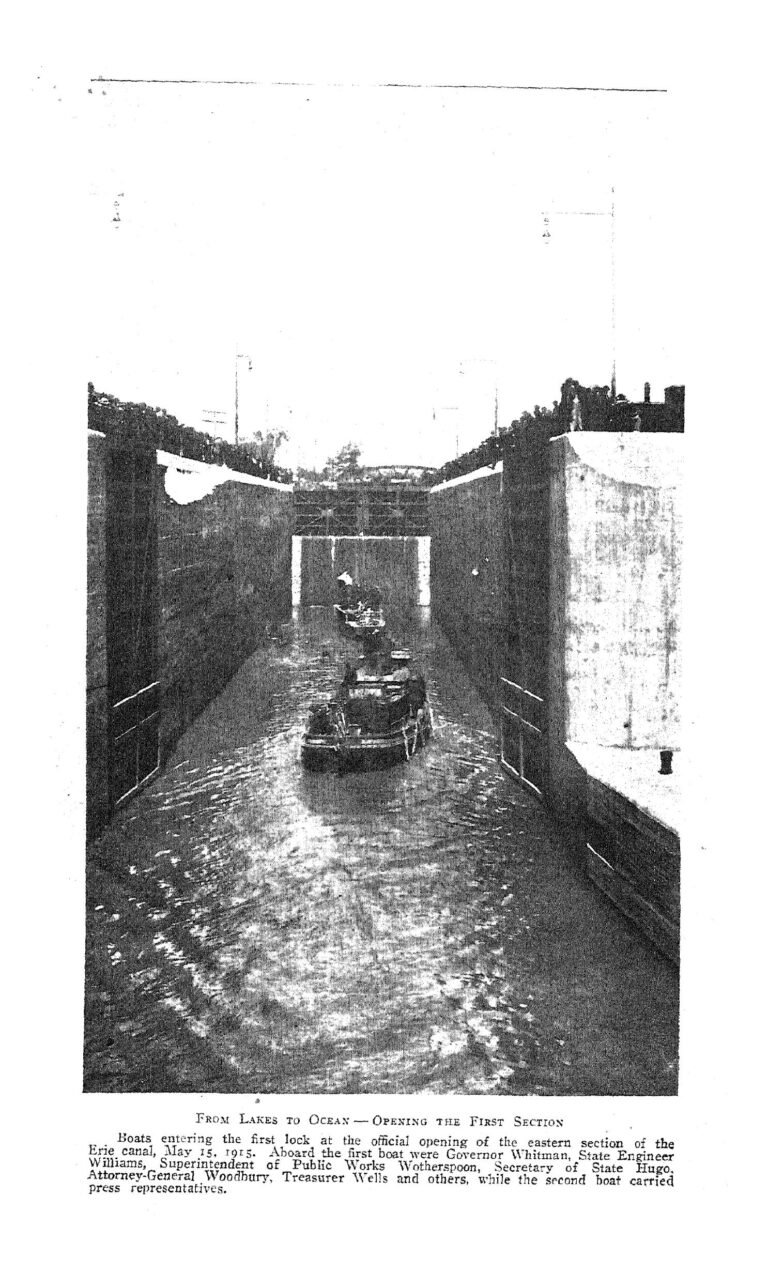
By the turn of the twentieth century, Clinton’s hand-dug ditch — four feet deep, sized for thirty-ton boats hauled by mules — was hopelessly outclassed. Railroads had already siphoned off much of its freight, and the canal that once made New York the Empire State looked like a relic. The state’s answer was not to patch it but to replace it. In 1903, New York voters approved a referendum authorizing a wholesale reconstruction, the New York State Barge Canal, at an authorized cost of roughly $101 million. Construction ran from 1905 to 1918, and the numbers wandered upward the way big public works always do: the specialist site eriecanal.org puts the construction figure near $96.7 million, while the state’s own histories note the total eventually climbed to around $170 million. Call it, honestly, a $100-million-plus rebuild — the exact tally depends on what you count. The canal opened to through traffic on May 15, 1918.
The radical idea: canalize the rivers
The original Erie was, above all, a channel that avoided rivers. Rivers flooded, froze, ran dry, and threw ice; a mule-drawn boat on a four-foot ditch wanted nothing to do with them. The Barge Canal’s engineers reversed the whole philosophy. Rather than dig a new trench across the state, they canalized the rivers themselves — the Mohawk, the Oswego, the Seneca, the Clyde, and the Oneida among them — damming each into a staircase of deep, still pools and running the barges right down the middle. Where the original canal had gone out of its way to bypass water, the new one embraced it. In long stretches between Waterford and Rome, the “Erie Canal” is simply the Mohawk River, held at navigable depth behind a dam. A boat now travels on the very water the first canal was dug to escape.
That change bypassed things, too. By following the river valleys, the Barge Canal left several cities that the old towpath had run straight through — Syracuse and Rochester among them — sitting off to one side of the new route.
The machinery: big electric locks and dams that vanish each winter
Canalizing a river means controlling it, and the Barge Canal’s hardware is where the machine age announces itself. To step boats up and down between the river pools, engineers built a system of large electrically operated locks, each chamber about 328 feet long and 45 feet wide with a navigable depth near twelve feet — cavernous compared with the original locks, and sized for self-powered steel barges of up to roughly 2,000 tons. (A word on that figure: you’ll see “3,000 tons” in some accounts, including eriecanal.org’s specification page, but the widely corrected and better-supported capacity for the standard Barge Canal vessel is about 2,000 tons. We flag the conflict rather than bury it.) Many of these locks draw their power from hydro plants at the very dams that create their pools.
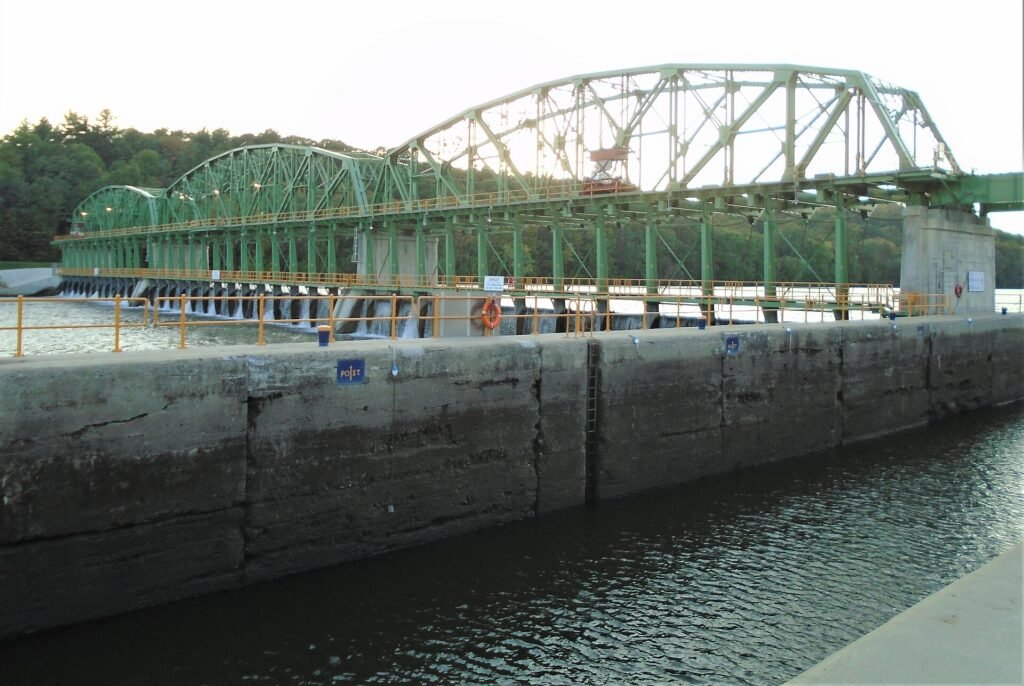
The most beautiful piece of engineering, though, is the one that disappears. Along the Mohawk, the state built movable “bridge dams” — steel gates suspended from overhead trusses that can be lowered in the boating season to hold the river placid and lifted out entirely each winter, so the freed Mohawk can run high and flush its ice downstream without tearing the structures apart. It is a dam that knows better than to stand and fight the spring thaw. East of Rome, the river and canal carry a mix of permanent and seasonal dams — a handful of the movable kind that lift away every autumn — alongside guard gates that can drop across the channel to seal off a section in an emergency or a flood. The whole system is a study in respecting the river while still using it.
From freight highway to front-porch waterway
For a while it worked as designed. The Barge Canal turned a mule-and-towpath ditch into a genuine inland shipping lane for self-propelled steel barges — a river navigation, not a hand-dug trench. But the twentieth century was unkind to canals. Trucks took the short-haul freight; the railroads had already taken much of the rest; and when the St. Lawrence Seaway opened in 1959, ocean-going ships could reach the Great Lakes without touching New York at all. Commercial tonnage on the canal, already fading, fell away. It is worth being careful here: the Seaway is often blamed for finishing the canal, but historians note the Erie had been losing ground to railroads for decades before 1959 — the Seaway was a late blow, not the first.
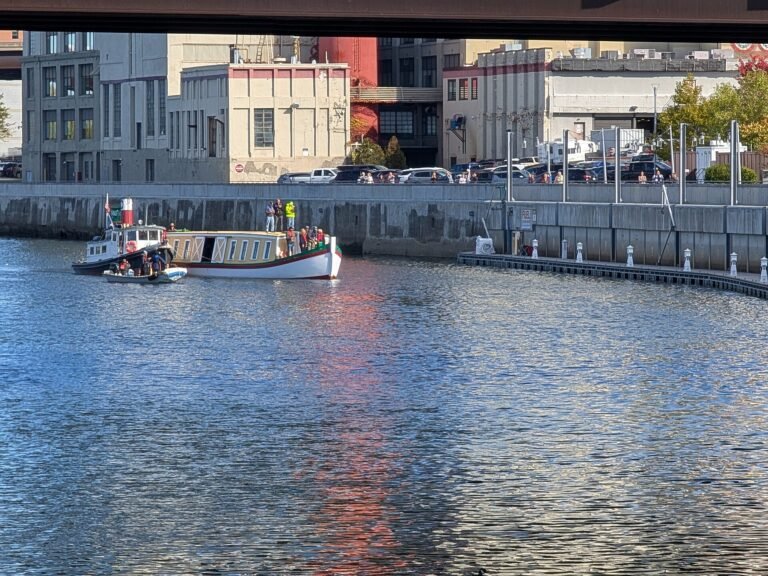
What the canal became instead is what you find on it today: one of the finest recreational waterways in the country, a 500-mile ribbon of pleasure boats, kayaks, cyclists on the towpath, and canal-town main streets. New York made the shift official in 1992, retiring the “Barge Canal” name and rechristening the whole network the New York State Canal System.
Where to see the machine age
The Barge Canal is not a museum piece; it’s working infrastructure you can walk up to. Watch the movable bridge dams along the Mohawk in the Schenectady–Amsterdam corridor — and time a spring visit to see the gates lifted and the river running free. Lock through one of the big steel electric locks to feel the scale the freight barges once needed. Stand at the Waterford Flight, where five 1915 Barge Canal locks hoist a boat some 169 feet in a mile and a half — the single most concentrated dose of machine-age canal engineering anywhere on the system. And at the Utica Harbor Lock, you can see how the twentieth-century canal tied its river pools to a working port. It’s all still here, still lifting boats, still lowering its dams each spring — the Erie you actually boat on.
Not sure which Erie you’re looking at? Start with our explainer: Which Canal Is This?
Gallery
Sources
Referendum 1903, construction 1905–1918, cost ~$96.7M, locks 328×45 ft, 12-ft draft, ~2,000-ton vessels, river canalization (Mohawk/Oswego/Seneca/Clyde), bypass of Syracuse/Rochester, opened May 15 1918, “no longer known by that name since 1992”: Wikipedia — “New York State Barge Canal” (https://en.wikipedia.org/wiki/New_York_State_Barge_Canal) and eriecanal.org (https://www.eriecanal.org/). Conflicting tonnage (eriecanal.org states “up to 3,000 tons”; ~2,000 tons is the corrected/standard figure per Wikipedia) — conflict surfaced, not resolved. Authorized ~$101M and final ~$170M cost: Consider The Source NY — “1918 The Barge Canal” (https://considerthesourceny.org/using-primary-sources/erie-canal-time-machine/1918-barge-canal). Movable “bridge dams” suspended from overhead trusses, lowered in season and lifted each winter to pass ice; permanent + seasonal/movable dams and hydropower east of Rome; electric locks powered from adjacent dams: American Canal Society — “Bridge Dams on the NYS Barge Canal” (https://americancanalsociety.org/bridge-dams-mohawk-river-barge-canal/) and New York Almanack — “Bridge Dams on the Mohawk River” (https://www.newyorkalmanack.com/2019/10/bridge-dams-on-the-mohawk-river/). St. Lawrence Seaway opened 1959 and commercial-traffic decline; railroads had already supplanted the canal before 1959 (nuance surfaced): Wikipedia — “New York State Canal System” (https://en.wikipedia.org/wiki/New_York_State_Canal_System) and “St. Lawrence Seaway” (https://en.wikipedia.org/wiki/St._Lawrence_Seaway). Renamed New York State Canal System 1992: Wikipedia — “New York State Canal System.” Waterford Flight (five 1915 locks, ~169 ft in ~1.5 mi): batch1-marquee-locks research brief; NYS Open Data — Canal System Locks (ta83-js48). Not to be confused with the 1825 canal — see the companion feature “Clinton’s Ditch: How the Erie Canal Was Built.”