The Packet Boat and the Westward Flood
How a nation moved west four miles an hour — aboard the cramped, silver-plated, foul-aired floating hotels of the Erie Canal, and the immigrant flood that rode the cheaper boats behind them.
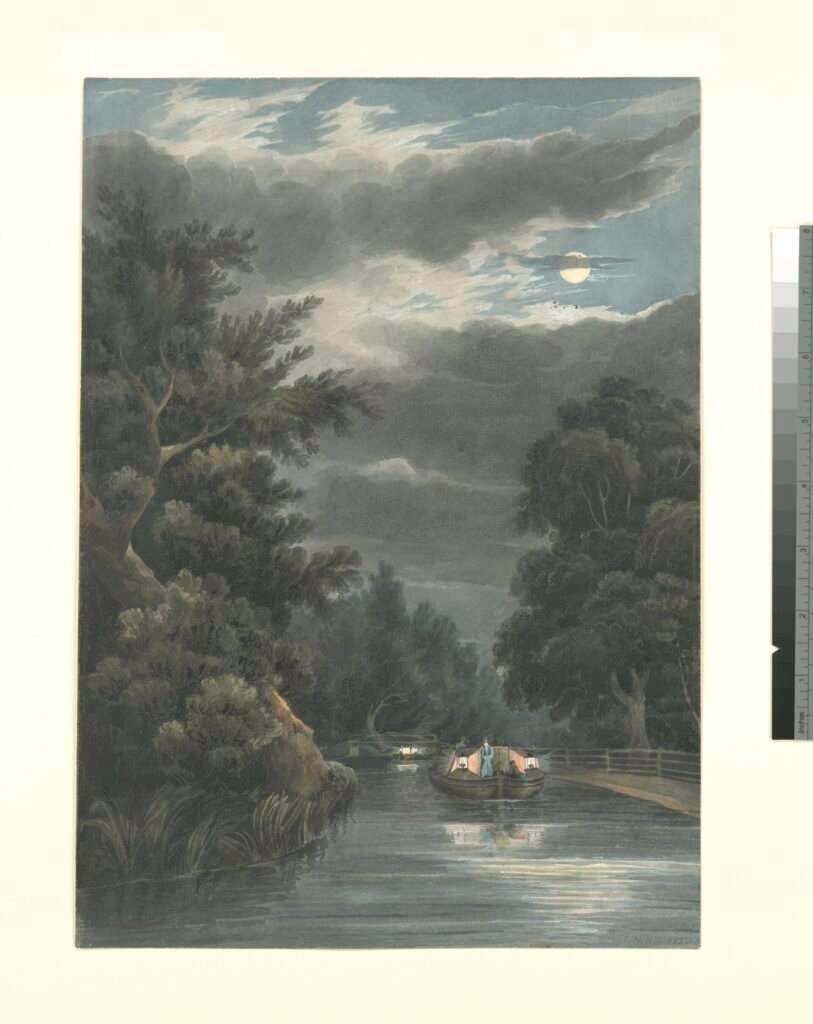
Sometime around 1836, a young Englishman named Thomas S. Woodcock climbed onto a packet boat at Schenectady and started keeping notes. What he recorded is the closest thing we have to a passenger’s-eye view of the Erie Canal at the height of its passenger era — a world of silver-plate captains, foul night air, and the peculiar art of sleeping seventy strangers in a space the size of a modern rail car. “The Table,” he wrote approvingly of packet dining, was “supplied with every thing that is necessary and of the best quality with many of the luxuries of life.” The berths were another matter. “The first Night I tried an upper berth,” he admitted, “but the air was so foul that I found myself sick when I awoke.”
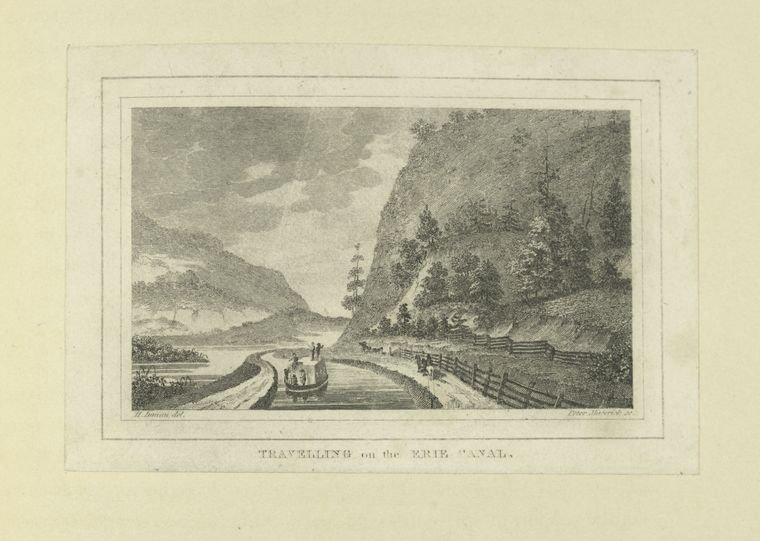
This is the Erie Canal most people forget: not a freight ditch, but a passenger highway — and, for a few decades, the busiest road into the American interior that the young republic possessed. To ride it was to travel four miles an hour through a country in the act of inventing itself.
Two kinds of boat, two kinds of traveler
A traveler heading west out of Albany in the 1830s faced a choice between two very different vessels, and the choice said a great deal about your wallet and your patience.
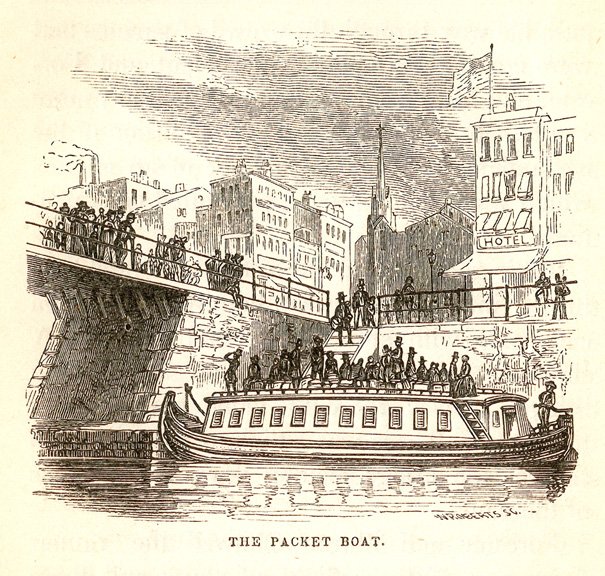
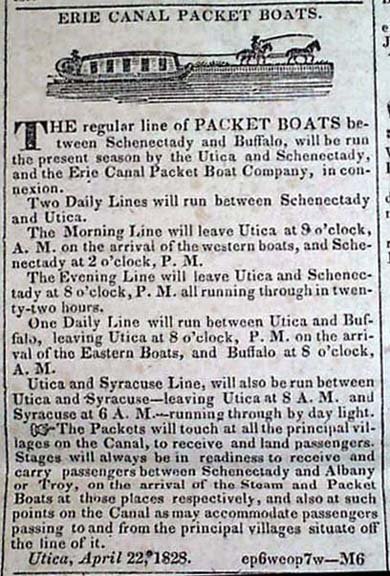
The aristocrat of the canal was the packet boat — long, low, and lightly built for speed. A typical packet ran 60 to 80 feet long and just over 14 feet wide, drawn by relays of horses that were swapped for a fresh team every seven to nine miles so the boat never had to slow down. Packets carried passengers and nothing else. They held the right of way over everything else on the water, and they charged for the privilege: about four cents a mile, meals and a berth included. One canal historian called the packet “the limited express train of those days.”
Its humbler cousin was the line boat, which carried freight and passengers together and made no promises about speed or comfort. Where a packet might make four to five miles an hour, a loaded line boat plodded along at roughly two. But it was cheap — a cent and a half a mile without board, two cents with — and cheapness was exactly what most westbound travelers needed. Line boats were, as the same historian put it, “the accommodation train,” and they vastly outnumbered the packets: something like 500 line boats worked the canal against only eighteen or twenty packets. The packets carried the tourists and the men of business. The line boats carried the flood.
A floating hotel at four miles an hour
The genius and the misery of the packet boat were the same thing: how much life it packed into so little space. By day the main cabin was a parlor, a dining room, and a reading room. By night it became a dormitory. “When night came,” one account runs, the crew would fold the long benches down into a lower berth, then hang two more above it — cot-like frames of canvas suspended from hooks in the ceiling, “the space between the berths being barely sufficient for a man to crawl in.” A single boat was usually fitted with 60 to 70 berths, and on a crowded night as many as 100 passengers might be aboard, the overflow bedding down on the cabin floor.
Not everyone found it charming. Clarissa Burroughs, traveling in 1835, disagreed vehemently with the boosters: she complained of the dirty, cramped, noisy interior, and lay awake worried about being pitched from her bunk each time the boat thudded against the stone walls of a lock. Woodcock, more forgiving, still remembered the shelved berths — three to a tier, upper, middle, and lower — as being “just wide enough for a man to lie in, and just far enough apart for a man to creep in between them.”
Then there were the bridges. Where a road crossed the canal, farmers and towns threw up low wooden bridges — some so low that a passenger sitting on the cabin roof, where the air was better and the view unobstructed, had to duck or, at the worst of them, flatten himself to the deck to avoid being swept off into the water. That daily indignity is the source of the canal’s most enduring folk memory — the shouted warning “Low bridge, everybody down!” that later became a song. It was not a metaphor. It was a survival instruction.
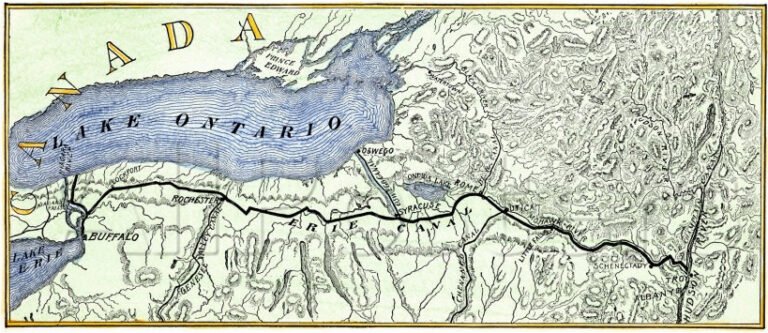
For all its cramping, the packet was a marvel of speed for its moment. Horses and mules towed a packet from Albany to Buffalo — the full 363 miles — in about five days, less than half the time a stagecoach took, and the stagecoach was worse in every other respect. Before the canal opened in 1825, the same Albany-to-Buffalo journey could eat two weeks. The waterway didn’t just make the trip cheaper; it collapsed the distance from a fortnight to a long, strange, gliding week.
The westward flood
The tourists and diarists are the part of the story we have quotes for. But the passengers who mattered most — the ones who changed the map of the country — rode in the cheap seats, on the line boats, with their furniture and their children and everything they owned lashed to the deck.
The timing was providential. The Erie Canal opened in 1825, precisely as the trans-Appalachian West was opening to settlement, and it opened the one thing that had held migration back: a cheap, reliable water road from the Atlantic seaboard to the Great Lakes. Before the canal, moving a family and its goods over the mountains by ox-drawn wagon was punishingly slow and expensive. The canal cut freight costs by roughly 90 percent. Suddenly a farming family in New England or an immigrant just landed at New York harbor could buy passage up the Hudson to Albany, transfer to a canal boat, ride the ditch to Buffalo, and there step onto a lake steamer bound for Ohio, Michigan, or the Wisconsin frontier. The line boats, in the words of the canal’s own historians, “helped many families to emigrate to Ohio and other parts of the Midwest by carrying them and their goods, transferring them to lake boats at Buffalo.”
The volume was staggering for its day. In the canal’s very first year of operation, more than 40,000 people traveled by packet boat alone — to say nothing of the far larger multitude on the line boats. And the National Heritage Corridor states the superlative plainly: the Erie Canal “transported more westbound immigrants than any other trans-Appalachian canal.” (The precise claim is a comparison against rival canals — the Erie’s competitors for the interior trade. It is often broadened in popular retellings to “any route”; we cite the sourced version.) Buffalo, sitting at the canal’s western mouth where the ditch met the lakes, became one of the great immigrant ports of the nineteenth century — Norwegian, Swedish, Italian, Polish, Armenian, and Czech travelers among the many who passed through it on their way to somewhere newer.
The same boats carried a steady flow of new languages, customs, and ideas that reshaped everywhere they landed. The canal towns — Rochester, Syracuse, Utica, Buffalo — boomed so fast on this traffic that the corridor earned a nickname: the “Mother of Cities.” But the deeper legacy was inland, in the Ohio wheat towns and Michigan mill villages settled by people who had come west four miles an hour on a boat.
The end of the passenger era
It did not last. The thing that made the packet boat obsolete was visible from the towpath by the 1840s and unmissable by the 1850s: the railroad, which could carry a passenger the length of the state in a day rather than a week, and did it sitting up. Passenger traffic drained off the canal and onto the rails; the packet boats, once the pride of the waterway, quietly disappeared. The canal itself lived on for freight, and lives on today for recreation — but as a rebuilt, rerouted machine-age waterway, not the hand-dug ditch these travelers rode. (If you’ve ever wondered why the “Erie Canal” you cruise today looks nothing like a narrow towpath ditch, the answer is that it isn’t one: see Which Canal Is This?)
What the packet era left behind is harder to see than a lock or an aqueduct, because it walked off the boats at Buffalo and kept going. For a couple of decades, this narrow ribbon of water was the main door through which a nation moved west — a cramped, foul-aired, thoroughly democratic floating hotel, gliding a family and its whole future across New York at the speed of a walking horse. Low bridge, everybody down.
Gallery
Sources
eriecanal.org — “Boats” (eriecanal.org/boats.html): packet speed “usual speed being four miles per hour,” 60–80 ft x ~14 ft, 60–70 berths / up to 100 aboard overnight, fold-down berth arrangement, packet fare 4¢/mile with meals & lodging, line-boat fare 1½–2¢/mile, low-bridge roof-ducking. eriecanal.org — “Packet Boat Stories” (eriecanal.org/packetboats.html): Thomas S. Woodcock (1836) quotes (“supplied with every thing…,” “first Night I tried an upper berth… air was so foul,” “just wide enough for a man to lie in…,” silver-plate captains, $3.50 Schenectady–Utica); Clarissa Burroughs (1835) complaints; three-tier berths. eriecanal.org — “Boats 2” (eriecanal.org/boats-2.html): line boats carried freight + passengers and “helped many families to emigrate to Ohio and other parts of the Midwest… transferring them to lake boats at Buffalo.” Erie Canalway National Heritage Corridor / NPS — History & Culture (eriecanalway.org/learn/history-culture): Albany–Buffalo by packet in ~5 days, “less than half the time of a stagecoach”; ~90% freight-cost cut vs ox-wagon; “transported more westbound immigrants than any other trans-Appalachian canal”; “Mother of Cities.” Chris Andrle, “Packet Boats and Line Boats on the Erie Canal” (2024, chrisandrle.wordpress.com, summarizing period sources): packet 5 mph vs line 2 mph, “limited express train” vs “accommodation train,” horse relays every 7–9 mi (packet) / 10–12 mi (line), packet right-of-way, ~500 line boats vs 18–20 packets, line-boat fare 1½¢ without board / 2¢ with. Smithsonian Magazine, “Grab Your Mule Named Sal…” (smithsonianmag.com): 40,000+ packet passengers in the canal’s first year; low bridges / roof-sitting; Buffalo as immigrant port; Norwegian/Swedish/Italian/Polish/Armenian/Czech travelers; Albany–Buffalo two weeks → five days. Internal: /history/which-canal-is-this/ (cornerstone) for the original-vs-modern canal distinction.