
St. Johnsville
Approx. Mile 65–71 along the Erie Canal
Barge Canal · 1918 — the canalized Mohawk River, where the valley steepens toward Little Falls. Which canal is this? →
St. Johnsville is a small Mohawk Valley village that punches well above its size for anyone traveling the canal under their own power. Its village-run marina and adjoining campground make it one of the most boater- and camper-friendly stops on the middle canal, with fuel, power, showers, laundry, and a pump-out gathered at a single working wall. On a stretch where services are thin, that combination is scarce enough to plan a day around.
Just east of the village stands Fort Klock, a c.1750 fortified stone homestead and National Historic Landmark on Route 5 — a rare surviving glimpse of the fortified frontier the Mohawk Valley once was. Nearby, Lock E16 lifts boats 20.5 feet, a striking step up from the roughly 8-foot locks just downstream toward Canajoharie and Fort Plain.
The valley that fought for its life
To lock through St. Johnsville today — to tie up at the village wall, take a shower, top off the fuel tank, and watch pleasure boats drift by below Lock E16 — is to see the calmest possible version of a place that spent the eighteenth century braced for attack. Long before the canal made this a gentle river town, the Mohawk Valley was one of the most dangerous frontiers in colonial America, and St. Johnsville sits in the thick of the stone forts that survived it.
The people who built those forts were Palatine Germans. Driven from the Rhineland by war and hard winters, they came to New York early in the 1700s and pushed up the Mohawk to farm its rich flats — a hard-working, hard-pressed community wedged between the British colonies to the east and the Iroquois and French to the west. Their answer to that exposure was to build homes that could double as fortresses, and the finest surviving example stands just east of the village on Route 5.
Fort Klock
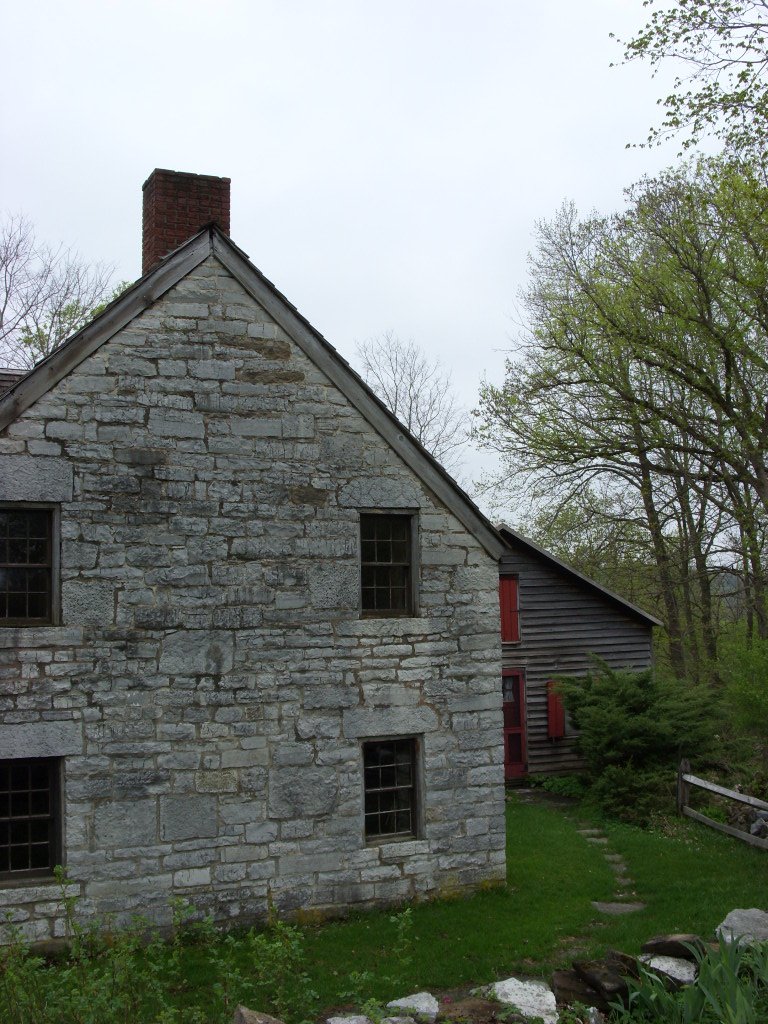
Around 1750, the fur trader Johannes Klock raised a fieldstone homestead on the south bank of the Mohawk that was less a farmhouse than a small keep. Its walls run about two feet thick, loopholed on every side so that defenders could fire muskets from cover, and part of the structure sits directly on bedrock — a foundation no attacker could tunnel or burn. A spring inside the walls meant the household could hold out under siege without venturing to the river for water. It was a textbook fortified Mohawk Valley homestead, the kind of place neighbors ran to when the alarm went up.
And the alarms came. Fort Klock stood through the French and Indian War and then through the Revolution, when the Mohawk Valley became a running battleground of raids and reprisals that emptied whole settlements. The house was built to survive exactly that, and it did.
The Battle of Klock’s Field
The valley’s war reached the fort’s own doorstep in October 1780. In the meadow just west of the homestead, American militia clashed with a mixed British, Loyalist, and Native force that had spent days burning farms up and down the Mohawk. The fight is remembered as the Battle of Klock’s Field — a rare instance where the valley’s defenders checked a raid that had, until then, moved almost unopposed. The ground where it happened is still open field today, a quiet stretch of valley floor that gives little hint of the smoke and panic of that autumn afternoon.
Fort Klock outlasted the war, the frontier, and the century, and in 1972 it was declared a National Historic Landmark. It survives now as a living-history site — the stone house, a Dutch barn, a blacksmith shop, and a nineteenth-century schoolhouse spread across the grounds — open seasonally to anyone who wants to stand inside two-foot walls and imagine the view down a loophole.
The gentler town the canal made
The waterway that runs past St. Johnsville belongs to a wholly different era — and here it is not a hand-dug ditch at all but the canalized Mohawk River itself, held at navigable depth by the twentieth-century Barge Canal (if that surprises you, see which canal is this?). The village grew into a modest, welcoming stop on that river-canal, and it plays the role generously. Its municipal marina — village-run, not a private outfit — offers fuel, showers, and a wall to tie up against, making it one of the friendliest tie-ups on the middle canal.
It sits just below Lock E16, and that lock is worth a glance. Its 20.5-foot lift is a sharp step up from the eight-foot chambers a boater has been clearing downstream around Canajoharie and Fort Plain — the first real sign that the valley is steepening. From here the canalized Mohawk begins to climb in earnest toward the rock gorge at Little Falls, where the river narrows and the going gets hard. St. Johnsville is the last easy breath before that climb: fuel, a shower, a quiet wall — and a two-hundred-year-old fort on the hill to remind you the valley was not always this peaceful.
In this stretch
Places to Eat
Provisions & Shops
Arriving by boat
Around Mile 70, the St. Johnsville Municipal Marina & Campground (15 Marina Drive) is the anchor stop here — a rare full-service municipal marina and a genuine overnight destination rather than a quick tie-up. Its fixed docks carry roughly 6 feet on the approach and 8 feet dockside and can handle vessels up to about 125 feet, so most cruisers working the canal will find room.
What sets St. Johnsville apart is how much is on hand in one place: 30- and 50-amp electric, water (pay), free WiFi, restrooms, showers, laundry (pay), and ice. Crucially for this thin-service stretch, there is a pump-out on-site and it is a fuel stop, with non-ethanol gas available — the kind of amenity that shapes an itinerary. An adjoining campground rounds out the stop. Nearby sit Fort Klock and Lock E16. Confirm hours and rates in season before you arrive.
By car
The marina and campground on Marina Drive offer parking, making the village an easy drive-in point as well as a boater stop. A short way east on Route 5 stands Fort Klock, a c.1750 fortified stone homestead open seasonally as a living-history site — the standout drive-in attraction in this stretch of the valley.
What to see
Fort Klock Historic Restoration is the marquee stop: a c.1750 fortified stone house and trading post built by Johannes Klock, with walls more than two feet thick, loopholed on every side for defense, and set partly on bedrock — a textbook mid-18th-century fortified Mohawk Valley homestead. The roughly 30-acre complex includes a Dutch barn, a blacksmith shop, and a 19th-century schoolhouse. It saw use in the French and Indian War and the American Revolution, was declared a National Historic Landmark in 1972, and is maintained today as a living museum.
Just west of the fort lies the site of the Battle of Klock's Field, an October 1780 Revolutionary War engagement. Together they make St. Johnsville a quietly rich stop for anyone drawn to the valley's frontier history.