
Herkimer, Ilion & Frankfort
Approx. Mile 83–95 along the Erie Canal
Barge Canal · 1918 — the canalized Mohawk River; the land cut to Rome begins just west. Which canal is this? →
This three-village stretch of the Mohawk Valley is the industrial and Revolutionary heart of Herkimer County. Ilion grew up around the Remington factory, which Eliphalet Remington II moved to the Erie Canal bank in 1828 for cheap access to markets and materials; a few miles west, the village of Herkimer preserves a Historic Four Corners and the 1834 jail that once held Chester Gillette. Just east stands the Herkimer Home State Historic Site, the Georgian mansion of Revolutionary War General Nicholas Herkimer, overlooking the Mohawk with Erie Canal lock remnants still on its grounds.
For boaters, the payoff is practical: the full-service Ilion Marina makes this a comfortable overnight, and it is one of the rare fuel stops on this part of the canal. Ashore, the region's signature souvenir is the Herkimer diamond, a doubly-terminated quartz crystal some 500 million years old and unique to the county.
Guns, a general, and a murder: three villages on the Mohawk
Three villages share this bend of the canalized Mohawk River, and among them they hold a strange trinity of American stories — an arms empire, a dying Revolutionary general, and a murder that became a novel. Start with the guns, because the guns are the canal’s doing.
Eliphalet Remington II learned his trade at his father’s forge in the hills above the valley, hammering out rifle barrels good enough that customers rode miles to buy them. But a barrel is heavy, roads were bad, and every wagonload cost him money to move. Then, in 1825, the state opened a ditch across the whole width of New York, and Remington did the arithmetic. Three years later, in 1828, he bought roughly a hundred acres of flat ground astride the new waterway at a hamlet called Morgan’s Landing and moved his works down to the canal bank. The reason was blunt and commercial: on the canal, a barrel could ride a boat to market instead of a wagon. The settlement that grew up around his factory took a new name — Ilion — and the gun works Remington planted on that towpath ground stayed there, through the Civil War contracts that made the Remington name a rival to Colt, and on through two centuries of American manufacturing, until the factory finally went quiet in 2024. Nearly two hundred years of industry, all because a man wanted his freight on the water.
The general’s story is older and sadder, and it belongs to the valley before the canal was ever imagined. Nicholas Herkimer was a Palatine German farmer and militia officer whose Georgian brick home — completed in the 1760s and now the Herkimer Home State Historic Site — still stands above the Mohawk just east of here. In August 1777, with a British column besieging Fort Stanwix at present-day Rome, Herkimer led some eight hundred Tryon County militiamen west to break the siege. In a wooded ravine near Oriskany on August 6, they were ambushed. The Battle of Oriskany was among the bloodiest single engagements of the Revolution, hand-to-hand and merciless. Herkimer took a musket ball in the leg early in the fight; as the story is told, he had himself propped against a tree and went on directing his men, smoking his pipe, refusing to leave. He was carried home to that brick house on the river, where his shattered leg was amputated by an inexperienced surgeon. The wound would not stop bleeding, and roughly ten days after the battle — on August 16 — he died. He is buried on the grounds of his own home, within sight of the water the canal would later follow.
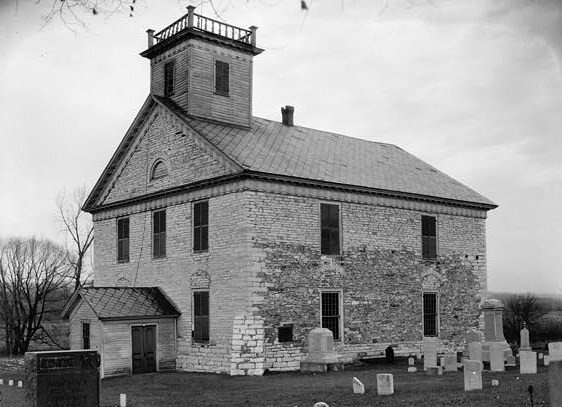
Then the strange one. In the village of Herkimer stands a squat stone jail — long known as the 1834 Herkimer County Jail — part of the downtown Historic Four Corners. In 1906 it held Chester Gillette, awaiting trial for the drowning of Grace Brown, a pregnant young woman, on Big Moose Lake up in the county’s northern woods. The trial in Herkimer that autumn was a national sensation; Gillette was convicted and, in 1908, executed. He might have faded into a footnote — except that Theodore Dreiser took the case, the ambition, and the killing and reshaped them into Clyde Griffiths, the doomed protagonist of his 1925 masterwork An American Tragedy, later filmed as A Place in the Sun. The stone jail that held the real man is still there, a few steps from the canal that runs through these towns.
One more local marvel, older than all of it. Dig into the dolomite rock around Herkimer County and you can pull out “Herkimer diamonds” — not diamonds at all but double-terminated quartz crystals, naturally faceted at both ends, formed here some half a billion years ago. They occur in quantity essentially only in this pocket of the Mohawk Valley, which is why the region’s dig sites let visitors keep what they crack loose. Guns, a general, a murder, and a gem sealed in stone since long before there was a Mohawk River to be canalized — and the water, as ever, is the thread that ties it all together. (For which canal you’re actually floating on through here, see Which canal is this?)
In this stretch
Places to Eat
Provisions & Shops
Things to see & do
Arriving by boat
The anchor stop here is Ilion Marina, near Mile 89, run by the Village of Ilion. It offers roughly 600 feet of fixed bulkhead with about 16 slips (12 transient), approach and dockside depths near 9 and 10 feet, and room for large vessels; the wall has handled boats up to 300 feet. It monitors VHF 13, and the slip fee includes water and electricity. The season opens May 1.
Most valuable of all: Ilion is a genuine fuel stop, with both gas and diesel on site — a real find, since fuel is scarce along much of the canal. Fuel here is not non-ethanol, so plan accordingly; call ahead for current price. The marina also has a pumpout, restrooms, showers and laundry, a launch ramp, and an on-site restaurant, making it a natural place to lay over.
Three miles east near Mile 92, Frankfort Harbor Marina & Park is a village-run free dock with floating docks, about 12 slips, and approach and dockside depths near 10 and 6 feet; the largest vessel it handles is around 50 feet. The anchor locks bracketing this section are E18 (Jacksonburg, 20-foot lift) and E19 (Frankfort, 21-foot lift). Confirm rates, fuel price, and current facilities in season.
By bike & foot
The Erie Canalway Trail / Empire State Trail runs paved and off-road straight through this section. Ilion Marina on Morgan Street is a signed trail stop and a natural trailhead hub for riders and walkers — restrooms, showers, a restaurant, and camping are all right there. For trailhead parking in Herkimer and Frankfort, confirm details in season.
By paddle
Ilion Marina has a launch ramp usable for paddlecraft, and this stretch is part of the NYS Canalway Water Trail. Paddlers will need to lock through or portage at the two big lifts, E18 (20 feet) and E19 (21 feet); confirm portage routes locally before you set out.
By car
By car, Ilion Marina & RV Park at 49 Morgan Street offers parking and an on-site restaurant. Nearby drive-in attractions include the Herkimer Home State Historic Site on State Route 169, the Historic Four Corners in downtown Herkimer, and the Herkimer Diamond Mines dig site on Route 28 north of the village.
Where to sleep
Boaters can stay aboard at Ilion Marina, which also runs a municipal RV park with 14 sites. For land lodging, the Herkimer Diamond KOA Resort sits north of Herkimer near the Diamond Mines. Verify availability and booking in season.
What to see
The Herkimer Home State Historic Site is the Georgian mansion, completed around 1764, of General Nicholas Herkimer. Its grounds hold his grave, a recreated kitchen garden, Erie Canal lock remnants, and Mohawk River views; tours run Wednesday through Sunday, Memorial Day to Columbus Day. Herkimer led roughly 800 Tryon County militia, with about 60 Oneida allies, toward Fort Stanwix in 1777, was wounded at the Battle of Oriskany on August 6, and died about ten days later after a leg amputation.
In downtown Herkimer, the Historic Four Corners gathers the 1834 County Jail, the 1873 Courthouse, the 1834 Reformed Church, and the 1884 Suiter Building, all on the National Register. The jail held Chester Gillette before his 1906 murder trial. North of the village, the Herkimer Diamond Mines let visitors dig for the doubly-terminated quartz "Herkimer diamonds," roughly 500 million years old and unique to the county.
Ilion's identity is bound to Remington: Eliphalet Remington II began making rifle barrels here in 1816 and moved to the canal bank in 1828, and during the Civil War the company's Union contracts produced some 250,000 arms, rivaling Colt. The Ilion factory closed in March 2024; confirm the current status and hours of any Remington-related museum before visiting.