 Mohawk Valley
Lock 9, Rotterdam Junction — lock view
Mohawk Valley
Lock 9, Rotterdam Junction — lock view
Erie Canal
Mohawk Valley
Amsterdam
Approx. Mile 29–45 along the Erie Canal
Barge Canal · 1918 — the canalized Mohawk River, held by movable bridge dams. Which canal is this? →
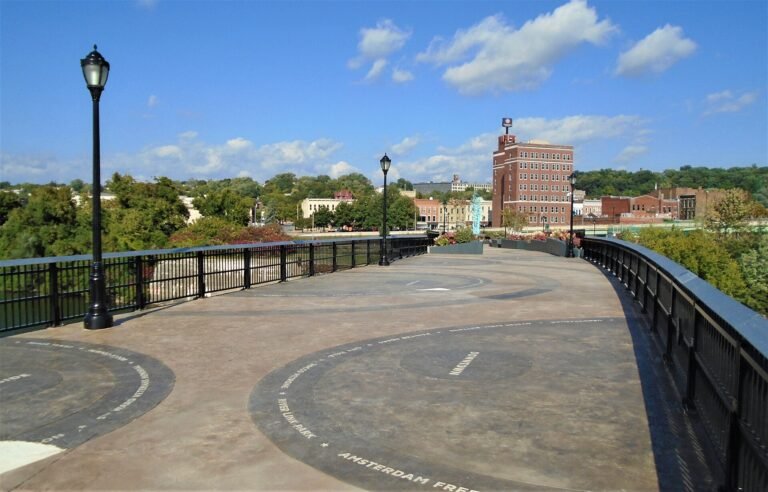
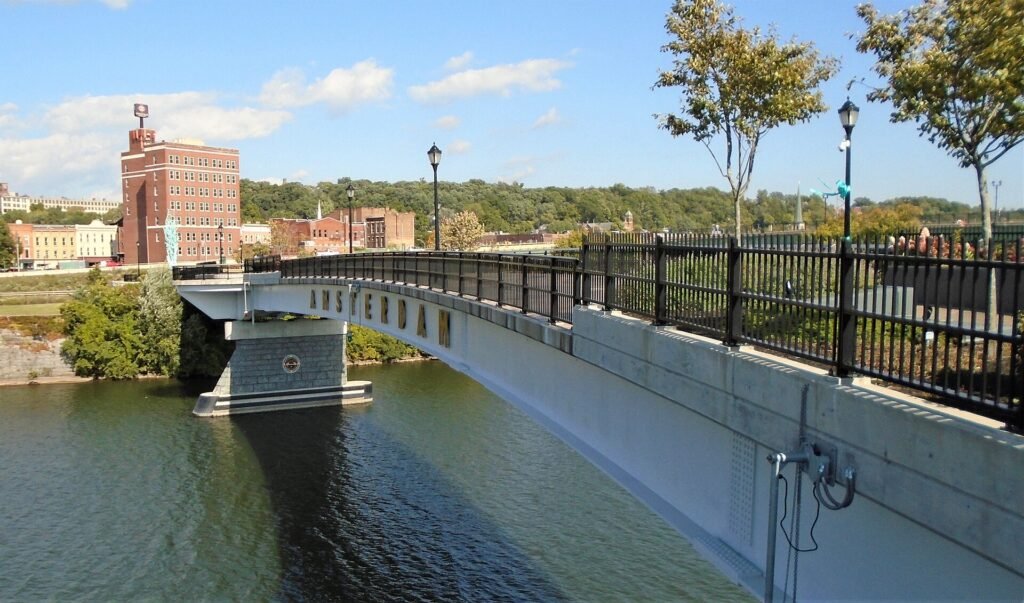
Amsterdam is a former carpet-mill city on the south bank of the Mohawk River, its downtown stitched back to the water by the Mohawk Valley Gateway Overlook — a curved, 511-foot pedestrian bridge that carries walkers from the riverfront straight into the heart of town. For anyone traveling the canal, this is the principal service stop in the stretch: Riverlink Park sits in the pool between Lock E10 (Cranesville) and Lock E11 (Amsterdam), offering dockage, power, water, showers, and laundry within a short walk of the city.
The section runs from the Rotterdam and Cranesville locks (E9, E10) west toward the Tribes Hill area approaching E12 — a working, lift-and-drop corridor where the river does the heavy lifting and the town rewards the tie-up.
The city the carpet built — and lost
Stand on the Mohawk Valley Gateway Overlook on a bright afternoon and you are walking, in a sense, across the ghost of an industry. The 511-foot pedestrian bridge that curves out over the river carries a twelve-foot glass mosaic worked into its deck — a deliberate echo, its designers say, of the patterns that once poured off the looms of “Carpet City.” For the better part of a century, this is what Amsterdam did: it made the floors of America, by the acre, on both banks of the river the Erie Canal now follows as a canalized channel held between movable bridge dams.
The scale is hard to picture now that the mills are gone. Two carpet giants faced each other across the town. Bigelow-Sanford ran its looms on one side; Mohawk Carpet Mills spun rugs on the other. Together they employed thousands — the beating economic heart of a Montgomery County city that had grown up on the strength of weaving. Wool came in, patterned broadloom went out, much of it moving on the same water corridor that had made the valley an industrial spine in the first place. If you wanted a single American town that stood for wall-to-wall carpet, for a good stretch of the twentieth century it was Amsterdam.
Then it unraveled, and it unraveled fast. In 1955 Bigelow-Sanford consolidated its operations out to Connecticut, and roughly 1,650 local jobs went with it — a wound a city this size does not easily absorb. The following year, 1956, Mohawk Carpet Mills merged with a Yonkers rival to form a new giant, Mohasco, and over the years that followed the company drifted its looms south, chasing cheaper labor the way the whole American textile trade was drifting in those decades. By 1968 the carpet-making was simply gone. What had taken generations to build came apart inside a single, brutal decade.
Long before the looms, this was frontier ground of a different kind. The stretch of the Mohawk around Amsterdam was Sir William Johnson country — the powerful Crown superintendent of Indian affairs whose family estates lined the valley in the years before the Revolution. Just west along the river stands Guy Park, the 1774 Georgian manor built for his nephew and son-in-law Guy Johnson, which later served as a tavern and stagecoach stop on the Mohawk Turnpike. The mills, in other words, were only one chapter; the river was drawing people to this bank of the Mohawk a full two centuries before the first carpet shipped.
What Amsterdam has done since is instructive: it has turned back toward the water that fed all of it. In 1993 the city became the first municipality on an inland New York waterway to win state approval for a Local Waterfront Revitalization Program — a quiet civic milestone that set the direction for everything after. Riverlink Park went in along the south bank. And in 2016 the Gateway Overlook opened, walking visitors up and over from the riverfront into downtown, its mosaic glinting with the memory of the vanished trade. The looms are silent, but the city is once again organized around the Mohawk — the reason it existed before the carpet, and the reason it endures after. If you are traveling the canal, tie up at Riverlink Park between Locks E10 and E11, and walk the bridge. You are crossing a hundred years of American manufacturing, rendered in glass. See also which canal is this?
Live on the canal
Mohawk Valley
Lock 9, Rotterdam Junction — lock view
In this stretch
Places to Eat
Provisions & Shops
Things to see & do
Arriving by boat
Riverlink Park (Mile ~38, south side, downtown) is the transient stop here — a mix of fixed and floating docks with roughly 11 slips, 10 of them transient, able to handle vessels up to about 100 feet. Dockage is first-come, first-served, with on-site QR-code payment; the marina monitors VHF 13. The Mohawk Valley Gateway Overlook pedestrian bridge connects the docks directly to downtown, so provisioning and dinner are an easy walk.
Shoreside facilities include 110V and 220V shore power (pedestals are not amp-rated or metered), fresh water, restrooms, showers, laundry, and a pump-out. There is no on-site fuel and no WiFi. Confirm any boater-critical detail — power, pump-out, and dock availability — in season before you rely on it.
Position matters for planning your lock timing: the park lies between Lock E10 (Cranesville, 15-foot lift) and Lock E11 (Amsterdam, 12-foot lift), so you'll pass through one on either approach.
By bike & foot
The Erie Canalway Trail / Empire State Trail passes through Amsterdam on paved, off-road surface. The Canajoharie-to-Amsterdam segment — about 22 miles, fully paved — ends at a trailhead parking area in South Amsterdam, at the intersection of Bridge Street and Erie Street. Amsterdam is where visitor services return along this run; there's little in between Canajoharie, Fultonville, and here.
On foot, the Mohawk Valley Gateway Overlook is the connector that makes the stop work: 30 feet wide and 511 feet long, it links Riverlink Park on the river side to Bridge Street downtown, letting boaters and trail users walk straight into the city.
By paddle
Amsterdam sits on the Erie–Mohawk Historic Water Trail, and Riverlink Park's floating docks make a practical put-in or take-out — confirm hand-launch suitability locally before committing. Paddlers cannot pass the dams under their own power: plan to lock through or portage at E10 and E11, and confirm current portage arrangements before you set out.
By car
Riverlink Park has vehicle parking on the riverfront, and there's a separate trailhead lot in South Amsterdam at Bridge Street and Erie Street. From the car, the drive-in draws are the Mohawk Valley Gateway Overlook and the Guy Park Manor / Walter Elwood Museum area along the river.
Where to eat
River's Edge, a New American restaurant at Riverlink Park itself, puts a riverside table within steps of the docks; it's typically closed Mondays and hours vary, so confirm before you count on it. Amsterdam has a handful of other local spots downtown — check current hours and status locally before you go.
What to see
The signature landmark is the Mohawk Valley Gateway Overlook, a curved 511-foot pedestrian bridge that opened in August 2016. It's more sculpture than shortcut: live trees are planted along the deck, a 12-foot glass mosaic references Amsterdam's carpet-mill heritage, and interpretive plaques line the walk. In 2019 it was recognized as one of the American Planning Association's "Great Places." Below it, Riverlink Park anchors the waterfront with a playground, a summer concert series, and a 9/11 Memorial.
A short way along the river corridor, Guy Park Manor — a 1774 Georgian house built for Guy Johnson that once served as a Mohawk Turnpike tavern and stagecoach stop — shares its site with the Walter Elwood Museum, a local-history collection founded in 1939 and relocated here in 2009. Together they read as a compact primer on the valley's turnpike, canal, and railroad past.
Local history
For a century, the floors of America were made here. Amsterdam was Carpet City, its Mohawk River mills weaving rugs by the acre — Bigelow-Sanford on one side of town, Mohawk Carpet Mills on the other, together employing thousands. Then it unraveled fast: Bigelow-Sanford consolidated out to Connecticut in 1955, cutting some 1,650 local jobs; Mohawk merged with a Yonkers rival to form Mohasco in 1956 and drifted its looms south to cheaper labor. By 1968 the carpet-making was gone. The city has since turned back to the water that fed the mills — the 511-foot curved Mohawk Valley Gateway Overlook, opened in 2016, now walks visitors from Riverlink Park into downtown, its glass mosaic deliberately echoing the vanished carpet trade. Amsterdam was the first municipality on an inland New York waterway to win state approval for a waterfront-revitalization plan, back in 1993.