The Songs of the Erie Canal
How a handful of ditch-side ballads kept the mule-era world alive — from the raucous “The E-ri-e” to Bruce Springsteen’s revival.
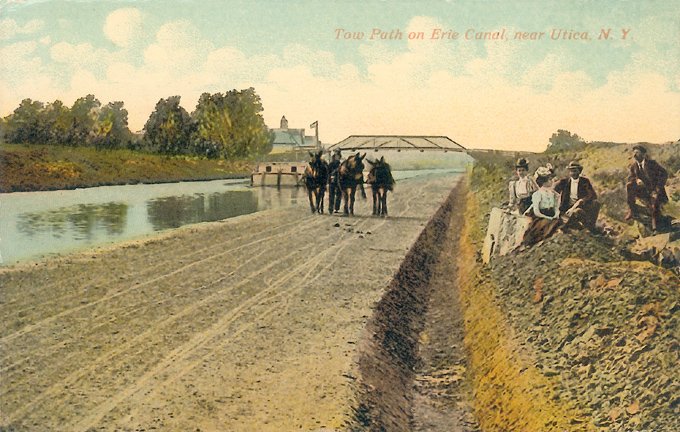
Long before the Erie Canal was a bike path or a bicentennial, it was a soundtrack. The 363-mile ditch that remade New York ran on muscle and monotony — mules plodding a towpath, a boat sliding through brown water at walking speed, days on end of it — and a world that moves that slowly invents songs to fill the hours. Some were bawled out by the boatmen themselves. Some were written decades later, in a parlor, to mourn a way of life already slipping under. Together they form a small, sturdy canon: the music of the mule era, still sung in campgrounds, classrooms, and, improbably, on a Bruce Springsteen record.
Here is the canon, and where you can still hear it.
“The E-ri-e”: the boatmen’s own anthem
If you want the sound of the canal as the canallers actually knew it, start with “The E-ri-e” — also cataloged as “The E-ri-e Canal” or, by its opening line, “We Were Forty Miles from Albany.” Nobody knows who wrote it. It is a genuine folk song, traditional and anonymous, handed down from the nineteenth-century boat-traffic era and attributed only to the nameless men who worked the water. That anonymity is the whole point: this is a song made by the labor, not about it.
It is also a comedy. “The E-ri-e” is a tall tale of a miserable voyage — fog, a cranky captain, a boat that never quite gets where it’s going — and its famous chorus turns thirst into an anthem:
“Oh, the E-ri-e was a-rising, and the gin was gettin’ low, / And I scarcely think we’ll get a drink till we get to Buffalo.”
Older and rowdier than anything that came later, “The E-ri-e” has been carried into the modern folk repertoire by singers including Pete Seeger and Roger McGuinn of the Byrds. It is the closest thing we have to eavesdropping on a canal boat’s deck.
“Low Bridge, Everybody Down”: the one everybody knows
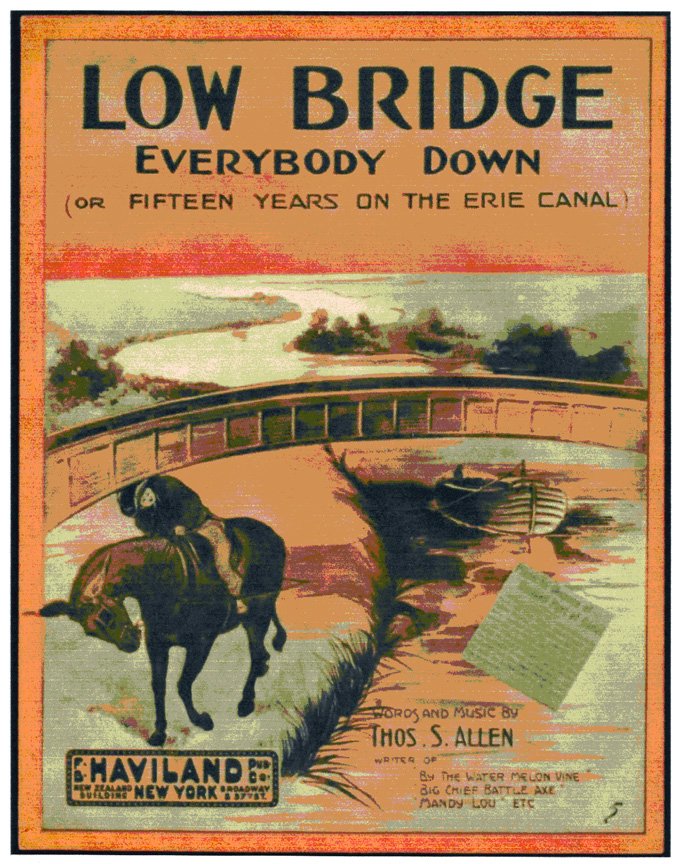
Then there is the giant. “Low Bridge, Everybody Down” — the “I’ve got a mule, her name is Sal” song — is, by a wide margin, the most famous piece of music the canal ever produced, and for millions of Americans it is the only thing they know about the Erie. It was written by Tin Pan Alley composer Thomas S. Allen, first published as sheet music in 1913 (Allen is generally said to have written it around 1905; the firmly documented milestone is the 1913 publication). It is unambiguously in the public domain in the United States — a status that was effectively affirmed in court when Allen’s publisher sued over the song appearing as folk material and lost in 1930.
Here is the twist that makes it worth its own study: Allen wasn’t a boatman writing at work. He was a professional songwriter composing an elegy, setting down the mule and the towpath precisely because they were vanishing under the coming age of engines. And the version nearly everyone sings today — “fifteen miles on the Erie Canal” — isn’t even what he first published, which read “fifteen years.” The full story of that song — the mules, the hoggees, why “fifteen miles,” and how a goodbye became the canal’s most beloved memory — has its own home here: Low Bridge, Everybody Down: The Song That Remembers the Mules. It is the essential companion to this page.
The deep cuts: canallers, comics, and Tin Pan Alley
Beyond the two headliners lies a whole strata of lesser-known canal music, and it splits neatly in two.
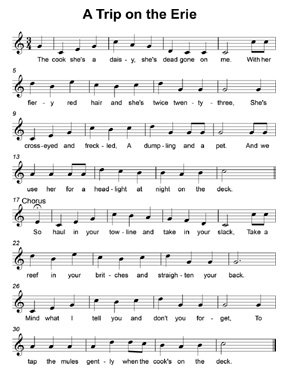
On one side are the anonymous canaller songs — the true folk stuff, most of it composed by unnamed boatmen and passed hand to hand: “A Trip on the Erie,” “Boating on a Bullhead,” “Black Rock Pork,” “From Buffalo to Troy,” and “The Good Ship Called Danger.” These are the working repertoire — gritty, regional, often funny, rarely tidy.
On the other side are the composed, commercial numbers with named authors, written when the canal was a popular subject for the stage and the sheet-music trade. “The Raging Canal” (Pete Morris, 1844) is a mock-heroic storm ballad. “Look Out, Dat Low Bridge” (Braham & Harrigan, 1881) came out of the New York theatrical world of Harrigan and Hart. And “Down by the Erie Canal” is attributed to George M. Cohan, the Broadway showman, around 1915. Every one of these predates 1929, which puts them all safely in the U.S. public domain. It’s a reminder that the canal wasn’t only sung about by the people who worked it — it was a national pop-culture fixture, the kind of thing Broadway and the parlor piano reached for when they wanted a whiff of American frontier romance.
Springsteen and the folk-revival afterlife
Canal music might have faded entirely if not for the twentieth-century folk revival, which treated songs like these as national heirlooms worth dusting off. Pete Seeger, The Weavers, and The Kingston Trio all carried Erie Canal material to mid-century audiences, and “Low Bridge” in particular became a fixture of school songbooks and summer camps — which is exactly why so many Americans can still hum it.
The most surprising modern chapter belongs to Bruce Springsteen. On his 2006 album We Shall Overcome: The Seeger Sessions — a raucous, live-in-the-living-room tribute to the folk songs associated with Pete Seeger — Springsteen recorded a track simply titled “Erie Canal.” It sits squarely in the lineage of Allen’s much-covered tune, dragging the mule and the low bridge into a horn-driven, foot-stomping arrangement roughly a century after the song first hit print. It is, in its way, the perfect capstone: a piece of vanished labor history, written as a farewell, reborn as a barn-burner for a stadium act.
Where to hear the canon
The music has also drawn documentarians. One rich guide to the canon is “Boom and Bust: The Songs of the Erie Canal” , a folk-history piece by the singer and folklorist George Ward, hosted by the folk-film archive Folkstreams. It traces the split this article draws — between the polished popular songs like Allen’s (originally issued on an Edison cylinder) and the true folk songs the canallers made themselves. It is the ideal next step for anyone who wants to actually hear the canon rather than read about it.
Two centuries on, the boats are gone and the mules with them. But the songs kept the towpath alive — a thirsty chorus about Buffalo, a mule named Sal, a warning to duck for the bridge — and as long as someone is still singing them, the slow brown water is never entirely quiet.
Gallery
Sources
Songs, writers, and dates verified against the site’s sourced media reference (research/content/songs-and-media.md) and the following: eriecanal.org, “Music of the Erie Canal” (“The E-ri-e” chorus and traditional/canaller song titles; “The Raging Canal,” “Look Out Dat Low Bridge,” “Down by the Erie Canal” attributions and dates) — https://www.eriecanal.org/music.html · Wikipedia, “Low Bridge (song)” (Thomas S. Allen; 1913 publication; “years” vs. “miles”; public-domain status and 1930 litigation; notable recordings incl. Seeger, The Weavers, The Kingston Trio, Springsteen) — https://en.wikipedia.org/wiki/Low_Bridge_(song) · Erie Canal Museum, “Low Bridge, Everybody Down” — https://reflections.eriecanalmuseum.org/music/low-bridge-everybody-down/ · Folkstreams, “Boom and Bust: The Songs of the Erie Canal” (2015, George Ward) — https://www.folkstreams.net/contexts/boom-and-bust-the-songs-of-the-erie-canal · Bruce Springsteen, “Erie Canal” on We Shall Overcome: The Seeger Sessions (2006) — https://www.springsteenlyrics.com/lyrics.php?song=eriecanal. Companion in-depth piece: /history/low-bridge-everybody-down-song/. Note: a claimed Bing Crosby recording and the exact titles inside Carl Carmer’s Songs of the Rivers of America (1942) remain unverified and are omitted.