The Mule, the Hoggee, and the Towpath: Life and Labor on the Old Canal
Before diesel and steel, the Erie Canal ran on muscle — the mules that hauled the boats at four miles an hour, and the barefoot children who walked beside them all day long.
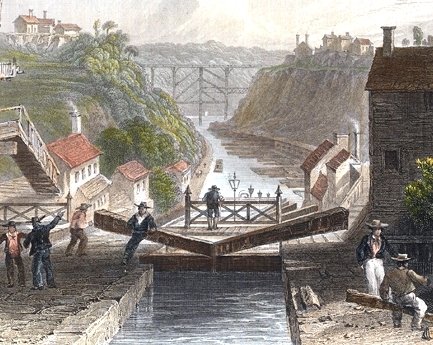
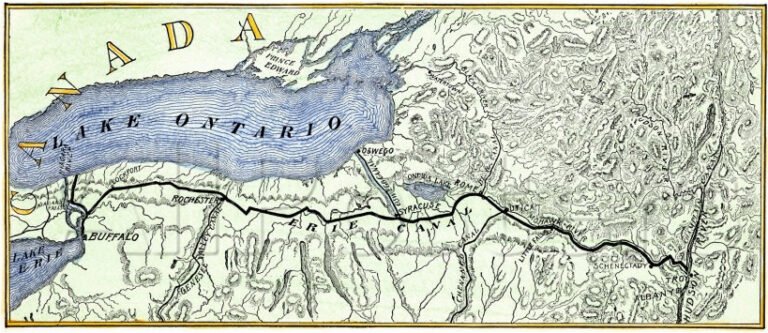
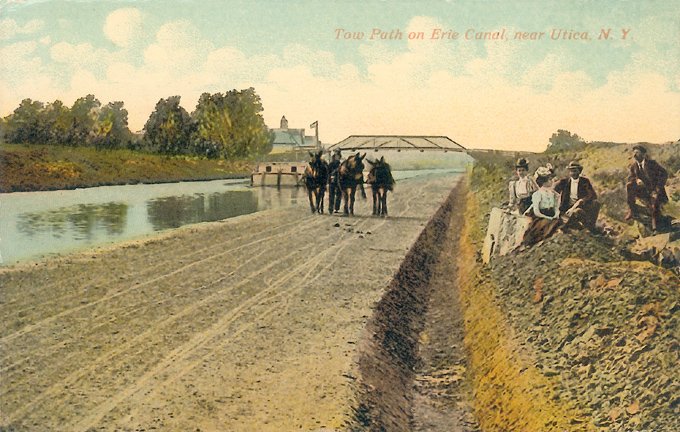
Stand on a stretch of the old Erie Canal towpath today and it is almost too quiet to imagine what it once was: a beaten dirt lane, worn hard by hooves and bare feet, running for hundreds of miles beside a ribbon of brown water. For nearly a century this path was the engine room of the busiest artery in America. Everything that moved on the canal — the flour and the lumber, the salt and the immigrants bound west — moved because something on that towpath was walking. Usually it was a mule. Almost as often, it was a child.
We remember the Erie Canal for its engineering marvels — the locks, the aqueducts, the staircase at Lockport. But the canal was also a workplace, and its working world has vanished so completely that it can be hard to picture. There were no engines. A loaded boat could carry around thirty tons of freight, and every one of those tons was dragged forward by animal muscle at the end of a long tow line, at a pace no faster than a person could comfortably walk.
Four miles an hour
The speed of the Erie Canal was, by the standards of the machine age that followed, almost comically slow. The usual pace of a working boat was about four miles per hour — and even that modest clip was often the legal limit, because a fast-moving boat threw up a wake that chewed at the canal’s earthen banks. Passenger packets, running lighter and swapping teams hard, might push a little faster; a heavy freight boat rarely did.
Slow as it was, four miles an hour was a revolution. Before the canal opened in 1825, hauling goods overland by wagon was so ruinously expensive that trade with the interior barely happened at all. A team plodding down the towpath, pulling thirty tons behind it, did the work of dozens of wagons for a fraction of the cost. The magic of the canal was never speed. It was leverage — the astonishing amount of weight a single animal could move once you floated it.
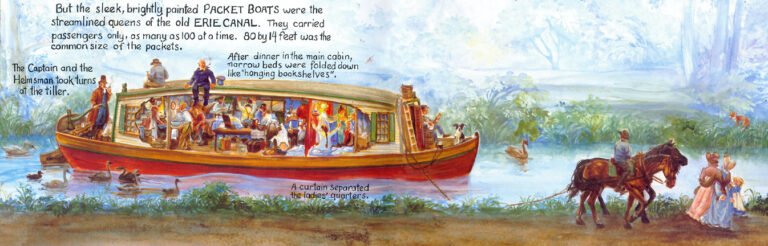
That leverage is the whole reason mules and horses mattered so much. On water and against so little friction, a single team could keep tons of cargo gliding forward for hours. The towline ran from a harness on the animals, along the towpath, out over the water, and down to a post on the boat. The steersman kept the boat off the bank; the team, out ahead on the path, simply kept walking.
Why mules
Horses and mules both worked the towpath, but canallers came to prize mules. A mule was tougher-footed, more surefooted on a muddy path, less prone to panic, and famously willing to endure conditions that would break a horse down — long hours, poor footing, monotonous miles. The mule’s reputation for stubbornness was, on the canal, closer to a reputation for good sense: a mule would refuse work that might hurt it, which on a narrow towpath beside deep water was not a flaw but a feature.
A well-run freight boat carried not one team but two, and here the canal’s rhythm reveals itself. The standard arrangement was six hours on duty, six hours off. One team walked the towpath in harness while the other rested aboard the boat itself, housed in a small stable built into the bow. When the shift changed, the fresh team was led out onto the path and the tired one loaded back into the stable — a changeover that a good crew could manage with barely a pause in the boat’s forward creep. Getting a reluctant animal up the gangway and into that cramped bow stable was its own daily wrestling match, sometimes accomplished by rigging a block and tackle and using one mule’s pull to haul the other aboard.
Round the clock, in good weather and bad, the boats crept on. And out on the path in front of every team, holding the line and setting the pace, walked the hoggee.
The hoggee
The word is odd and wonderful, and its origin is a small argument among canal historians. The most common explanation traces it to the driver’s commands to the team — the “haw” and “gee” that told an animal which way to turn — slurred together into hoggee. Others suspect it descends from hogler, an old English word for a lowly laborer. The etymology is disputed; what the word meant on the canal was not. A hoggee was the driver who walked the towpath and kept the team moving, and very often the hoggee was a child.
The iconic image, preserved now in a bronze statue across from the Erie Canal Museum in Syracuse, is of a boy of about ten — barefoot, in overalls and a straw hat — walking beside his mules. It was not a romantic image in its own time. It was a job, and a hard one, done by children because children were cheap and the work, while grueling, did not require a grown man’s strength. Many hoggees came aboard as crew by the ages of ten to twelve. Some began younger.
The hours were built around the mules, not the boy. When his team came off shift, the hoggee’s day was not done: the animals had to be fed, watered, and tended before he could rest, and he typically slept in the bow stable alongside the off-duty team he was responsible for. A driver might walk something on the order of eighteen to twenty miles in a day — mile after mile at the mules’ four-mile-an-hour plod, in July heat and October cold, in the dark of the pre-dawn shift, along a path with deep water on one side.
The pay was as thin as the work was hard: often around ten dollars a month, plus that sleeping space on the boat and food from the galley — meat, potatoes, and whatever vegetables the cook had. For a child from a boat-owning family, this was simply the family economy, and life aboard had its compensations: winters off when the canal froze and the boat laid up, a season of school, ice skating, even trips to the canal-town amusement parks. For an orphan or a hired-out poor child, it could be something closer to indenture. Unscrupulous captains were known to hold a boy’s wages until the season’s end, and then simply not pay — turning a child out, unpaid and homeless, into the winter.
The human cost of freight
The towpath was dangerous in ways that fell hardest on the smallest workers. The gravest threat was the water itself. A child walking all day at the edge of a canal, often exhausted, sometimes leading animals in the dark, could slip in and drown — and drownings were common enough that some families tethered their children to the towline or the boat by a rope, or even a chain, so that a stumble would not be fatal. It is a detail that says everything about the era’s arithmetic of risk and labor: the safety measure was not to keep the child off the path, but to tie him to it.
Disease traveled the canal as freely as freight. Cholera, measles, and whooping cough moved boat to boat and town to town along the corridor, and crews living in close quarters had little defense. Sanitation aboard was rudimentary — a bucket, emptied over the side into the same canal the boats drew from.
The scale of this child workforce was not small. An 1848 church report counted roughly ten thousand boys employed on New York’s canals — an entire population of children walking the towpaths of the Empire State to keep its commerce moving. They left few words of their own behind; the record of their lives survives mostly in photographs, in the recollections of those who grew up on the water, and in the fragments of the songs and rhymes they used to pass the endless miles — a traditional bit of towpath doggerel that has come down to us runs, “Hoggee on the towpath, don’t know what to say / Walk behind a mule’s behind all the live-long day.” Whether any particular hoggee ever sang exactly those words, we cannot prove; that they capture the tedium of the work, we can.
Low bridge, everybody down
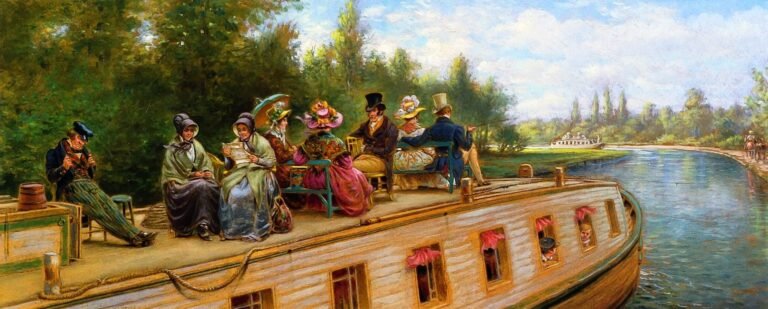
One phrase from the canal has outlived nearly everything else about it: Low bridge, everybody down. It was a literal warning, not a lyric. The canal was crossed by countless low road bridges, and passengers riding on the flat roof of a boat — the coolest, best seat on a slow summer day — had to duck flat or scramble down entirely as one approached, or be swept off. The steersman’s cry passed the danger back down the boat. (The song that made the phrase famous is a story of its own, told elsewhere in our history section; here it is enough to know that the words describe a real hazard of a world moving at four miles an hour, close enough to the bank that a bridge could take your hat — or your head.)
That is the texture of the vanished working canal: slow water, a hard dirt path, a patient team in harness, a barefoot child keeping pace, and a shout to duck as the bridge came on. The Erie Canal made New York the Empire State and opened a continent to settlement. It did so at four miles an hour, one mule and one hoggee at a time.
Gallery
Sources
eriecanal.org — Working Boats (eriecanal.org/boats-2.html): six-hours-on/six-off shift, two teams (one working, one resting in the bow stable), changeover with little delay, hoggee sleeps with the off-duty team, block-and-tackle loading of reluctant mules; and eriecanal.org/boats.html: usual speed of four miles per hour, boats drawn by horses or mules on the towpath. Erie Canal Museum — “19th-Century Kids on the Erie Canal” (eriecanalmuseum.org/19th-century-kids-erie-canal): hoggees as the iconic child job (ages ~10–12), ~$10/month plus sleeping space aboard, drowning risk and children tethered by rope or chain, cholera/measles/whooping cough, bucket sanitation emptied overboard, winter school/skating/amusement parks, and the 1848 church report of ~10,000 boys employed on New York's canals. Erie Canal Museum, Reflections — “Low Bridge, Everybody Down” (reflections.eriecanalmuseum.org/music/low-bridge-everybody-down): “fifteen miles” as the average distance a mule pulled a boat; passengers on the roof ducking or getting down at low bridges. Sullivan County Democrat, “Hoggees on the Towpath” and The Delaware Company, “Homage to a Hoggee”: etymology of “hoggee” (from “haw/gee,” disputed vs. “hogler”), barefoot boy in overalls/straw hat, ~10 years old, walking ~18–20 miles a day, and the traditional “Hoggee on the towpath” verse (attribution uncertain, presented as traditional). Boat capacity ~30 tons per the guide's Clinton's Ditch feature (eriecanal.org). Bronze hoggee-and-mule statue at the Erie Canal Museum, Syracuse. NOTE: The frequently cited first-person Catherine Huftill account (canalmuseum.org) is from the D&H Canal, not the Erie, and was deliberately not quoted here.