Low Bridge, Everybody Down: The Song That Remembers the Mules
A working man wrote it in 1905 to mourn a way of life that was already disappearing.
If you grew up anywhere near New York State, you can probably sing the chorus without being asked twice:
“Low bridge, everybody down /
Low bridge, for we’re coming to a town.”
That’s from “Low Bridge, Everybody Down,” also cataloged as “Fifteen Miles on the Erie Canal,” and it is, by a wide margin, the best-known Erie Canal song ever written. It is also a piece of deliberate nostalgia — a farewell, composed at the exact moment the world it describes was being paved over by engines. Understanding why it was written, and why it says what it says, turns a children’s-camp singalong back into what its author intended: an elegy for the age of the mule.
Who wrote it, and when
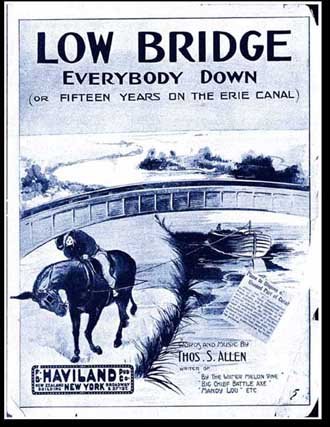
The song is credited to Thomas S. Allen, a songwriter of the Tin Pan Alley era, who wrote it in 1905. There’s a useful distinction to keep straight here, because dates get muddled: Allen wrote the song in 1905, but it was first recorded in 1912 and published in 1913 by the F.B. Haviland Publishing Company. Wikipedia notes that despite Allen’s credit as author and composer, the song’s precise “origin and authorship remain in question” — a fair flag, since folk-flavored Tin Pan Alley numbers often borrowed freely.
One caution on that 1905 date: it’s the year the Erie Canal Museum and other sources give for when Allen wrote the song, but the firmly documented milestone is the 1913 sheet-music publication (the surviving primary-source sheet music in the New York Public Library’s collection carries the 1913 imprint). When it first appeared in print in 1913, its full title was “Low Bridge! — Everybody Down,” subtitled “Fifteen Years on the Erie Canal.” The now-familiar “fifteen miles” wording didn’t appear in print until 1926. Keep all three dates in view — written c. 1905, published 1913, “miles” variant printed 1926.
The reason the year matters is everything. By the time Allen set the song down, the Erie Canal had been open for roughly eighty years, and the mule-drawn boat was on its way out. New York State was already committed to building the New York State Barge Canal, a massive modernization that would move traffic off the old towpath and hand it to steam and, soon, diesel power. The Erie Canal Museum puts it plainly: Allen wrote the song “to commemorate nearly 80 years of Erie Canal history,” right as the animal that had powered that history was being retired. The song isn’t a work song sung by boatmen at their labor — it’s a memorial written about them, looking back.
What the song is actually about: the mule era
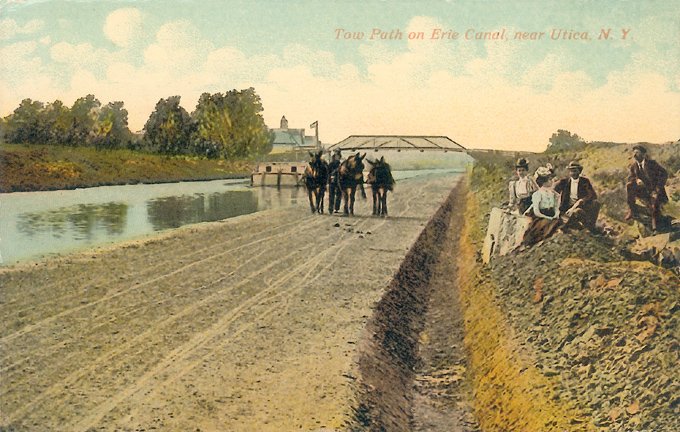
To hear the song correctly, you have to picture how a canal boat actually moved. There was no engine. A boat was pulled along the water by a team of mules (or sometimes horses) walking a dirt path beside the canal called the towpath, connected to the boat by a long tow-line. Leading those animals was a driver — often a child — called a hoggee (pronounced HO-gee), a term for someone who drives animals along a canal. Kids as young as grade-schoolers walked the towpath for long hours and low pay, sometimes around $10 a month and a place to sleep on the boat. A church report in 1848 claimed 10,000 boys were employed on New York’s canals.
That’s the world of the song. Its narrator is a boatman addressing his mule — famously named Sal — with the weary affection of someone who’s spent his life beside the animal:
“I’ve got a mule, her name is Sal /
Fifteen miles on the Erie Canal.”
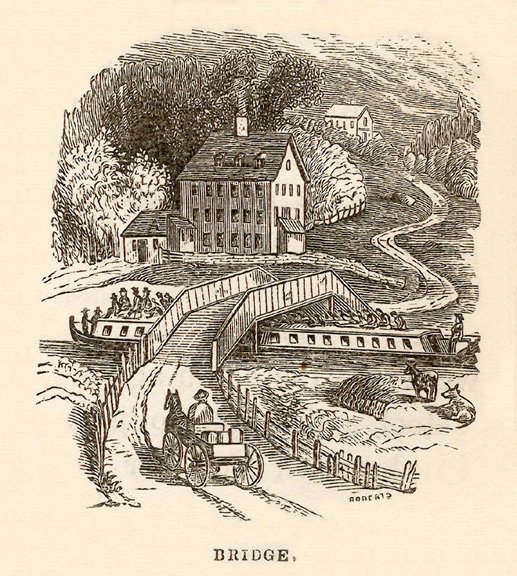
The “low bridge” of the title was a real, constant hazard, not a metaphor. Passengers liked to ride up on the flat roofs of the canal boats to catch the air and the scenery. But the canal was crossed by countless low road bridges, and when the boat approached one, anyone on the roof had to duck flat or scramble down or risk being swept off. The cry “Low bridge, everybody down!” was the boat crew’s warning shout — the song simply set the working reality to a tune.
Why “fifteen miles”? (And why the original said something else)
Here’s the detail that trips up almost everyone, and it’s worth getting right because it’s the single most-asked question about the song.
The version nearly everyone sings today says “fifteen miles on the Erie Canal.” But Allen’s original 1905 lyric was “fifteen years on the Erie Canal.” The two words tell two different stories:
- “Fifteen years” — the original — was the narrator describing how long he’d worked the canal alongside his mule Sal. It’s a statement about a lifetime of labor.
- “Fifteen miles” — the modern, more common version — refers to the typical distance a mule team would haul a boat before being swapped out for a fresh team.
That “fifteen miles” figure isn’t arbitrary, and it’s corroborated by how the boats actually operated: fast passenger packet boats changed their mules roughly every fifteen miles, some carrying spare animals in an onboard stable so the swap could happen with little delay. So the modern lyric, even though it wasn’t Allen’s, happens to encode a genuine operational fact of canal life. Both readings are “correct” — one is the author’s, one is the folk tradition’s. A good rule when writing or teaching the song: name both, and don’t pretend the popular version is the original.
A song with a lot of names
Part of what makes the song feel like folk tradition rather than a single copyrighted number is that it travels under many titles. Beyond “Low Bridge, Everybody Down,” it’s known as “Fifteen Miles on the Erie Canal,” “Fifteen Years on the Erie Canal,” “The Erie Canal Song,” “The Erie Barge Canal,” and simply “Mule Named Sal.” That title-drift is itself evidence of how thoroughly the piece slipped out of Tin Pan Alley and into the American common songbook.
The legacy: from parlor tune to national standard
Allen’s melody proved astonishingly durable. Over the twentieth century it was recorded by a who’s-who of American popular and folk music — early recordings by Billy Murray and Vernon Dalhart, then the folk-revival giants Pete Seeger, The Weavers, and The Kingston Trio, and, much later, Bruce Springsteen, who cut it for his 2006 folk album We Shall Overcome: The Seeger Sessions. It crossed into children’s culture too, turning up in television as varied as Animaniacs and VeggieTales. For generations of American schoolchildren, it became the default — often the only — thing they’d ever learn about the canal.
There’s a quiet irony in that success. Thomas S. Allen wrote a goodbye. He set down the mule, the towpath, the hoggee’s shout, and the fifteen-mile haul precisely because they were vanishing — pushed aside by the engines of the Barge Canal era. The song was meant to preserve a memory. Instead it became the memory. When most people picture the Erie Canal today, they don’t picture the concrete locks and diesel barges that replaced the old ditch; they picture a boatman, a mule named Sal, and a low bridge coming up on a town.
That’s not the whole truth of the Erie Canal. But it might be the most beloved part of it — and it survives because one man in 1905 thought a disappearing world deserved a song.
A note on copyright: This article quotes only short, widely-reproduced public-domain lines from the chorus and first verse. The full lyrics and sheet music are freely available through the sources below.
Gallery
Sources
Erie Canal Museum, Reflections on Erie’s Waters — “Low Bridge, Everybody Down”: https://reflections.eriecanalmuseum.org/music/low-bridge-everybody-down/; Wikipedia — “Low Bridge (song)” (corroboration source): https://en.wikipedia.org/wiki/Low_Bridge_(song); Explore Buffalo — “Low Bridge, Everybody Down by Thomas S. Allen (1905)”: https://explorebuffalo.org/wp-content/uploads/2018/05/Erie-Canal-Song.pdf; Erie Canal Museum, Reflections on Erie’s Waters — song context: https://reflections.eriecanalmuseum.org/music/low-bridge-everybody-down/; Erie Canal Museum & eriecanal.org — canal life (hoggees, packet-boat mule changes): https://eriecanalmuseum.org/19th-century-kids-erie-canal/ and https://www.eriecanal.org/boats-2.html