Mother of Cities: How the Canal Built Buffalo, Rochester, Syracuse, and Utica
They were frontier villages when the first shovel went in. A single generation later, they were industrial cities — flour, salt, grain, and cloth, all of it riding the same forty-foot ditch.
The Erie Canal earned a great many nicknames in its long life — Clinton’s Ditch, Clinton’s Folly, the Grand Canal — but one of them is a quiet boast about what the waterway did to the land it crossed. The Erie Canalway National Heritage Corridor calls it the “Mother of Cities,” a name earned, in the Corridor’s words, “because it gave rise to so many cities, towns, and villages.”
That is not sentimentality. It is close to literal fact. When the first shovel went in near Rome on July 4, 1817, the places that would become Rochester, Syracuse, Buffalo, and Utica were frontier settlements — mill hamlets, salt camps, a lakeshore trading post, a Mohawk River ford. A single generation later they were industrial cities, each one built on a specific commodity that the canal, and only the canal, could carry to market at a price that made the whole enterprise pay. Immigrants, the Heritage Corridor notes, “flocked to the state, knowing they could find work in the many new communities developing along the canal.”
What follows is the boomtown effect city by city — four villages, four fortunes, one ditch.
Rochester: the Flour City
No city rose faster or more directly on the canal than Rochester, and none tells the story more cleanly. The ingredients were already in place: the Genesee River drops over a series of falls right in the heart of town, and waterpower like that had drawn millers to the spot before anyone had strung a canal across the state. What Rochester lacked was a way to sell what its mills produced.
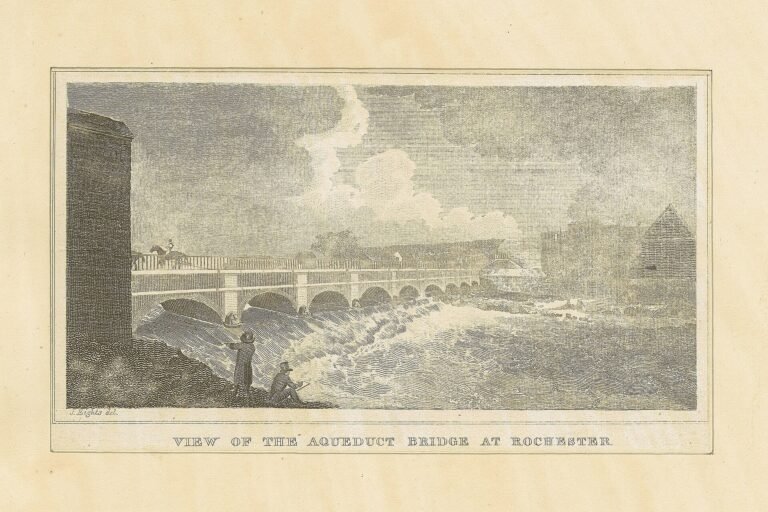
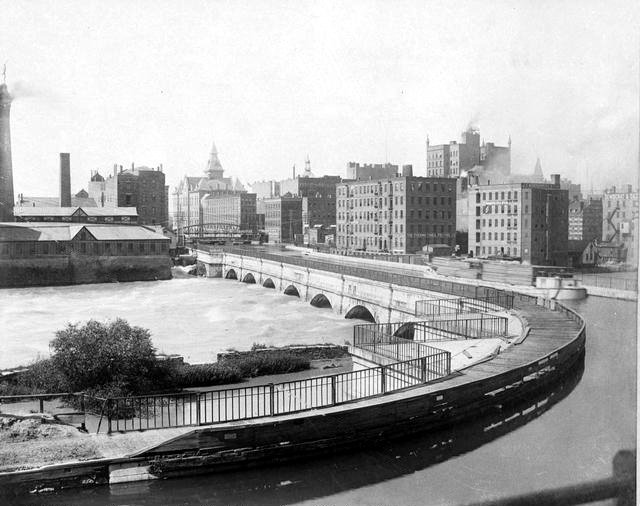
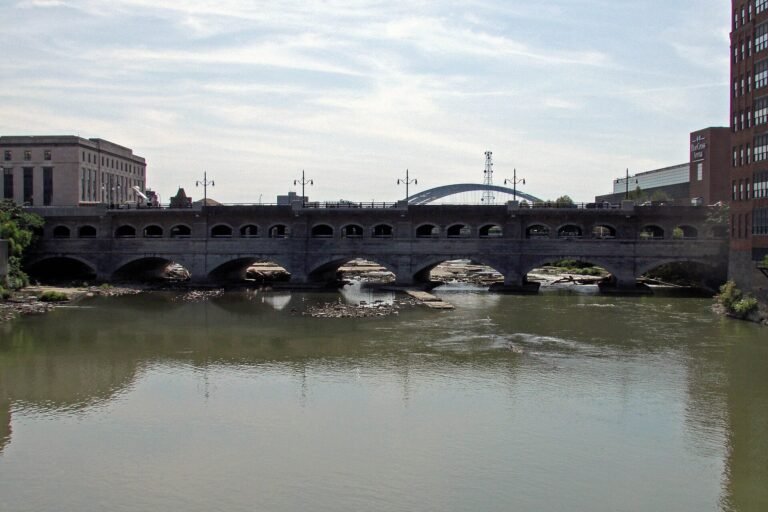
The canal supplied it — and did so before the line was even finished. In 1823, two years ahead of the full opening, builders completed the first Erie Canal aqueduct across the Genesee, an 800-foot stone bridge that carried the canal over the river and stitched Rochester into the eastbound trade. The effect was instant and almost comic in its scale: in the first ten days after the canal opened east to the Hudson, the histories record, 40,000 barrels of Rochester flour — some 3,600 tons — moved to Albany and New York City.
The arithmetic behind that flood explains everything. Before the canal, shipping a ton of flour out of Rochester by wagon cost roughly $100; the canal, by the figures the local histories carry, dropped that to around $7 a ton. A miller who had been landlocked was suddenly a national supplier. The Genesee River powered the mills, the mills made the flour, and the canal moved the flour — and the town clustered along the gorge at Brown’s Race became, by 1838, the largest flour-producing city in the world. Population followed the barrels: Rochester passed 9,200 residents by 1830 and was re-chartered as a full city in 1834. It has been the “Flour City” ever since — a name later softened, when the mills gave way to seed farms and nurseries, into the “Flower City,” a pun the town has never quite let go of.
Syracuse: the Salt City
Syracuse was built on brine. The salt springs around Onondaga Lake had been known for centuries — the Onondaga Nation used the salty waters long before French Jesuits wrote about their taste in the 1600s — and in 1797 the New York legislature set the whole area aside as the Onondaga Salt Springs Reservation, a public resource the state leased and taxed by the bushel. Salt was boiled out of the brine in iron kettles or dried in vast shallow beds under the sun. What it lacked, again, was cheap carriage to the rest of the country.
Here the canal and the commodity are bound together more tightly than anywhere else on the line, because the salt helped pay for the canal that carried it. The tax New York levied on Onondaga salt was, by the histories’ account, a significant source of the state revenue that funded canal construction — a rare, almost circular arrangement in which a single commodity underwrote the very infrastructure that would make its fortune. When the canal opened in 1825, it did exactly that: it “amplified the industry,” in the standard telling, by making it cheap to ship Syracuse salt across the growing nation.
The output that followed is hard to picture now. By the mid-1800s the Syracuse works were producing more than 12 million bushels of salt a year and stood as the largest salt-producing region in the United States. The nickname wrote itself: the “Salt City,” a title Syracuse still wears on team jerseys and beer labels long after the last works closed. And close they did — competition and the exhaustion of the concentrated brine sent the industry into decline by 1900, and the final salt works shut down in the 1920s. But the city the brine built remained.
Buffalo: the grain port at the end of the line
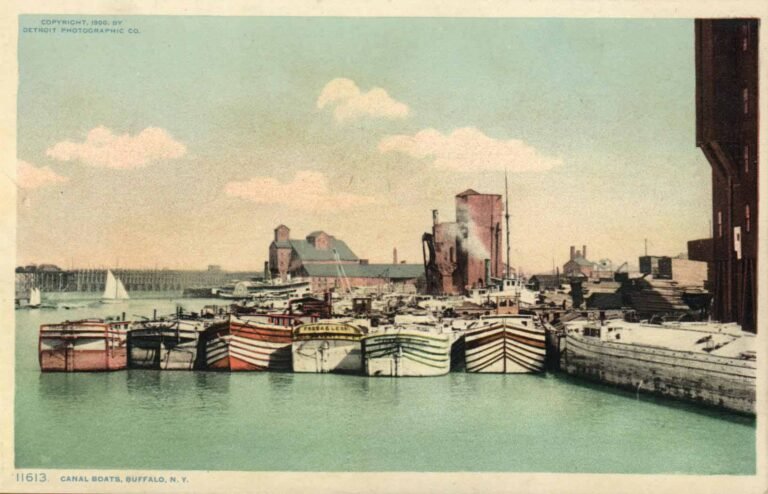
Buffalo won the greatest prize on the canal simply by standing where it did. The village sat at the eastern edge of navigation on the Great Lakes and the western end of the new canal — the exact seam where lake shipping had to stop and canal shipping began. Every bushel of Midwestern grain bound for the Atlantic seaboard came off a lake vessel at Buffalo, and every bushel had to be moved, by hand, into a canal boat for the 363-mile haul to Albany. Geography made Buffalo the great transfer point of the American interior, and the grain trade made it rich.
The bottleneck was the transfer itself, and Buffalo solved it with a machine that changed world shipping. In the fall of 1842, the merchant Joseph Dart and the engineer Robert Dunbar built a steam-powered grain elevator on the Buffalo waterfront — a tower of buckets that scooped grain straight out of a ship’s hold and hoisted it into storage, doing in hours what gangs of laborers had done in days. Buffalo’s own histories and the Heritage Corridor call it the first of its kind in the world; Dart’s own biography is cited more cautiously as “the first in America.” Either way, it worked, and it multiplied. Within roughly fifteen years, ten elevators lined the Buffalo harbor, and the histories’ common claim is that Buffalo became the largest grain-shipping port in the world — by one account overtaking London and Rotterdam — a title it held into the era of the railroads. The grain elevator itself became Buffalo’s signature contribution to industry, and the surviving concrete giants along its river are landmarks to this day.
Utica: the transfer town that wove cloth
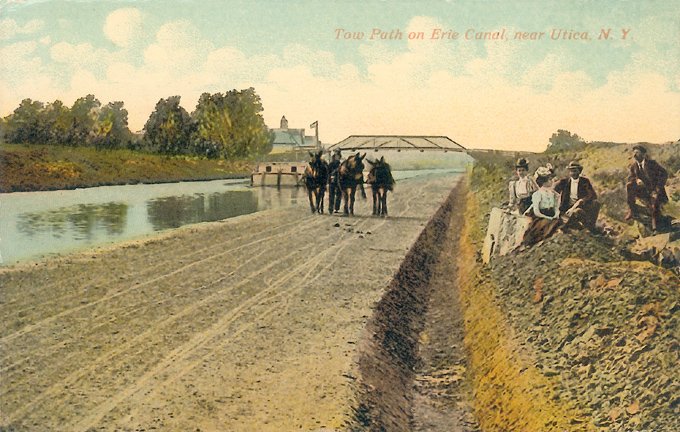
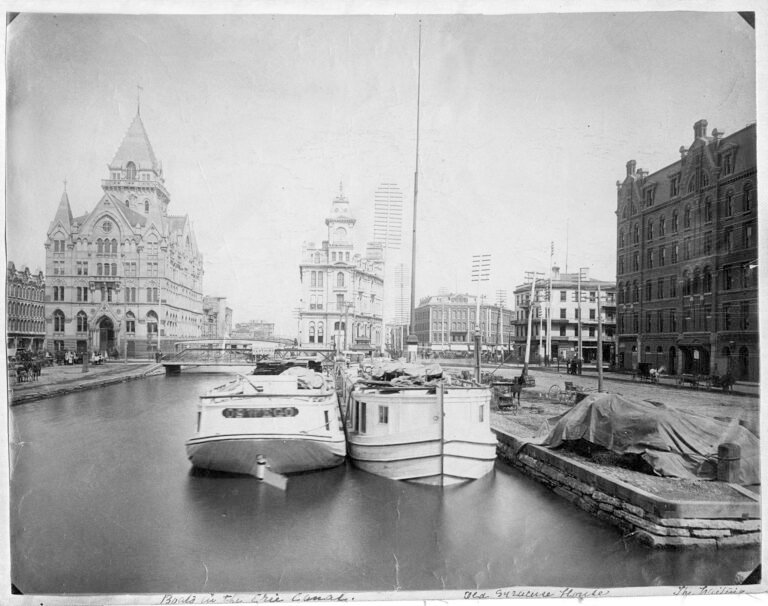
Utica’s rise was quieter than the others, but no less a creature of the canal. The settlement sat on the Mohawk River at a natural crossing point, and when the canal came through it made Utica a layover — a place where freight and passengers moving between Albany and Syracuse stopped, changed hands, and spent money. The canal turned an old river ford into an inland port, and the port drew people. The town’s population climbed from about 3,000 in 1820 toward a figure that would reach 56,000 by 1900, growth rapid enough that the histories rank Utica among the fastest-growing cities in the state.
What turned a transfer town into a manufacturing one was cloth. The canal delivered both the raw cotton and the immigrant labor — waves of Irish and German newcomers carried in on the completed waterway — and Utica put them to work in textile mills. By the middle of the nineteenth century, textiles were the city’s dominant industry, its mills producing cotton cloth and apparel and employing thousands; in time the city styled itself a hub of the textile trade. Utica was incorporated as a city in 1832, seven years after the canal opened, and by the 1840 census it already held more people than Chicago, Detroit, or Cleveland — frontier towns that had not yet had their own canals and railroads come through.
The common thread
Look at the four together and the pattern is unmistakable. Each city had something the world wanted — Rochester’s flour, Syracuse’s salt, Buffalo’s position at the grain gate, Utica’s cloth — and each had it stranded, before 1825, behind the crushing cost of moving heavy goods overland across a roadless interior. The canal did not invent the flour or the salt or the harbor. It did something subtler and more powerful: it made them sellable, by dropping the cost of carriage so far that a landlocked mill town could suddenly supply a continent. That is the boomtown effect in a sentence. The ditch that a president had called “little short of madness” reached across the state and, in the span of a single generation, turned a string of frontier villages into the industrial spine of New York.
The cities it mothered are still here, and still carry their canal-era names — the Flour City, the Salt City, the grain port at the end of the line. To follow the modern waterway west is to trace that same rise, stop by stop, from the mills of Rochester to the harbor at Buffalo. The canal made them. It is a claim the histories make without hedging, and for once the record backs the boast.
Gallery
Sources
Erie Canalway National Heritage Corridor / NPS — History & Culture, “Mother of Cities” framing, canal opened interior to settlement, immigrants “flocked to the state” (eriecanalway.org/learn/history-culture). Rochester: Wikipedia, “History of Rochester, New York” — Flour City name, mills on Genesee falls at Brown’s Race, 800-ft Genesee aqueduct completed 1823, 40,000 barrels (3,600 tons) in first ten days after opening, largest flour-producing city in the world by 1838, population 9,200 by 1830, city charter 1834 (en.wikipedia.org/wiki/History_of_Rochester,_New_York); WHEC “How the Erie Canal made Rochester the ‘Flour City’” and Wikipedia “Rochester, New York” — $100/ton to $7/ton wagon-vs-canal freight figure, corroboration. Syracuse: Syracuse Salt Co. / Exploring Upstate / Onondaga Historical Association / Empire State Plaza — Onondaga salt springs, 1797 Onondaga Salt Springs Reservation (state-leased, taxed per bushel), salt tax revenue helped fund canal construction, >12 million bushels/year and largest U.S. salt region by mid-1800s, “Salt City” nickname, decline by 1900 and works closed 1920s; Wikipedia “Syracuse, New York.” Buffalo: Wikipedia “Joseph Dart” — steam-powered grain elevator built 1842 (“first in America”), opened June 1843, ten elevators within ~15 years, “world’s largest grain shipping port,” overtaking London and Rotterdam; buffaloah.com Grain Elevators history and ESD “Erie Canal’s Western Terminus” — Buffalo at east end of Great Lakes navigation / west end of canal, lake-to-canal grain transfer, Dart & Dunbar first steam-powered elevator “in the world” (attribution noted; sources vary between “in the world” and “in America”). Utica: Wikipedia “Utica, New York” and Britannica — canal-driven growth, incorporated as a city 1832, population ~3,000 (1820) to 56,000 (1900), Irish/German immigration via canal, textile/cotton manufacturing dominant by mid-19th century, larger than Chicago/Detroit/Cleveland in 1840 census. Jefferson “little short of madness” quote — see companion feature, History.com. Note on conflicting figures surfaced in text: Buffalo grain-elevator “first in the world” vs. “first in America.”