Troy
Approx. Mile -4–0 along the Erie Canal
Tidewater Hudson — the river gateway below Erie mile 0; a federal lock lifts boats toward the canal. Which canal is this? →
Troy is where the Hudson stops behaving like a river and starts behaving like a canal. The Troy Federal Lock and Dam, a U.S. Army Corps of Engineers structure spanning the river from Troy on the east bank to Green Island on the west, marks the upper end of the Hudson River estuary — the furthest reach of tidal influence. This is the head of tide: below it, the river breathes with the ocean; above it, you are climbing.
For a boater bound west, Troy is the last tidal stop and the true gateway, though not quite the starting line. The Erie Canal officially has no "Lock 1"; the canal proper begins a few miles upstream at Waterford, where Lock E-2 opens the famous flight. The Federal Lock is the unofficial start — a prologue lock before the canal's real work begins.
What makes Troy worth the tie-up is what waits ashore: a restored working waterfront at the Downtown Marina and Riverfront Park, one of the best-preserved 19th-century commercial streetscapes in the Northeast, and an industrial-revolution history dense enough to fill an afternoon. Provision here, walk the old city, then go make your climb.
The city that armed and dressed a nation
Troy is not on the Erie Canal — and that is exactly the point. The true canal begins a few miles upstream at Waterford, where Lock E2 lifts boats into the Mohawk. Troy sits below it on the tidal Hudson, at the head of tide: the Troy Federal Lock and Dam, thrown across the river from Troy to Green Island by the U.S. Army Corps of Engineers and opened in 1916, marks the furthest reach of the ocean’s pull up the river. Above it the water runs fresh and man-made; below it, twice a day, the Atlantic still climbs 150 miles inland to lap at the city’s docks. For a boater bound west, Troy is the last tidewater stop and the doorstep of the whole 360-mile story — and if the difference between a canal and a canalized river needs sorting out, start with Which canal is this?
What makes the doorstep worth a long look is what Troy did with that tidewater. Deep-water ships reached it from New York Harbor, canal boats from the west, and the Wynantskill and Poesten Kill tumbled down from the hills behind town with water power to spare. That rare combination — ocean navigation, canal freight, and falling water in one place — turned Troy into one of the most productive industrial cities in nineteenth-century America.
It armed the Union. When the ironclad USS Monitor was rushed into being in the winter of 1861–62, its iron came largely from Troy: the Albany Iron Works rolled the hull plates and the neighboring Rensselaer Iron Works forged the rivets. Troy iron went to sea at Hampton Roads and helped change naval warfare in an afternoon. The city’s greatest ironmaster, though, made his name on something humbler and endless: horseshoes. Henry Burden, a Scottish-born engineer who came to Troy in the 1820s, built machines that spat out finished horseshoes by the millions, and powered his works on the Wynantskill with the Burden Water Wheel — a colossus 62 feet across and 22 feet wide, weighing some 250 tons and turning out roughly 500 horsepower. Built in 1851, it is remembered as one of the most powerful vertical water wheels ever built, and it turned, day and night, for nearly half a century before it was abandoned in the 1890s.
And it dressed the country. In 1827, by local tradition, a Troy housewife named Hannah Montague grew tired of laundering her husband’s whole shirt when only the collar was soiled, and simply cut the collar off to wash it separately. The detachable collar was born, and Troy became the “Collar City,” at its peak producing the overwhelming majority of the collars worn in America. The industry’s giant was Cluett, Peabody & Co., whose Arrow brand — sold behind the impossibly dapper illustrated “Arrow Collar Man” — made Troy shirts a national byword for style.
All of that industry needed engineers, and Troy built the school that made them. Rensselaer Polytechnic Institute was founded here on November 5, 1824 — the year before the Erie Canal opened — by patroon Stephen Van Rensselaer and the scientist Amos Eaton, “for the application of science to the common purposes of life.” It is the oldest technological university in the English-speaking world, and its graduates went on to build the bridges, railroads, and waterworks of a rising continent.
Troy’s most famous export, though, wears a top hat. By long tradition, the nation’s nickname was born here: Samuel Wilson, a Troy meatpacker who supplied the U.S. Army in the War of 1812, is said to have stamped his provision barrels “U.S.,” and soldiers joked the initials stood for “Uncle Sam.” Historians treat the barrel-stamp anecdote as folklore — the printed tale postdates the war, and “Uncle Sam” had appeared in print even before Wilson’s contract — but the affection was real enough that Congress formally recognized Troy’s Samuel Wilson as the namesake in 1961. Wilson lies today in the city’s Oakwood Cemetery, above the tidewater river that made Troy rich. Tie up at the downtown marina and it is all within a walk: the Collar City that clothed America, the ironworks that armored it, and the quiet grave of the man who gave it a name.
In this stretch
Places to Eat
Provisions & Shops
Things to see & do
Arriving by boat
The Troy Downtown Marina sits on the east bank right in the heart of downtown, and the City of Troy has announced its opening for the 2026 season (city contact 518-279-7130). Listings describe it as offering over 400 feet of available dockage with seasonal and transient slips; a fuel dock, pump-out, and marina store are also described but could not be independently confirmed for this guide, so treat fuel, pump-out, and hours as things to confirm on arrival and in season. Likewise, depth, VHF working channel, and transient rates were not verified in our sources — call ahead or check the marina's own listing before you commit.
Just downstream, William F. Chamberlain Riverfront Park is a 4.4-acre waterfront in the center of town, reopened by a 2020 renovation and equipped with power, water, and free WiFi. Whether the park wall permits transient tie-up — versus docking only at the adjacent marina — is not confirmed; check with the city first.
Transiting the Troy Federal Lock itself is straightforward in concept: a single USACE chamber, 520 feet by 45 feet, with a lift of roughly 14 to 17 feet (1 Federal Lock Access Road). The monitored VHF channel and small-craft lockage signaling were not captured in our sources — confirm the current procedure against USACE or your cruising guide before you arrive. No designated anchorage in the immediate Troy pool was verified either; plan on the marina rather than swinging on a hook.
By bike & foot
Troy is unusually walkable off the water, and it rides well too. The Uncle Sam Bikeway (with the South Troy Riverfront Trail) runs roughly seven miles connecting north and south Troy, including about three miles of paved off-road riding along the former Troy & Boston Railroad line, stitched together downtown with shared lanes, bike lanes, and cycle tracks.
For long-distance riders, the payoff is the connection to New York's Empire State Trail: at the Troy–Menands Bridge, the Uncle Sam Trail meets the Mohawk–Hudson Bike-Hike Trail, a few yards north of the Route 378 bridge. From there you can reach a riverside parking lot, pass beneath the Collar City Bridge (Route 7) and the Green Island Bridge, and roll right into Chamberlain Riverfront Park. The off-road segment is paved former rail bed; the downtown stretches run on-street. Specific trailhead parking and local bike-shop names weren't verified — worth a quick check before you rely on either.
By paddle
Paddlers have a purpose-built put-in at the Ingalls Avenue Boat Launch (1 Ingalls Avenue), a 30-by-80-foot concrete ramp with a sectional floating dock, aluminum gangway, and a dedicated kayak launch port. It's ADA-designed, with 19 car/trailer spaces, and serves both motorized and non-motorized craft. It's listed as a Canoe/Kayak Access on the Hudson River Water Trail.
Note the geography before you plan a route: Ingalls Avenue sits immediately south of — and below — the Federal Lock and Dam. To continue upstream, you'll either need to lock through under small-craft procedure or portage around the dam; whether a formal paddler portage exists at the Federal Lock is not confirmed, so check with USACE first. Further up, paddlers can "paddle the flight" at Waterford during festival events.
By car
If you're rolling in on wheels, downtown Troy offers on-street and lot parking around Monument Square and River Street; the Troy Waterfront Farmers Market publishes a parking page worth consulting, though specific municipal lot names and rates weren't verified. From a car base you can easily reach the RiverSpark Visitor Center (251 River St), the Burden Iron Works Museum, and Oakwood Cemetery with Uncle Sam's grave. The USS Slater lies about six miles south in Albany — on your way up the Hudson, but not in Troy itself.
Where to eat
Dinosaur Bar-B-Que (377 River St) is the natural first stop off the marina — a River Street anchor since November 2010, with riverside seating overlooking the Hudson, a back porch, and a private Hudson Room that seats up to 45. It's an easy walk off the docks and a reliable crowd-pleaser.
Beyond the barbecue, Troy's dining runs deep. Sunhee's Farm and Kitchen brings Korean cooking to downtown, and Tara Kitchen turns out Moroccan tagines and couscous in an intimate, date-night setting. Both surfaced through a local roundup rather than primary listings, so confirm current hours and addresses before you set out. The three above are the best-verified of a much larger scene — worth exploring on foot once you've tied up.
Where to sleep
If you're stepping off the boat for a night ashore, the Hilton Garden Inn Troy offers quick access to downtown and I-787, with an on-site Recovery Sports Grill and Garden Grille & Bar, an indoor pool, and free WiFi. The Best Western Plus Franklin Square Inn Troy/Albany is a downtown option popular with families, and the Courtyard by Marriott Albany Troy/Waterfront gives you a waterfront-branded Marriott nearby.
For something with more character, the Gardner Farm Inn is a preserved Victorian B&B with a patio, private parking, and garden views — though confirm it's in or near Troy proper before you book, as its exact location wasn't verified.
What to see
Start with the history that built the city. The RiverSpark Visitor Center (251 River St), run by the Hudson Mohawk Industrial Gateway, is the best introduction to Troy's industrial heritage. From there, the Burden Iron Works Museum occupies the Romanesque Revival former Burden office (1881–82) and tells the story of the legendary Burden Water Wheel — described as the most powerful vertical water wheel in history at 62 feet in diameter, 22 feet in breadth, roughly 250 tons, and about 500 horsepower. It's open May through December, Wednesday to Friday, noon to 4 p.m.; admission is $10 for adults, and kids under 12 are free with an adult.
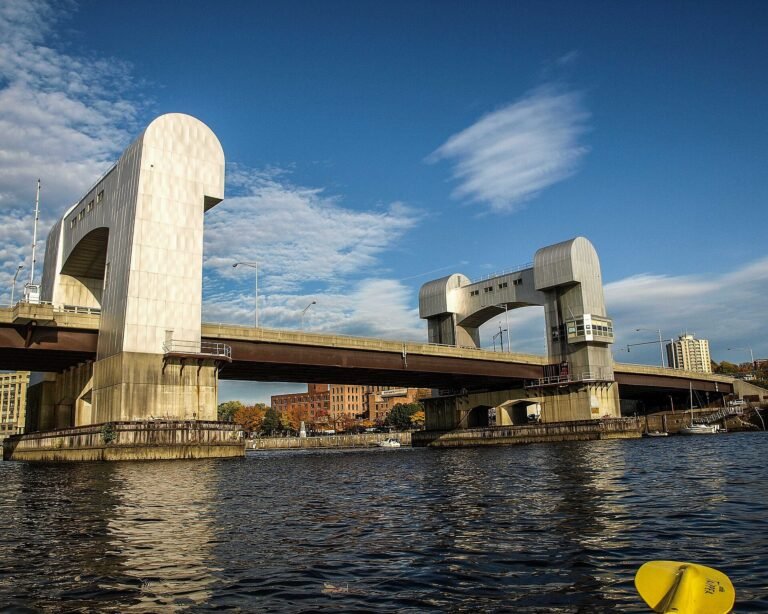
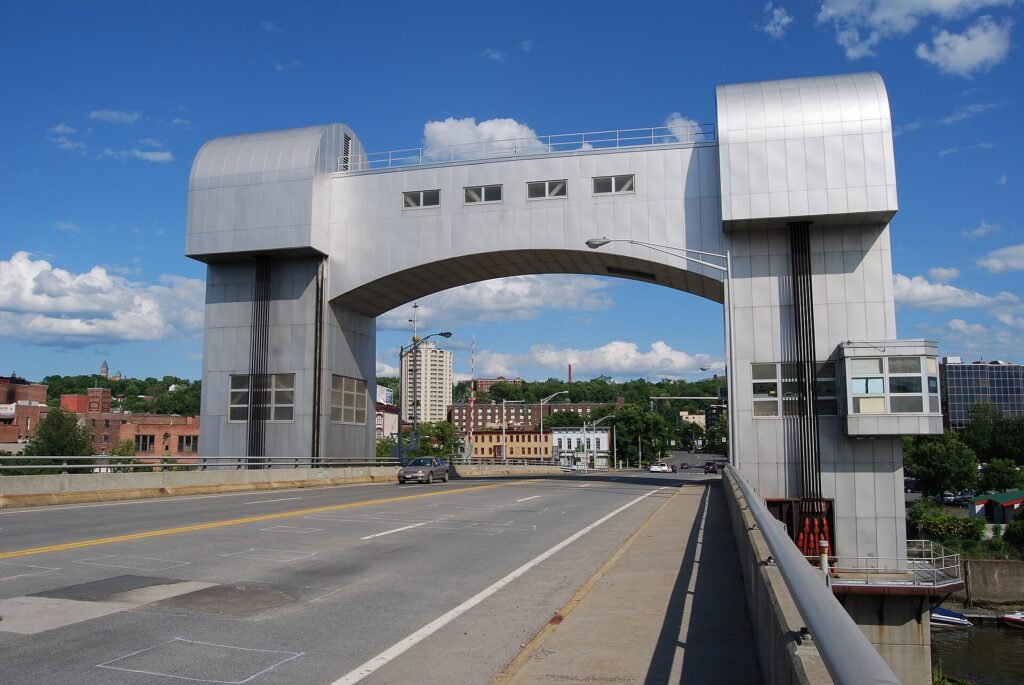
On the waterfront, the Green Island Bridge — a vertical-lift bridge opened September 12, 1981 — is the signature landmark right at the downtown marina. Inland, Monument Square and the Soldiers & Sailors Monument (Broadway & 2nd St) form the historic heart of the Central Troy Historic District, while Oakwood Cemetery — one of America's largest rural cemeteries, established 1848 — overlooks the Hudson Valley and holds the grave of Samuel "Uncle Sam" Wilson. Wilson (1766–1854) was a Troy meat packer who supplied the U.S. Army in the War of 1812; Congress officially recognized him as the origin of the national personification in 1961. The tale that soldiers read his "U.S." barrel stamps as "Uncle Sam" is folk tradition — repeated for two centuries, and treated here as legend rather than documented fact.
A little south, the USS Slater (DE-766) — a Cannon-class destroyer escort and National Historic Landmark, the only U.S. destroyer escort afloat in wartime configuration — is moored at 141 Broadway in Albany, about six miles down the Hudson. It's not in Troy, but it's directly on a boater's route up from New York.
Local history
In pictures