 Capital Region
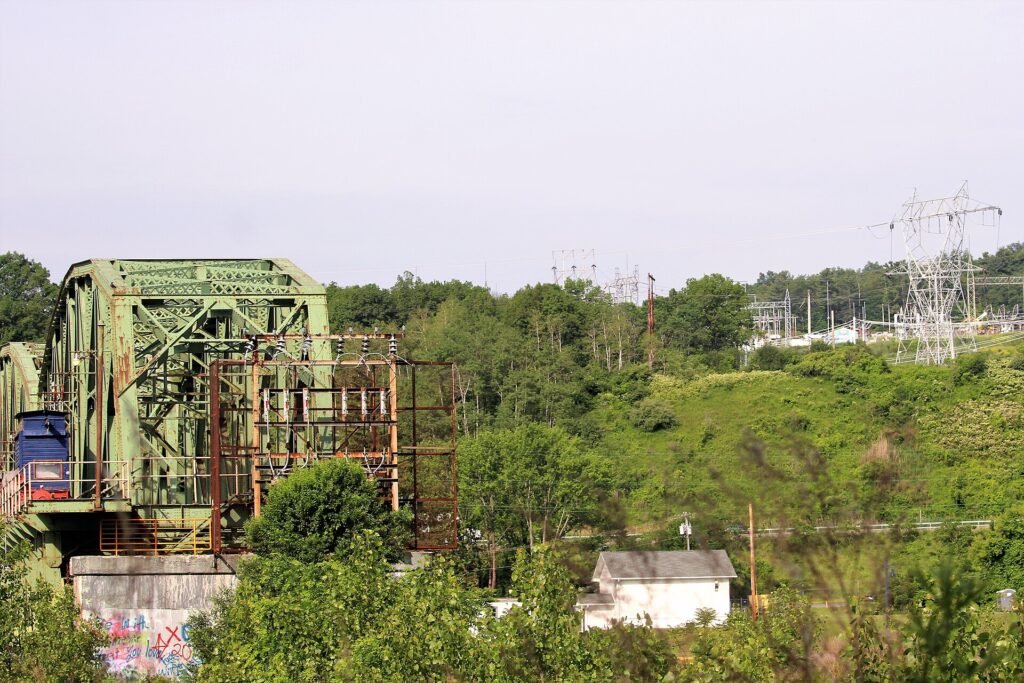
Freeman's Bridge
Capital Region
Freeman's Bridge
Erie Canal
Capital Region / Eastern Gateway
Schenectady & Scotia
Approx. Mile 13–24 along the Erie Canal
Barge Canal · 1918 — the canalized Mohawk River through Schenectady (Mohawk Harbor). Which canal is this? →
In the Schenectady reach, the Erie Canal is the Mohawk River. The canalized river carries traffic between Lock E7 at Niskayuna and Lock E8 at Rotterdam, sweeping past a revitalized city waterfront that has become one of the most talked-about stretches on the eastern canal. Schenectady earned its nickname, "The Electric City," honestly: Edison's machine works came here in 1886 and grew into General Electric, and the company anchored the city's fortunes for more than a century.
The two banks tell different stories. On the north side sits the Village of Scotia, with its riverfront Freedom Park and the beloved Jumpin' Jack's Drive-In. On the south and west bank lies downtown Schenectady, the centuries-old Stockade District, Union College, and the restored Proctors Theatre — a walkable core that rewards anyone willing to tie up and explore.
The frontier village that burned, rebuilt, and electrified the world
The raiders came out of a February blizzard. On the night of February 8, 1690, a war party that had left Montreal three weeks earlier — roughly 210 French Canadians and their Sault, Algonquin, and Mohawk allies, who had marched some 200 miles overland through the snow in about 22 days — reached the north gate of Schenectady’s stockade and found it standing open. As the story has been told ever since, the only sentries on duty were two snowmen. The village, split by the political poison of Leisler’s Rebellion, had simply stopped guarding itself.
What followed was one of the bloodiest nights on the colonial frontier. Sixty inhabitants were killed — 38 men, 10 women, and 12 children, a toll that included eleven enslaved people — and 27 more were seized and marched back toward Canada, a few of them not to return for eleven years. The attack, led by Jacques le Moyne de Sainte-Hélène and Nicolas d’Ailleboust de Manthet, was meant to remind England’s colonies that the interior belonged to France. It did not settle the question. It only proved how exposed a Dutch trading post on the Mohawk could be.
Because that is what Schenectady was. Dutch merchants had received title to farm the “Great Flats” along the Mohawk River in 1661, drawn by some of the richest bottomland in the Northeast and by the river itself — the water road to the fur country of the west. The settlement they laid out survived the massacre, rebuilt on the same ground, and then, astonishingly, kept it. Today that grid of streets is the Stockade Historic District, its blocks still lined with pre-Revolutionary brick and clapboard homes. In 1962 it became the first locally designated historic district in New York State — a neighborhood continuously inhabited for more than three centuries, protected precisely because so little of it was ever torn down.
The second act is stranger than the first. Two hundred years after the raid, a different kind of invader arrived — this one welcomed. In 1886 Thomas Edison moved his Edison Machine Works to Schenectady, taking over two unfinished buildings on a ten-acre site that had been meant for a locomotive works, and bringing about 200 workers with him. The bet paid off at a scale no one could have predicted. Edison’s electrical companies merged into Edison General Electric in 1889; three years later, in 1892, that firm combined with the Thomson-Houston Electric Company to form General Electric — which made Schenectady its headquarters. A frontier village that had been burned to snow-covered ash became, without exaggeration, one of the places where the twentieth century was engineered. The city earned a nickname it still wears: “The Electric City.”
The river tied both stories together, and it still does. The Erie Canal that runs through Schenectady is not DeWitt Clinton’s hand-dug ditch of 1825 — here the modern canal is the Mohawk River itself, canalized in the Barge Canal era and carried between Lock E7 at Niskayuna and Lock E8 at Rotterdam. For most of the twentieth century that waterfront was industrial hardpan. Now it is Mohawk Harbor, a revitalized district with a 50-slip marina billed as the only man-made harbor on the 200-year-old canal, plus an amphitheater and a kayak launch, all sitting directly between the two locks.
Stand at the harbor and the whole improbable arc is in view at once: the flats the Dutch farmed in 1661, the neighborhood that outlived a massacre, the river that carried furs and then floated the components of the electric age, and the water a boater rides today. Schenectady has burned, rebuilt, and reinvented itself more thoroughly than almost any city on the canal — and every version of it has stood on the same bend of the same river.
Live on the canal
Capital Region
Freeman's Bridge
Capital Region
Lock 8 — lock view
In this stretch
Lock E8Lock
Mohawk Harbor MarinaMarina
Mohawk Valley MarineMarina
Schenectady Yacht ClubMarina
Arrowhead Marina and RV ParkMarina
Vischer Ferry Car Top LaunchPaddle
Rotterdam Kiwanis ParkPaddle
Scotia Village Docks at Freedom ParkPaddle
Niskayuna Lions ParkPaddle
Freeman’s Bridge Fishing Access/Boat LaunchPaddle
Lock E9 Upper, RotterdamPaddle
Aqueduct ParkPaddle
Places to Eat
Provisions & Shops
Things to see & do
Arriving by boat
The centerpiece here is Mohawk Harbor Marina, and it is genuinely one of a kind: the only man-made harbor on the Erie Canal, dredged into the Mohawk Harbor development and tucked directly between Locks E7 and E8. The marina offers roughly 50 slips — about 15 of them transient — on floating docks that can handle vessels up to about 75 feet. Approach depth runs around 8 feet, and slips carry 30- and 50-amp electric, water, and WiFi.
Hail the marina on VHF channel 13 before you enter the harbor (working channel 16) to arrange a slip. Note two gaps in the amenities: there is no fuel dock and no pump-out on site, so plan those stops elsewhere along the canal. Confirm current rates and any seasonal details with the marina in season.
Once you're secured, the payoff is immediate. The harbor puts you steps from Rivers Casino & Resort, Druthers Brewing, and the Mohawk Harbor Amphitheater, with the historic Stockade district and downtown a short walk or ride beyond.
By bike & foot
The Empire State Trail and Erie Canalway Trail run straight through Schenectady, making this an easy stop for anyone traveling on two wheels or on foot. The paved, off-road Amsterdam-to-Schenectady segment — roughly 17 miles — ends in the city near Route 5 and Washington Avenue. From there, the paved Schenectady-to-Niskayuna segment continues about 11 miles east to Lions Park. Surfaces are mostly asphalt with occasional stone-dust stretches, and off-road sections typically run 10 to 12 feet wide.
Lions Park has a bike repair station and puts you within easy reach of restaurants and hotels. For shop service, New York Bicycle Co operates downtown; call ahead to confirm rentals and repairs before you rely on them.
By paddle
Paddlers have several good options in this reach. The Freeman's Bridge boat launch, a free NYSDEC access point on the Glenville/Scotia shore, is the only free public launch on the Mohawk in Schenectady County and has a wheelchair-accessible entrance. Mohawk Harbor also has a dedicated kayak launch, with additional canoe and kayak access noted at points along the Schenectady County Blueway.
Canoes and kayaks are welcome to lock through the canal's locks — figure roughly 15 to 20 minutes per lock, and it's free for paddlers. Near Lock E7, a short portage across the 1825 Towpath Trail drops small craft into a preserved segment of the original "Clinton's Ditch" along Riverview Road — a rare chance to paddle a piece of the first Erie Canal.
By car
Even if you're following the canal by car, Schenectady is worth the detour. Jumpin' Jack's Drive-In in Scotia is a seasonal riverfront institution — burgers, fries, and shakes served next to Freedom Park with ample parking and river views; check current-season hours before you go. At Mohawk Harbor, parking is free within the development, with casino parking on hand as well. Downtown, the Jay Street pedestrian strip and the Proctors district reward a park-and-wander afternoon.
Where to eat
Right on the water at Mohawk Harbor, Druthers Brewing Company pours its own beer in a large garden overlooking the harbor, while The Shaker & Vine offers a self-serve wine bar and cocktail lounge with a wide patio facing the amphitheater — two easy walks from the marina.
Across the river in Scotia, Jumpin' Jack's Drive-In serves iconic seasonal burgers, fries, and shakes on the Mohawk. Downtown, the Jay Street pedestrian strip near Proctors gathers a cluster of independent eateries worth exploring on foot.
Where to sleep
For boaters who want a night off the water, the Courtyard by Marriott Schenectady at Mohawk Harbor sits right on the riverfront at the harbor development, with river-view rooms, free WiFi and parking, and an on-site bistro. It's an easy walk from the marina and close to Proctors, Union College, and Schenectady County Community College. The Landing Hotel at Rivers Casino & Resort offers additional on-property lodging within the same Mohawk Harbor development; confirm amenities in season.
What to see
Start with the Stockade Historic District, the city's oldest neighborhood and one of the most storied on the canal — settled by Dutch traders in 1661, it became New York State's first local historic district in 1962 and holds one of the highest concentrations of pre-Revolutionary homes in the country. The district's history is not all genteel: in the 1690 Schenectady Massacre, a French-Canadian and allied Native force burned the stockaded village.
The city's industrial legacy lives at miSci — the Museum of Innovation and Science, home to the General Electric Hall of Electrical History and its vast archive of GE and Edison-era documents and photographs. Nearby, Union College centers on the Nott Memorial, a 16-sided National Historic Landmark. And downtown, Proctors Theatre — a 1926 movie palace that opened its doors on December 27 of that year — remains the anchor of the city's arts revival, alongside the Rivers Casino & Resort and the Mohawk Harbor Amphitheater's summer concert series. Across the river, Scotia's Freedom Park hosts a free summer concert series and, in 2026, marks its 50th anniversary.
Local history
According to tradition, the only sentries on duty were two snowmen. On the bitter night of February 8, 1690, a raiding party of French soldiers and allied Mohawk and Algonquin warriors found Schenectady’s stockade gate unguarded and burned the frontier village to the ground — killing some sixty inhabitants and marching others north to Canada. The settlement rebuilt on the same Mohawk River ground it had occupied since Dutch traders arrived in 1661, and that ground endures: the Stockade became New York State’s first locally designated historic district in 1962, its blocks still lined with pre-Revolutionary homes. Two centuries after the raid, Thomas Edison moved his machine works here in 1886, and the company that became General Electric made this “The Electric City.” The Erie here is the Mohawk River, canalized.