The Reform Highway: How the Erie Canal Carried a Revolution in Ideas
The same cheap, fast water that carried wheat east from Buffalo carried preachers, printers, and radicals west — and lit the most combustible stretch of moral ground in nineteenth-century America.
The freight nobody weighed
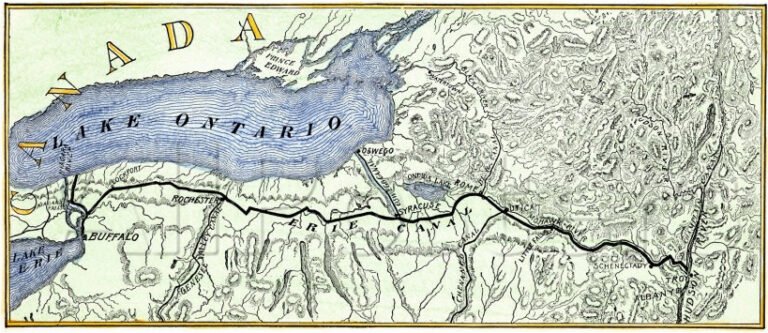
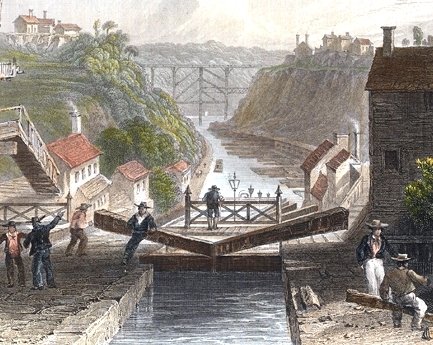
Open any ledger from the Erie Canal’s first decades and you will find it thick with tonnage: wheat, flour, salt, lumber, potash, immigrants by the boatload. What the ledgers never counted is the cargo that proved hardest to forget. Down the same 360-mile ditch that carried barrels and settlers west, there also traveled preachers, pamphlets, printers, and ideas — and in a single generation the corridor from Albany to Buffalo became the most spiritually and politically combustible ground in the United States. Historians even have a name for its western end: the Burned-Over District, a phrase the revivalist Charles Grandison Finney popularized in his 1876 memoir, for a region so repeatedly swept by religious enthusiasm that, like a scorched forest, there was no fuel left to burn.
The argument worth making here is causal, and should be read as interpretation rather than fact: mobility bred ferment. A canal that let a barrel of flour reach New York City cheaply and fast did the same for a sermon, a newspaper, or a fugitive. The Erie was an information highway as much as a freight route, and moving ideas is how you set a region on fire.
Religious fire
The blaze began, appropriately, with a fire-and-brimstone man. Finney was a lawyer turned evangelist whose revivals in the late 1820s and 1830s swept the canal towns of western New York — Rome, Utica, and above all Rochester, where his 1830–31 campaign became one of the most famous revivals in American history. He preached an urgent, democratic Christianity: salvation was a choice any listener could make now, and a converted soul was obligated to go remake the world. That second half mattered enormously. His revivals didn’t just save individuals; they manufactured reformers, and they did it in exactly the towns the canal had made into crossroads.
Finney was one preacher among hundreds. The genius of the canal, from a revivalist’s point of view, was that it collapsed distance. An itinerant preacher could ride a packet boat village to village for pennies a mile, working camp meetings and rented halls in a string of towns that water had strung together like beads, with new sects competing for souls in every one. The result was less a single revival than a permanent, rolling one — the Second Great Awakening at its most intense, concentrated along a waterway.
The town that printed a religion
Out of that fever came the corridor’s most improbable export. In a second-floor printshop on Main Street in Palmyra — a Wayne County canal boomtown — a book rolled off Egbert B. Grandin’s hand-press over the winter of 1830, on sale, the Wayne Sentinel announced, by March 26. It was the Book of Mormon, and the young man behind it, Joseph Smith, had described growing up amid what he called “an unusual excitement on the subject of religion” — the very competition of Presbyterians, Baptists, and Methodists that made the Burned-Over District burn. (Our Palmyra & Macedon section tells the full story of the printing.) The point for the corridor is simple: the faith was born in canal country, printed in a canal town, and carried outward by missionaries who fanned west along the very waterway that had made Palmyra rich enough to be called the “Queen of the Erie Canal towns.”
Utopias by the water
If mainstream revival was one response to the ferment, radical experiment was another — the conviction that a perfected community could be built from scratch. In 1848, in the town of Oneida just south of the canal line, John Humphrey Noyes founded the Oneida Community, a religious commune organized around his doctrine of “Perfectionism.” It practiced communal property, communal child-rearing, and a shocking system of “complex marriage” that scandalized outsiders for decades; it endured until 1881 and left behind, of all things, a silverware company. Elsewhere along the corridor the Shakers — the celibate United Society of Believers, established near Albany at Watervliet, America’s first Shaker settlement — offered another model of the perfected society. The canal region wasn’t just revising the old faiths. It was a laboratory for building entirely new ways to live.
The reformers ride the same water
The most consequential cargo was political. The corridor’s revival energy — the conviction that a saved soul must remake the world — poured straight into the era’s two great reform movements, and both put down roots in the canal towns.
In Rochester, the most explosive was abolition. Frederick Douglass, the formerly enslaved orator, chose the canal city as his base and there launched his antislavery newspaper The North Star, whose first issue appeared on December 3, 1847. Its masthead carried a line that became a creed of the movement: “Right is of no Sex — Truth is of no Color.” A newspaper needs distribution, and Rochester — the boomtown the canal had built into the flour-milling capital of the country — sat on the fastest information route in the young nation. The same towns that shipped abolitionist words also hid the people the movement was fighting for: canal cities up and down the corridor served as stations on the Underground Railroad, moving freedom-seekers north toward the Canadian border. (Our Rochester section carries more of that history.)
The convention just off the canal
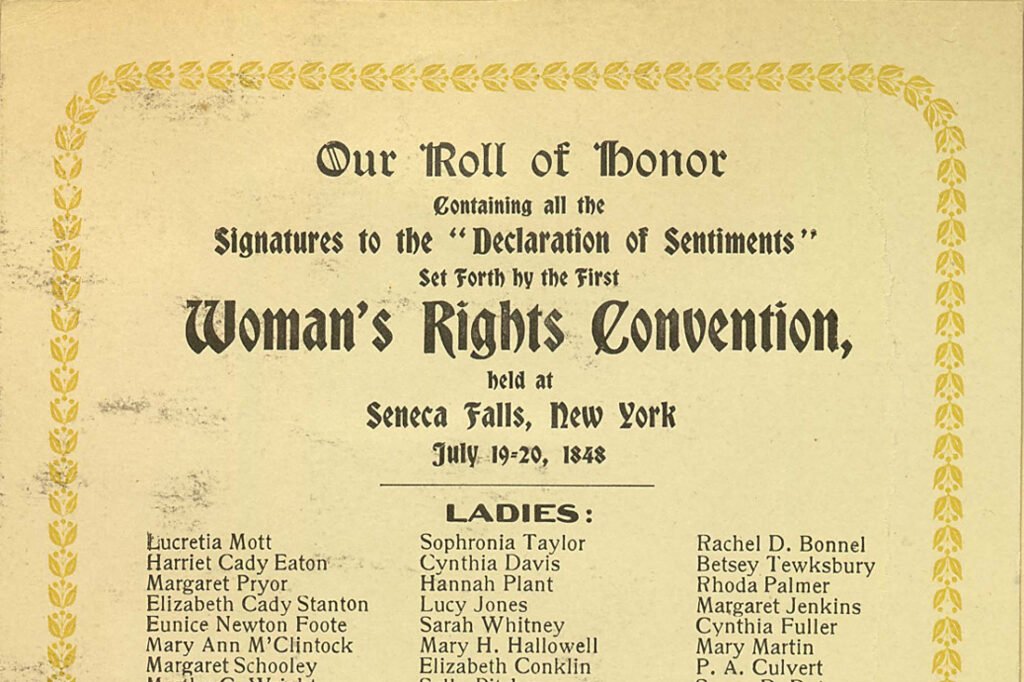
And in July 1848 — the same summer Noyes founded Oneida — a small crowd gathered in the village of Seneca Falls, a short way off the canal near the head of the Finger Lakes, for the first women’s rights convention in the United States. Out of it came the Declaration of Sentiments, modeled on Jefferson’s language and demanding, most radically, the vote. It did not fall out of the sky; it grew from the same reform-saturated soil the canal had watered — and its greatest champion would make her home a few miles up the line. Susan B. Anthony settled in Rochester, campaigned for suffrage for the rest of her life, and in 1872 was arrested there for the crime of voting. The abolitionist press, the women’s movement, and the revival fire that fed them all shared the same few dozen miles of towpath.
An idea is heavier than a barrel
It is tempting to treat the Erie Canal as a triumph of commerce and stop there — the ditch that made New York the Empire State and built a string of boomtowns on tolls. But its strangest legacy is that it was porous to ideas in a way no dirt road had ever been. Cheap, fast, reliable movement is a technology, and once you have it you cannot control what rides it. New York’s engineers dug a channel for freight and accidentally built the nervous system of American reform — a corridor down which a preacher, a printer, a fugitive, and a radical newspaper could all travel at the speed of the fastest packet boat. The wheat is long since eaten. The ideas are still here. (For the several canals that have occupied this ground, see Which canal is this?)
Sources
Burned-Over District & the term popularized by Charles Grandison Finney in his 1876 memoir; western NY as revival country; canal as conduit for itinerant preachers and reform movements — Wikipedia ‘Burned-over district’ (en.wikipedia.org/wiki/Burned-over_district). Finney’s revivals in canal towns incl. the famous 1830–31 Rochester revival; revivalism producing reformers — Wikipedia ‘Charles Grandison Finney’ (en.wikipedia.org/wiki/Charles_Grandison_Finney). Book of Mormon printed at Palmyra by E. B. Grandin, on sale March 26 1830, Wayne Sentinel announcement; Joseph Smith ‘an unusual excitement on the subject of religion’; ‘Queen of the Erie Canal towns’ — site section-palmyra-macedon deep-dive (sourced there to churchofjesuschrist.org ‘Printing and Publishing the Book of Mormon’ + Wikipedia ‘E. B. Grandin’ + Life in the Finger Lakes). Oneida Community founded 1848 by John Humphrey Noyes near Oneida NY; Perfectionism, complex marriage, communal property, dissolved 1881, became Oneida silverware — Wikipedia ‘Oneida Community’ (en.wikipedia.org/wiki/Oneida_Community). Shakers / United Society of Believers at Watervliet near Albany as America’s first Shaker settlement — Wikipedia ‘Watervliet Shaker Historic District’ / ‘Shakers’ (en.wikipedia.org/wiki/Shakers) and NPS Watervliet material. Frederick Douglass launched The North Star in Rochester, first issue Dec 3 1847, masthead ‘Right is of no Sex — Truth is of no Color’ — Wikipedia ‘The North Star (antislavery newspaper)’ (en.wikipedia.org/wiki/The_North_Star_(anti-slavery_newspaper)). Underground Railroad stations in Rochester and canal-corridor towns — National Park Service, Network to Freedom / Erie Canalway NHC (nps.gov). Seneca Falls Convention, July 1848, first women’s rights convention, Declaration of Sentiments — Wikipedia ‘Seneca Falls Convention’ (en.wikipedia.org/wiki/Seneca_Falls_Convention). Susan B. Anthony resident of Rochester, arrested there for voting 1872 — Wikipedia ‘Susan B. Anthony’ (en.wikipedia.org/wiki/Susan_B._Anthony). Causal claim ‘mobility bred ferment / canal as information highway’ presented explicitly as interpretation, not asserted fact.