
E34-35 Lockport
Lockport · Mile 320.68 · Operated by NYS Canal Corporation
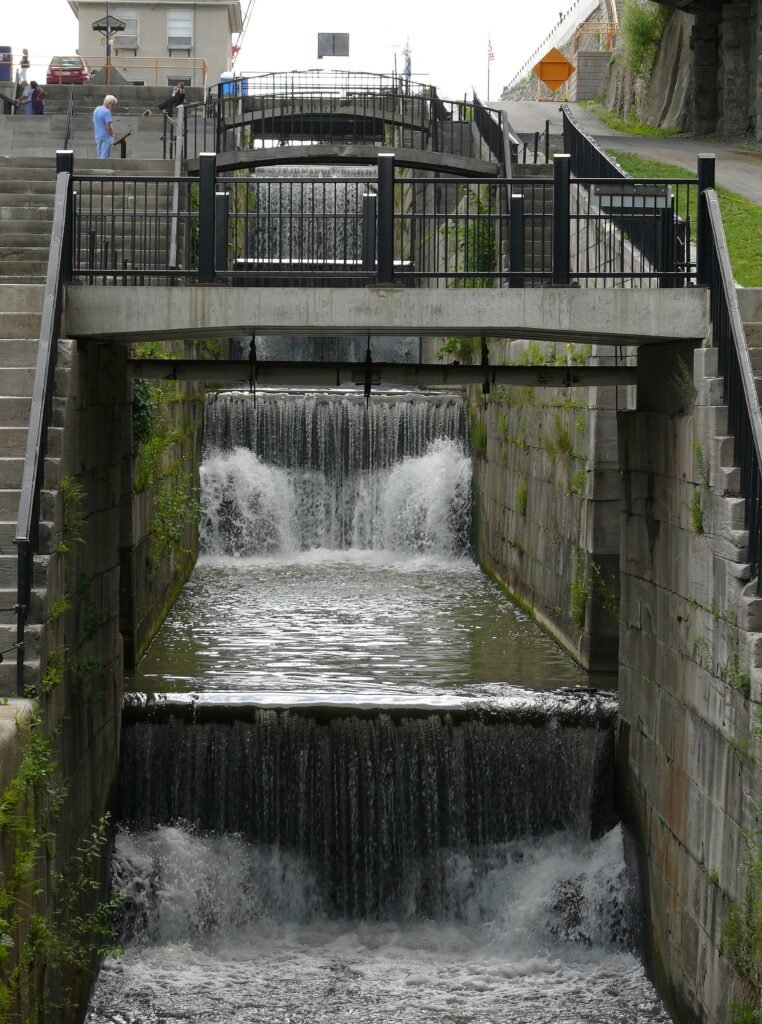
Barge Canal · 1918 — a land-cut climb over the Niagara Escarpment; the original 1825 Flight of Five survives alongside as a spillway. Which canal is this? →
History
The Erie Canal saved its hardest problem for last. At Lockport a wall of solid rock — the Niagara Escarpment, the same ridge Niagara Falls pours over — stood between the diggers and Lake Erie. Nathan Roberts, a former schoolteacher with no formal engineering training, answered it with the canal’s masterpiece: a double staircase of five stone locks, side by side, so that boats could climb and descend at the same time. Finished in 1825, the “Flight of Five” was celebrated as one of the wonders of the age, and it gave the city of Lockport both its name and its reason to exist. Boats today ride two modern locks, E34 and E35; the original flight survives right beside them — the largest intact piece of the historic Erie Canal left anywhere.
The staircase that finished the canal
The Erie Canal’s builders spent eight years working toward a single, terrible obstacle, and they knew it was coming the whole time. In the canal’s last thirty miles the land throws up the Niagara Escarpment — a spine of hard rock running clear across western New York, the very same ledge that Niagara Falls thunders over a few miles to the south. There was no going around it. To reach Buffalo and the lakes, the canal had to climb straight up the rock face, and no one was entirely sure how.
The man who figured it out was Nathan Roberts, a former schoolteacher and self-taught surveyor who, like most of the Erie’s engineers, was inventing American civil engineering as he went. His solution has been admired for two centuries. Rather than one impossible lift, Roberts designed a flight of five locks marching up the escarpment in sequence, each raising a boat about twelve feet — roughly sixty feet in all. Then he did the clever thing: he built the whole staircase twice, side by side, two parallel sets of five, one for boats going up and one for boats coming down, so that the canal’s worst bottleneck could run in both directions at once. Buffalo-bound and Albany-bound traffic climbed and dropped simultaneously, passing each other on the rock.
Cutting the channel to reach the locks was its own ordeal. West of the flight, crews blasted the “Deep Cut,” a canyon gouged as much as thirty feet down through solid rock with black powder and hand tools — dangerous, deadly work that did much to earn the canal its reputation for swallowing lives. When the last stones went into the Lockport locks in 1825, the final and hardest section of the entire canal was done, and a settlement that had barely existed a few years earlier — one the locks themselves had summoned into being, and named — became a boomtown overnight.
Contemporaries understood at once that they were looking at something extraordinary. The Flight of Five became the single most celebrated sight on the canal, drawing sightseers and dignitaries who came simply to watch boats climb a cliff by water.
Here the numbers deserve a careful word, because the sources genuinely differ. The National Heritage Corridor describes the Lockport locks as raising and lowering boats 49 feet; older accounts of the original Flight of Five put the rise at about 60 feet. Both are right, because they describe different structures. The historic Flight of Five was five chambers of roughly twelve feet each. The locks a boat actually uses today are a pair — E34 and E35, a “combined” double lock built during the Barge Canal reconstruction of the early twentieth century — and they cover the escarpment in two big steps of about 24 feet each. When you see two different heights quoted for “the Lockport locks,” you are usually reading about two different canals stacked in the same place.
And both are still here. The modern double lock does the daily work of lifting pleasure boats and the occasional tug over the escarpment. Immediately beside it, five of the original Flight of Five chambers survive — nineteenth-century stonework, rebuilt and widened during the canal’s mid-1800s enlargement and long ago repurposed as a spillway — commonly called the largest intact stretch of the old Erie Canal left anywhere. You can stand between them and take in the whole arc of the canal’s history at a glance: the hand-cut stone flight that first climbed this escarpment in 1825, and the concrete Barge Canal locks that replaced it, working side by side on the same ancient wall of rock.