Buffalo
Approx. Mile 338–351 along the Erie Canal
Western terminus — the 1825 canal ended at Buffalo’s Commercial Slip; today reached via the federal Black Rock Lock. Which canal is this? →
Buffalo is where the Erie Canal story both begins and ends. The reconstructed Commercial Slip at Canalside marks the original 1825 western terminus — the spot where Governor DeWitt Clinton boarded the canal boat Seneca Chief on October 26, 1825 to launch the "Wedding of the Waters." For today's boater, though, the distinction that matters most is this: the historic terminus is Buffalo, but the modern navigable end of the through-canal is Tonawanda. The old canal line between the two is no longer continuously navigable, so reaching Buffalo Harbor and Lake Erie means a run down the Black Rock Canal and through the federal Black Rock Lock.
The end that was really a beginning
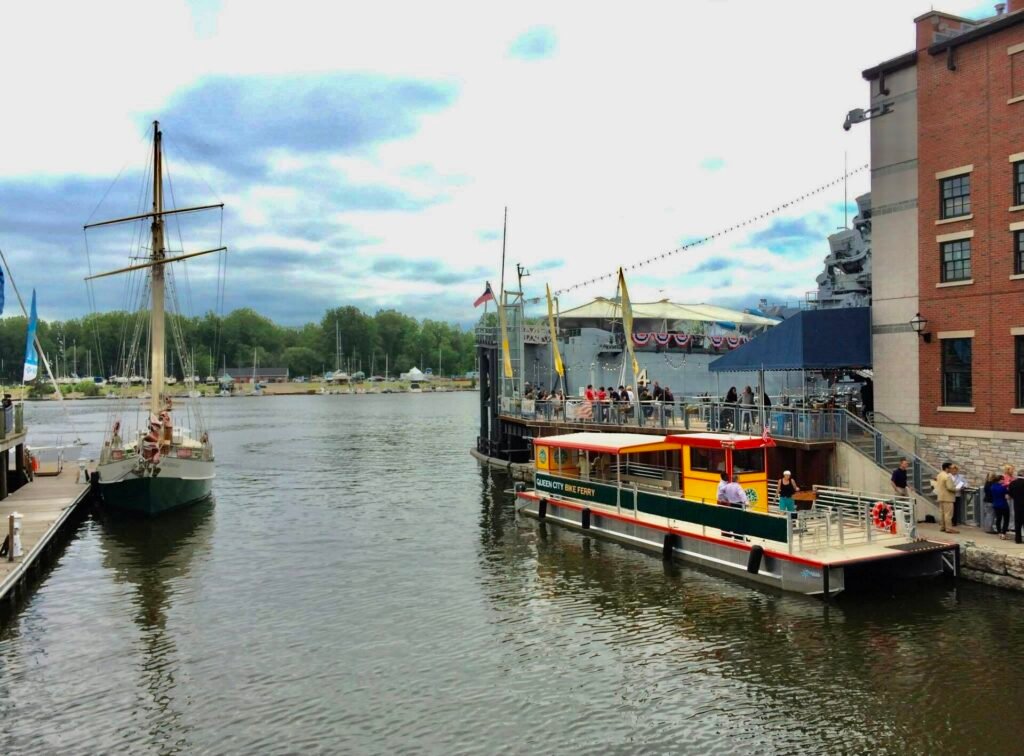
Stand at the Commercial Slip today and it looks almost too tidy to be the birthplace of a continent’s commerce: a short, re-watered canal basin at the edge of downtown Buffalo, ringed by a walkway, crossed by a truss bridge, busy in summer with a bike ferry. But this rectangle of water is the original western terminus of the Erie Canal — the point where, for the first time, a boat could float from the Great Lakes to the Atlantic without ever touching a wagon road. Everything the canal did to America, it did through here.
The most famous morning in Buffalo’s history was October 26, 1825. Governor DeWitt Clinton — the man who had staked his career on a ditch his rivals mocked as “Clinton’s folly” — boarded the packet boat Seneca Chief at Buffalo and set off east down the finished canal, carrying casks of Lake Erie water for a very specific purpose. The ceremony itself, the “Wedding of the Waters,” did not happen here. It came ten days and 360-odd miles later, on November 4, 1825, when Clinton poured that lake water into the Atlantic off New York Harbor, symbolically marrying the inland seas to the ocean. Buffalo was the departure gun, not the altar — a distinction the city has spent two centuries gently correcting.
The port that grain built
What the canal delivered to Buffalo was not ceremony but cargo, and one commodity above all: grain. Midwestern wheat, floated across Lake Erie in ever-larger boats, piled up at Buffalo because this was where lake shipping ended and the narrow canal began. Every bushel had to be hauled out of a ship’s hold and into a canal boat, and for years that meant men on ladders with buckets — slow, backbreaking, and a bottleneck on the whole national breadbasket.
A local merchant named Joseph Dart fixed it. Working with the Scottish-born engineer Robert Dunbar, Dart adapted the bucket-conveyor ideas of Oliver Evans into a steam-powered “marine leg” — a belt of scoops that could dip straight into a ship’s hold and hoist loose grain into towering storage bins. Built on the Buffalo River and running by June 1843, Dart’s Elevator unloaded well over 200,000 bushels in its first year and turned a day’s labor into a few hours. It is generally credited as the world’s first steam-powered grain elevator, and it was copied almost immediately. Within roughly fifteen years, ten elevators crowded Buffalo’s harbor, and the city had become — by the common claim of the histories — the largest grain port on earth, surpassing Odessa, London, and Rotterdam. The concrete elevators that still loom over Buffalo’s waterfront are the great-grandchildren of Dart’s wooden original.
How boats reach Lake Erie now
Here is the part that surprises people who come looking to “arrive by canal.” You cannot, not the way Clinton left. The old canal line between Tonawanda and Buffalo is no longer a continuous through-navigable waterway, so for a modern boater Tonawanda is the practical western end of the Erie. To reach Buffalo’s harbor and Lake Erie, vessels instead run the federal Black Rock Canal — a sheltered channel of about three and a half miles — and lock through the Black Rock Lock, operated by the U.S. Army Corps of Engineers. The lock exists for a blunt reason: the Niagara River drops fast out of Lake Erie in a run of rapids no boat can climb, so the channel and lock sidestep them entirely. A lock has guarded this spot since 1833; the current Corps structure dates to 1908–1913.
The clearest way to hold it in your head: Buffalo is the historic terminus, Tonawanda the navigable one. The Commercial Slip is where the story happened; the Black Rock Lock is how you get there by water today.
The Seneca Chief sails again
The slip you see is itself a resurrection. In the early twentieth century the old terminus district was filled in and razed, and the Commercial Slip was simply buried. Archaeologists found it again, and in 2008 it was excavated and re-watered in its original alignment as the centerpiece of Canalside. For the canal’s 2025 bicentennial, the Buffalo Maritime Center went further and rebuilt the boat itself: a full-size, traditionally constructed replica of the Seneca Chief, some seventy-three feet long, hand-built by volunteers and students inside the Longshed at Canalside from 2020 to 2024. On September 24, 2025, she cast off from the Commercial Slip and retraced Clinton’s route — roughly 500 miles, 28 stops — reaching New York City on October 26, 2025, exactly two hundred years after the canal first opened the door to the west.
In this stretch
Places to Eat
Provisions & Shops
Things to see & do
Arriving by boat
Getting to Buffalo by water is a deliberate side trip off the main line, and it is worth understanding before you cast off. From Tonawanda, the route runs down the Niagara River via the Black Rock Canal — roughly 3.5 miles of federal channel — and through the USACE Black Rock Lock, which bypasses the Niagara River rapids at Lake Erie's outlet. This is a working ship lock, not a canal-tender's chamber, and its schedule and pleasure-craft locking rules are best confirmed in season with the Buffalo District before you go.
Your reward at the far end is one of the best-equipped stops on the whole system. Erie Basin Marina sits at Buffalo's downtown waterfront at the canal's western terminus, on Lake Erie's Buffalo Harbor at 329 Erie Street — a full-service, public-access marina and a genuine destination in its own right. It monitors VHF 16 (working channel 68) and offers 30A and 50A electric, free water, restrooms, showers, a ship store, and ice. Crucially for a long-haul boater, it has both a fuel dock with non-ethanol gas and a pump-out ($10) — a rare pairing this far west. Check in at the fuel dock on arrival. The marina's award-winning gardens connect directly to Canalside, putting the historic terminus a short walk from your slip. It runs a seasonal calendar, roughly May 1 to October 15, so confirm in season.
By bike & foot
Buffalo is the western terminus of the Empire State Trail and the Erie Canalway Trail, and Canalside is the ceremonial endpoint on the waterfront — the place where a cross-state ride quietly ends at the water. The district itself is walkable, built around the reconstructed towpath and walkway that ring the Commercial Slip. In season, the Queen City Bike Ferry runs from the Commercial Slip area across to Buffalo's Outer Harbor, a short, cheap crossing that extends a ride or a walk out along the lake.
By paddle
The Buffalo Maritime Center runs on-the-water and paddle programming at Canalside, which is the safest way to get a hull in the water here. Beyond that, treat the local water with respect: the Niagara River current and the Lake Erie breakwater make this no place to improvise. Do not paddle near the Black Rock Lock or the Niagara rapids without verified local guidance, and confirm any public launch details in season before you unload a boat.
By car
Canalside is a major drive-in destination in downtown Buffalo, and everything worth seeing clusters tightly on the inner harbor. Within a few minutes' walk you have the Commercial Slip, the Longshed and Buffalo Maritime Center, the Explore & More Children's Museum, and the event lawns that anchor the waterfront. Confirm current parking options in season.
What to see
Canalside / Commercial Slip is the headline: the reconstructed original 1825 western terminus of the Erie Canal, a re-watered navigable slip (completed 2008) laid out along the original alignment, complete with a whipple-truss bridge, a reconstructed stretch of Commercial Street, and the preserved Steamboat Hotel ruins archaeological site. Standing here, you are at the exact spot the canal reached the Great Lakes.
A few steps away, the Buffalo Maritime Center at the Longshed is home to the Seneca Chief replica — a traditionally built, full-size (73-foot, roughly 44-ton) reproduction of the 1825 Erie Canal packet boat, built in public view by some 218 volunteers and students between 2020 and 2024. Launched May 7, 2024, it departed on its Bicentennial Voyage September 24, 2025 and reached New York City on October 26, 2025 — the 200th anniversary of the original journey. Rounding out the waterfront are the Erie Canal Harbor / Erie Basin Marina area and the Explore & More – Ralph C. Wilson Jr. Children's Museum at Canalside.