E17 Little Falls
Little Falls · Mile 78.99 · Operated by NYS Canal Corporation
Barge Canal · 1918 — here the Erie Canal is the Mohawk River itself, climbing its rock gorge at Little Falls. Which canal is this? →
History
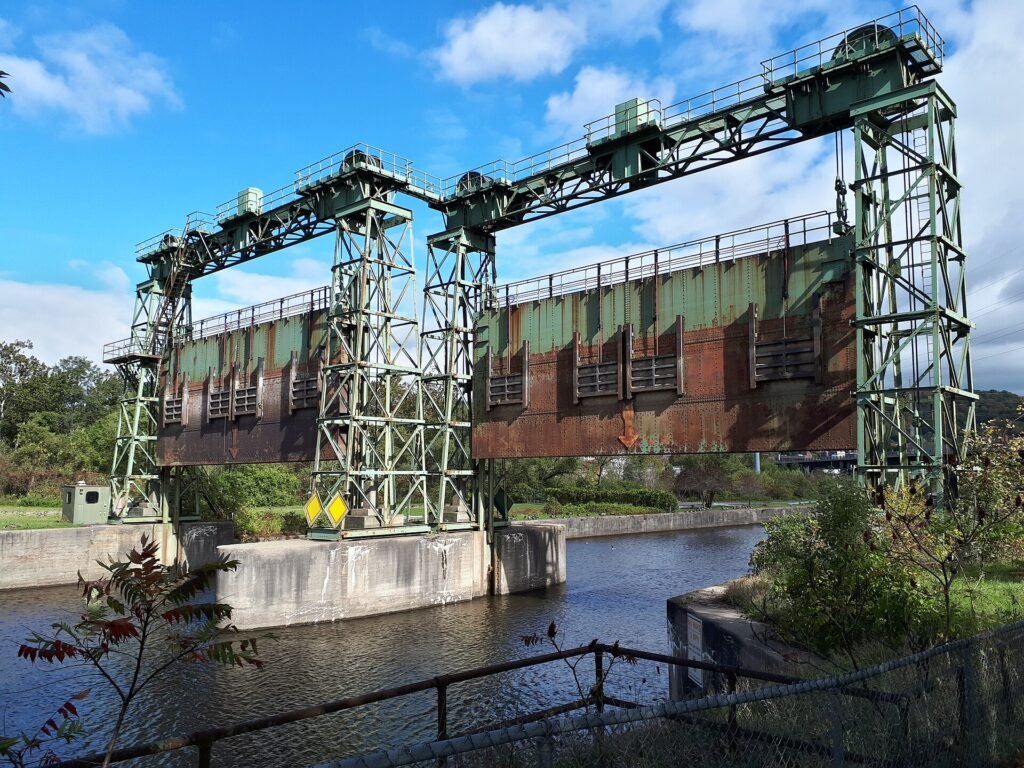
At Little Falls the Mohawk carved a rock gorge, and for two centuries canal builders have been trying to climb it. Lock E17 is their boldest answer: at 40.5 feet it is the highest lift of any lock on the Erie Canal, and the only one closed by a guillotine gate — a massive counterweighted slab that drops straight down to seal the chamber’s lower end instead of swinging shut like ordinary lock doors. It opened on June 30, 1916, a headline feat of the new Barge Canal. Boosters of the day called it the highest lift lock in the world; that title is disputed, but its rank at the top of the Erie is not. And it wasn’t the first canal here — a hand-dug channel beat it to the gorge by 120 years.
The gorge that humbled every canal
For most of its length the Mohawk River is a forgiving thing, a broad flat highway through the mountains. At Little Falls it is not. Here the river squeezes into a rock gorge and drops — nearly a mile of rapids falling roughly forty feet — and for as long as people have moved goods up the Mohawk Valley, Little Falls is where they have had to stop, unload, and carry. The town’s whole existence is owed to that inconvenience.
The first people to beat the gorge with engineering did it a full generation before the Erie Canal was imagined. In 1792 a group of investors led by the Revolutionary War general Philip Schuyler chartered the Western Inland Lock Navigation Company, and at Little Falls they cut a canal roughly a mile long — five small lift locks, a guard lock, and a dam, blasted mostly through solid rock — to lift boats around the rapids. Work began in 1793, and the first boats passed through on November 17, 1795. It was one of the earliest canals in the United States, and it proved, decades ahead of Clinton’s Ditch, that New York’s waterways could be tamed with locks. The little company eventually failed, but the idea it demonstrated did not.
The Erie Canal came through Little Falls in the 1820s and climbed the same grade with its own locks. But the version that stops travelers today belongs to the third canal on this ground: the New York State Barge Canal, and its centerpiece here, Lock E17.
Lock 17 is a record-holder. At 40.5 feet it lifts boats higher than any other lock on the Erie Canal — a single step taller than any of the five giant chambers at Waterford. To manage a lift that big, the engineers did something they did nowhere else on the canal. Instead of a pair of swinging miter gates at the downstream end, they hung a guillotine gate: a huge steel slab, counterweighted like a window sash, that rises to admit a boat and drops vertically to seal the chamber behind it. Boaters still crane their necks to watch it come down. It is the only gate of its kind on the system.
The lock was a long time coming. Construction began in September 1908; the chamber itself was probably finished around 1912, but it could not open until the Barge Canal sections east and west of it were complete. The grand opening finally came on June 30, 1916, with Governor Charles Whitman and a crowd of state officials on hand. The promoters of the day billed Lock 17 as the highest lift lock in the world — a claim the local histories repeat with an audible wink, because such records are slippery and rivals abound. What is not in dispute is its rank at home: no lock on the Erie lifts a boat farther.
Stand on the wall at Little Falls and the layers are all visible at once — the gorge itself, the traces of the 1795 canal, the old Erie alignment, and Lock 17, still lowering pleasure boats through 40 feet of Mohawk bedrock more than a century after it opened. Three canals, one stubborn mile of falling water. Little Falls has been the hardest place on the river for more than two hundred years, and it has never once stopped being interesting.