
E2 Waterford
Waterford · Mile 0.63 · Operated by NYS Canal Corporation
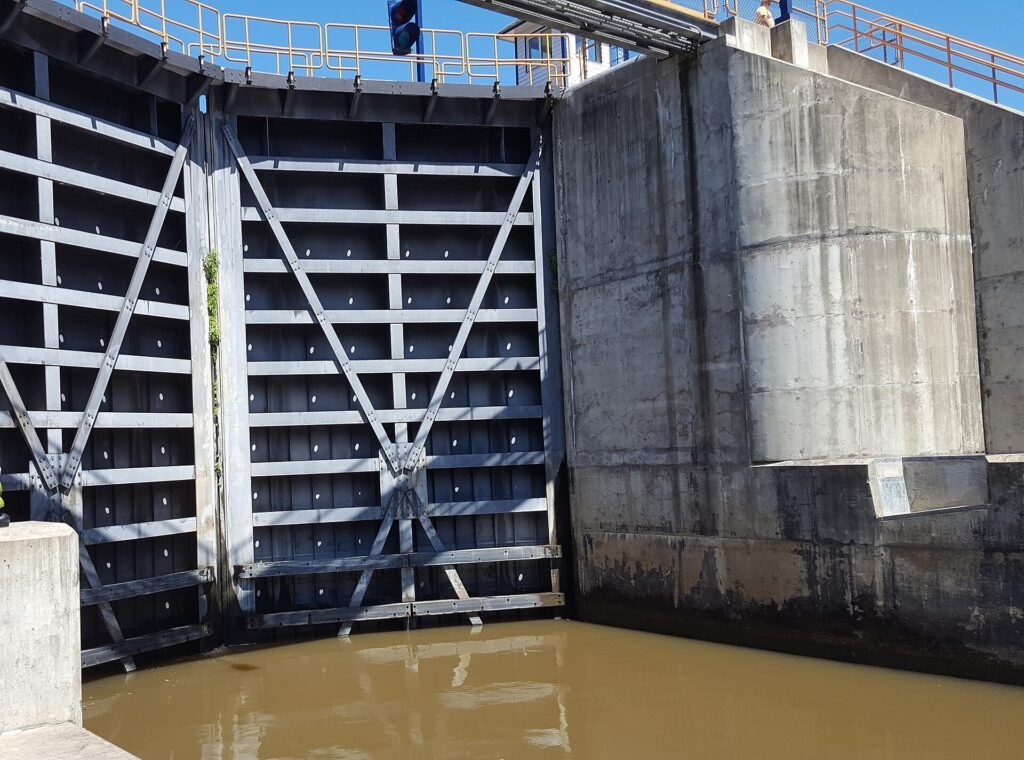
Barge Canal · 1918 — the Waterford Flight, lifting boats from the Hudson tidewater up to the canalized Mohawk River. Not the hand-dug canal of 1825. Which canal is this? →
History
The Erie Canal begins here, where the Hudson meets the Mohawk and the land ahead rises fast. Lock E2 opens the Waterford Flight — five locks in barely a mile and a half that hoist a boat some 169 feet past the falls at Cohoes. It is one of the steepest climbs on any canal on earth; the Waterford museum, refreshingly honest, calls the “highest lift in the shortest distance in the world” title merely speculated rather than settled. Don’t mistake these chambers for Clinton’s original ditch: the Flight opened in 1915, part of New York’s machine-age Barge Canal, generations after the 1825 canal it replaced. Waterford itself claims to be the oldest continuously incorporated village in the United States, chartered in 1794 — older than the canal that made it famous.
The staircase at the start of everything
Every westbound boat on the Erie Canal begins its long climb in the same place: Waterford, where the Hudson meets the Mohawk and the land ahead rises fast. In the first mile and a half out of the harbor a vessel passes through five consecutive locks — E2, E3, E4, E5, and E6 — and is lifted roughly 169 feet, the height of a fifteen-story building, before it has traveled far enough to lose sight of where it started. Canal people call it the Waterford Flight, and it is the reason the guidebooks reach for superlatives.
The obstacle is the falls at Cohoes, a cascade on the Mohawk that has blocked river traffic since long before anyone thought to dig around it. The Flight is the engineers’ answer: a stair-step of chambers climbing the valley wall to lift boats past the falls and deliver them, calm and level, into the Mohawk above. Each lock raises a boat between 33 and 34.5 feet — enormous by canal standards, where a rise of ten or twelve feet is more usual.
You will read, in more than one place, that the Waterford Flight is “the highest lift in the shortest distance of any canal in the world.” It may be. But the Waterford Historical Museum, which knows the flight better than anyone, is careful to call the record speculated rather than proven — and offers the yardsticks to judge it: the Panama Canal moves ships through about 85 feet of change; the Welland Canal climbs 326 feet, but over 27 miles. Waterford does its 169 feet in a mile and a half. We’ll pass the claim along the way the museum does: impressive, widely repeated, and honestly unsettled.
Here is the surprise most visitors miss. These are not the locks DeWitt Clinton built. The famous “Clinton’s Ditch” of 1825 — four feet deep, dug by hand — climbed past Cohoes on a different alignment entirely. The Waterford Flight belongs to a wholly different canal: the New York State Barge Canal, the concrete-and-steel rebuild of the early twentieth century that moved the waterway into the rivers themselves. The Flight opened to navigation in 1915; the full Barge Canal was finished in 1918. When you lock through Waterford today, you are riding machine-age infrastructure that is itself now more than a century old — one of several canals to occupy this ground, not the first.
The town beneath the locks has its own claim to age. Waterford bills itself as the oldest continuously incorporated village in the United States, chartered on March 25, 1794 — a full generation before the canal arrived to make it a crossroads. It sits at a genuine four-way junction of water: the Hudson, the Mohawk, the Erie Canal’s eastern end, and the Champlain Canal branching north toward Lake Champlain. For a boater, Waterford is mile zero and the last easy tie-up before the climb; for a historian, it is the doorstep of the whole 360-mile story.
Most travelers hurry through the Flight, eyes on the gauges. It rewards a slower look. Stand at the bottom on a clear morning and you can see the whole staircase ahead of you — chamber above chamber above chamber, water waiting at five different elevations — the plainest picture anywhere on the canal of what it actually takes to lift a boat over the edge of a continent.